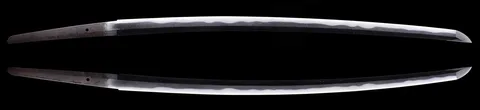
Ōmi no Kami Hisamichi
近江守久道 (Ōmi no Kami Hisamichi)
Lineage: the signature does not state the generation
Line of Mishina school swordsmiths in Kyoto, Yamashiro province, founded in the second half of the 17th century and continued through the Edo period.
Profile
The name Ōmi no Kami Hisamichi was carried by several smiths of the Mishina school in Kyoto. The first, born in Ōmi province in 1626, moved to Kyoto and trained with the Kinmichi (金道), from whom he took the Mishina family name. He signed first as Ōmi Daijō (近江大掾) and later as Ōmi no Kami, often adding a chrysanthemum crest, the kikumon (菊紋), to the tang. He worked from the 1660s to the end of the Genroku era and died in 1711. He is counted among the Kyō go-kaji (京五鍛冶), the five smiths of Kyoto. His son Hisatsugu (久次), second of the line, made jointly signed blades with him from the Genroku era on, and the name passed to later generations. The work follows that of his teachers: gunome with angular shoulders, sometimes yahazu-shaped, with stretches of suguha in the valleys, an underlying notare, sunagashi, tobiyaki, and deep nie with a bright nioiguchi.
Swords available
-
Ōmi no Kami Hisamichi
Shintō katana from the Mishina school of Kyoto, signed Ōmi no Kami Minamoto Hisamichi with the kiku-mon engraved on the tang, with a declared NBTHK Tokubetsu Hozon Tōken certificate and mounted in koshirae. Katana by Ōmi no Kami Hisamichi, a smith of the Mishina school settled in Kyoto (Yamashiro province) during the Edo period, within the shintō group. The blade has a nagasa of 70 cm and a sori of 1.55 cm, with a motohaba of 3.32 cm and a weight of 805 g according to the original seller's index. In the photographs the blade shows a notare hamon mixed with gunome in nie, an itame hada tending to masame along the shinogi, and a bōshi with a short return. The tang appears intact (ubu) with a single mekugi-ana, a kurijiri end and visible file marks; above the signature Ōmi no Kami Minamoto Hisamichi it bears an engraved chrysanthemum on a branch (eda-kiku-mon), the emblem of the Mishina family. There is no engraved date. The original seller declares an NBTHK Tokubetsu Hozon Tōken certificate and, in addition, an older Kōshu Tokubetsu Kichō Tōken paper from the retired system; neither appears in the photographs. The sword is mounted in a complete koshirae with a black-lacquered saya, a tsuka wrapped in black ito over same with gilt menuki, and a dark round tsuba; the seller neither describes nor dates the mounting, which is documented only by the photographs, where the saya and the ito look very clean.
52.5/100
€8,770