On this page
Hamon
According to the Japanese Wikipedia, his work resembles that of his master: a square-shouldered gunome, sometimes shaped like an arrow notch (矢筈, yahazu), with short stretches of suguha in the valleys between gunome, some notare, sunagashi and tobiyaki in the manner of tōran-ba (濤瀾刃, tōran-ba). The nie is deep and the nioiguchi bright.
Bōshi
The bōshi is that of the school, the 三品帽子 (Mishina-bōshi), according to the Japanese Wikipedia.
Nakago and mei
He signed 近江大掾源久道 (Ōmi Daijō Minamoto Hisamichi) in his early period and later 近江守源久道 (Ōmi no Kami Minamoto Hisamichi) or 近江守久道 (Ōmi no Kami Hisamichi), and added to the signature a chrysanthemum, 菊紋 (kikumon), or a chrysanthemum on a branch, 枝菊紋 (edagiku-mon). The katana of the Tokyo National Museum bears the chrysanthemum on a branch before the signature 近江守源久道 (Ōmi no Kami Minamoto Hisamichi).
What is not on record
None of the sources consulted describes the shape of his tang or its file marks, and none explains how the blades of the first and the second are told apart.
Details
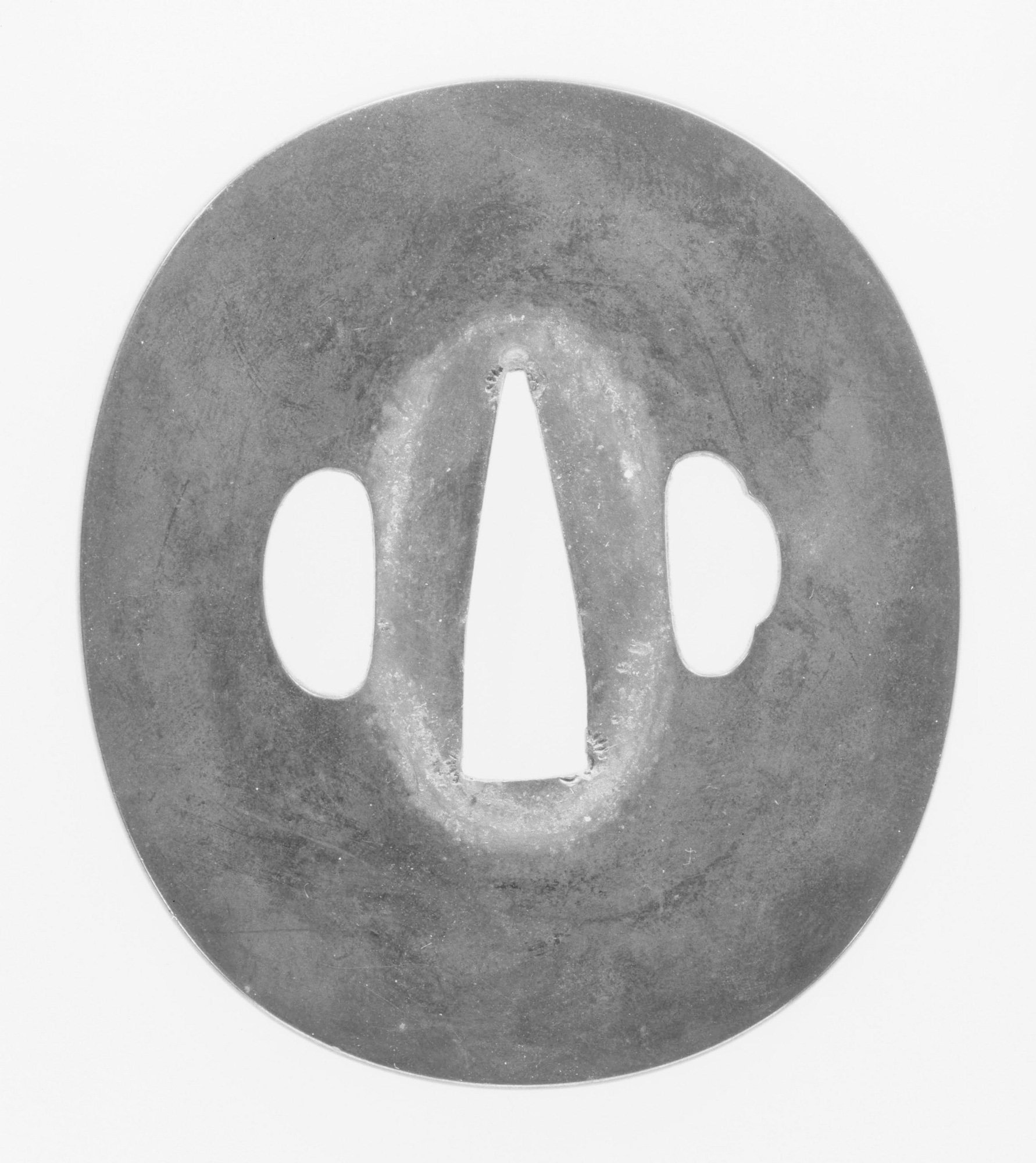
The tsuba of the mounting of the katana of the Tokyo National Museum; it belongs to the mounting, not to the smith. Tokyo National Museum, via ColBase · ColBase terms of use · source