Sugata
The Tokubetsu Jūyō katana by the first Tanba no Kami that the NBTHK discusses has a blade of 2 shaku 5 sun 7 bu (about 77.9 cm) and 5 bu of sori, in shinogi-zukuri with an iori-mune: it is wide, with a long, thick point, the shape of the shintō of the Keichō era.
Jihada
In that katana, a tight ko-itame with a strong nagare and masame in the shinogi-ji, abundant ji-nie and fine chikei, according to the NBTHK. According to Hawley, in the Japanese Sword Index, the hada is itame with masame in the shinogi.
Hamon: the sudare-ba
According to the tradition recorded by the NBTHK, Yoshimichi created the sudare-ba (簾刃), a temper whose bands recall a bamboo blind. The NBTHK cites two old treatises: one describes a “broken” sudare-ba, and the 新刀弁疑 (Shintō Bengi) says that a clear sudare-ba is very rarely seen; in practice, stretches shaped like a blind appear within a free midare. In the katana by the first, the NBTHK describes a long, straight yakidashi at the base and, above it, a broad notare with gunome and ko-gunome, ashi and yō, shimaba, a dense nioiguchi, tobiyaki, yubashiri, kinsuji, sunagashi and nie-suji, with signs of the sudare-ba that would become the style of the next generation. Hawley adds that some blades bear in the monouchi a design of Mount Fuji among clouds.
Bōshi
In the katana by the first, a wide suguha with hakikake and a pointed tip, according to the NBTHK. The sources consulted give no rule for the bōshi of the other generations.
Nakago and mei
According to Hawley, the two branches are told apart by the stroke of the dot of 守 (kami): in Kyoto it points to nine or eleven o’clock, and in Osaka to six. They wrote 丹波 (Tanba) with the first character shaped like a ship’s sail, and those of Kyoto bear from the second generation on the sixteen-petalled chrysanthemum. The Tokubetsu Jūyō katana by the first is signed 丹波守吉道 (Tanba no Kami Yoshimichi) and adds 為内藤九郎右衛門代々 (tame Naitō Kurōemon daidai): made for the family of Naitō Kurōemon, from generation to generation.
His legacy
According to the NBTHK, the first Yoshimichi influenced Kunikane, the first of Sendai, a pupil of Etchū no Kami Masatoshi: a blade of his of 1629 (Kan'ei 6) recalls the work of his master’s elder brother, with several steps in the hamon, like a sudare-ba.
Details
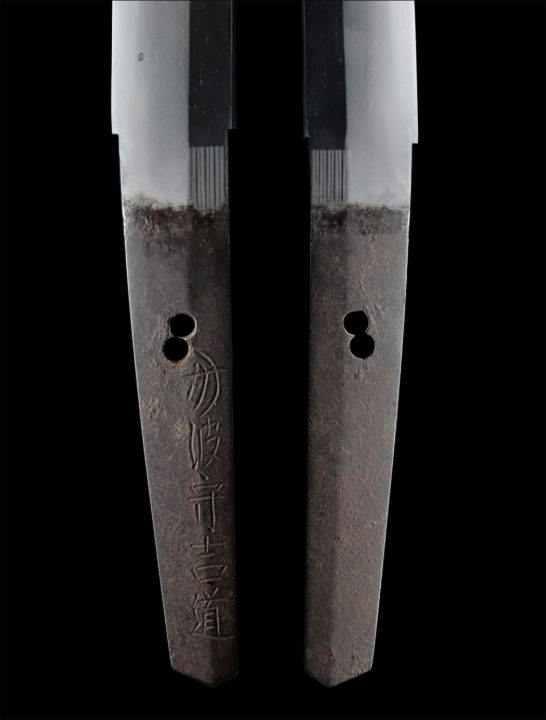
The tang of a wakizashi signed 丹波守吉道 (Tanba no Kami Yoshimichi): the first character, 丹 (tan), with its sail-shaped stroke. Photo: dealer in Japan