On this page
Training
He was born in 1947 (Shōwa 22) in Kōchi Prefecture. He studied at Karasujō high school in Okayama Prefecture and at a school of the Ministry of Construction, where he learned to operate construction machinery.
From high school onwards he practised iaidō and suemonogiri (据物斬り, the cutting of objects). He wanted a sword that cut better and decided to make it himself: he left a salaried job, already married and with children, to become a swordsmith, something rare at the time.
He became an apprentice to a first master whose name the sources do not make clear, then to 今泉俊光 (Imaizumi Toshimitsu), with whom he learned the tatara, and finally to 河内國平 (Kawachi Kunihira), in Nara, to improve his forging technique.
The tatara
He says that his sword did not reach the cut he was after and that the cause lay in the iron and in the way it was smelted. Since then he has studied the tatara: more than thirty years, according to him, and forty at the craft.
He makes the tamahagane himself in a small tatara, with mochitetsu (餅鉄, iron ore in cobbles) and iron sands from different regions of Japan that he mixes; he uses neither foreign steel nor foreign sand. He holds that almost all smiths forge with the same steel from the association and that this is why their swords look alike.
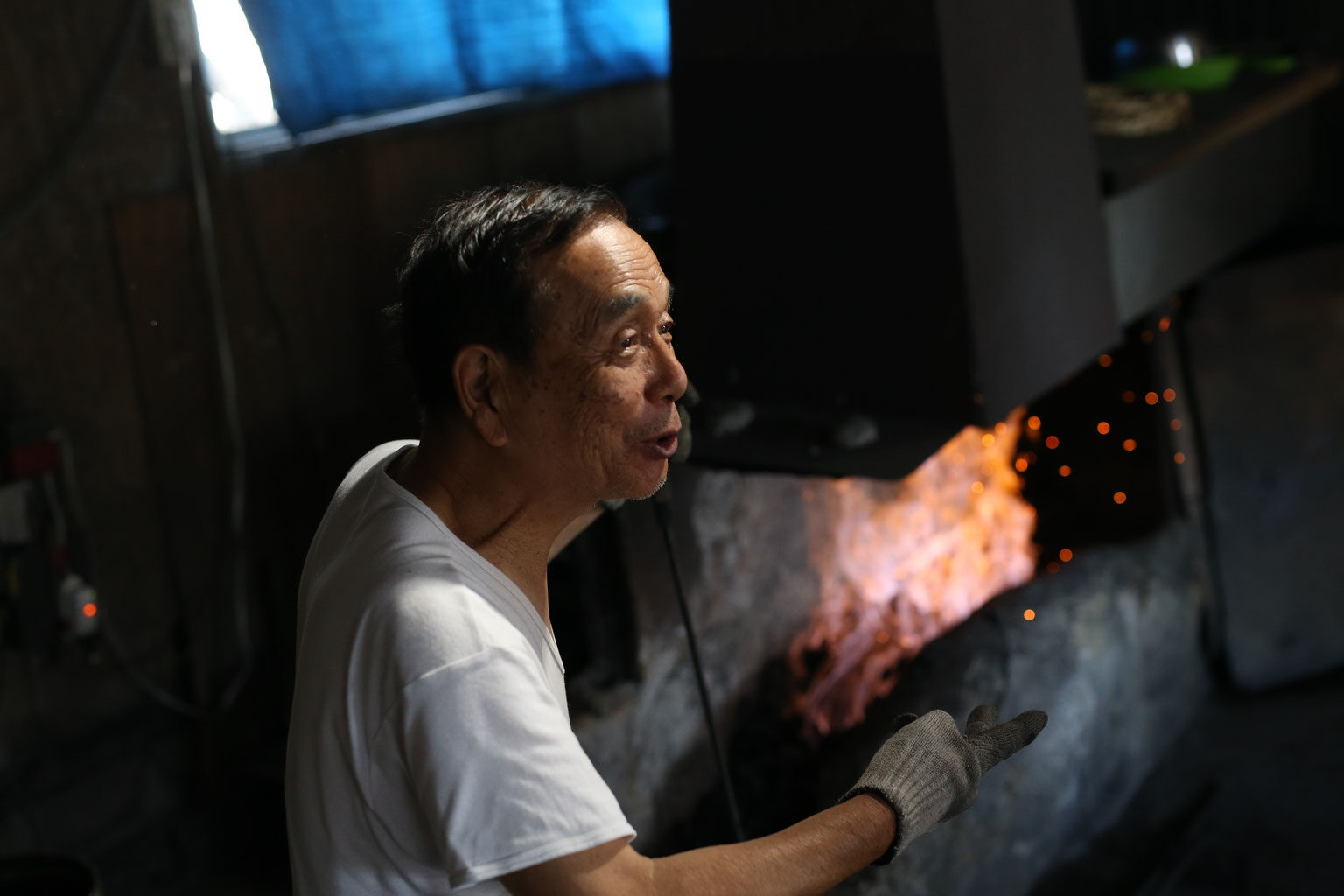
The workshop
His workshop in Osafune was called Bizen Osafune Nihontō Denshūjo (備前長船日本刀傳習所). In May 2020 it was renamed Bizen Osafune Nihontō Seisakujo (備前長船日本刀製作所), and the name Denshūjo was inherited, as its representative, by his pupil 山本祐永 (Yamamoto Sukenaga).
In April 2021 a sword of his was presented as an offering to the Munakata shrine (宗像大社, Munakata Taisha), in Fukuoka, and with the leftover iron he forged another, which came back from polishing in January 2022. He says he thought it would be his last work because of his health, but that he recovered.