Kantei keys
- Sugata
- Tachi with a wide mihaba, robust, with funbari, high koshizori and an ikubi kissaki or chū-kissaki. HD
- Jihada
- Very tight itame or ko-itame, with showy midare-utsuri or chōji-utsuri. HD
- Hamon
- Chōji-midare or ō-chōji with jūka-chōji, abundant ashi and yō and a tight, bright nioiguchi; at times, some nie. HD
- Bōshi
- Midare-komi, almost yakizume, with a small turn-back; on the Shimazu blade, komaru with hakikake. HD
- Nakago and mei
- Kurijiri, katte-sagari or sujichigai yasurime, and the signature 吉房 (Yoshifusa) in two characters, sometimes small and between the hi. HD
His style
- For the Japanese Wikipedia his typical manner is an itame with midare-utsuri and a chōji midare hamon that, in his best pieces, has 重花丁子 (jūka-chōji), double chōji like double-flowered cherry trees: the showiest blade of the school.
- The Tokyo National Museum gives him as the Fukuoka Ichimonji swordsmith with the showiest chōji, and his manner, with a wide, robust blade, a showy chōji and utsuri, as the most mature form of the Bizen sword.
- The NBTHK uses Yoshifusa’s hamon as a point of comparison for that of Bizen Saburō Kunimune, whose chōji have a narrow base and are not jūka-chōji.
Three National Treasures, from their records
| Work | Measurements | Details |
|---|---|---|
| Okada-giri (Tokyo National Museum) | 69.0 cm, sori 2.1 cm, motohaba 3.1 cm | Shinogi-zukuri, iori-mune, ikubi-kissaki, shortened; itame with chōji-utsuri; chōji-midare with jūka and togariba; bōhi on both sides; two holes and the signature at the tip of the nakago |
| Tachi of the Fukuyama Museum of Art | 74.0 cm, sori 3.5 cm, motohaba 3.2 cm | Thick kasane, ikubi-kissaki, high koshizori; ko-itame with midare-utsuri; ō-chōji with jūka; bōhi and koshi-hi; nakago never shortened, three holes, small signature between the two hi |
| Tachi of the Shimazu house | 81.2 cm, sori 3.3 cm, motohaba 3.0 cm | Chū-kissaki, high koshizori, funbari; very showy jūka-chōji, livelier on the omote; nakago never shortened, kijimomo-shaped, two holes, large signature cut with a thick chisel |
Gallery

The Okada-giri, whole, on one side. Tokyo National Museum, via ColBase · ColBase terms of use · source 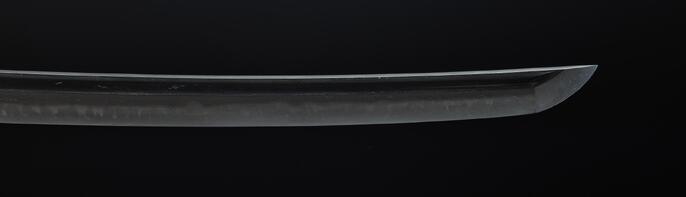
The Okada-giri: the point half, with the chōji temper. Tokyo National Museum, via ColBase · ColBase terms of use · source 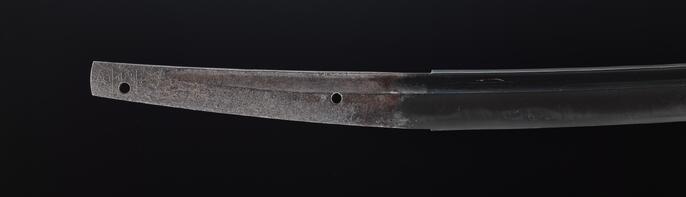
The nakago of the Okada-giri, shortened, with its two holes. Tokyo National Museum, via ColBase · ColBase terms of use · source 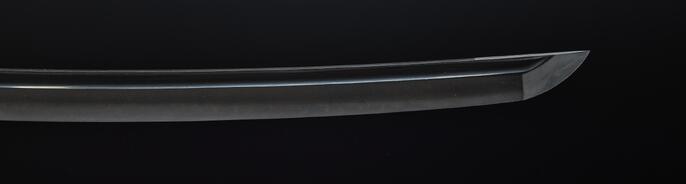
The Takenokoshi tachi: the point half. Tokyo National Museum, via ColBase · ColBase terms of use · source 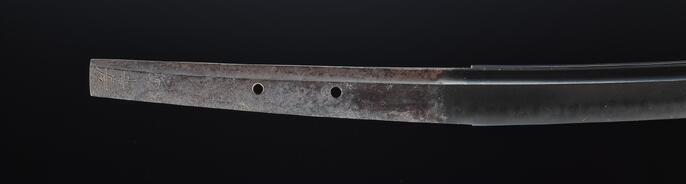
The nakago of the Takenokoshi tachi. Tokyo National Museum, via ColBase · ColBase terms of use · source