On this page
Style
- He forged tachi, katana, wakizashi and tantō and, for the Ise shrine, also straight swords (直刀, chokutō). His hallmark is the beauty of the jihada, which he achieves with his own iron; the hamon ranges from the great luminous midare of the Sōshū tradition to the suguha of the Yamashiro tradition.
- His motto was 刀は地鉄 (katana wa jigane, “the sword is the steel”), and he was known as 鉄の天田 (tetsu no Amata, “the Amata of iron”). He made few swords, but of great quality.
- The blade of the 1977 Masamune Prize was an elegant suguha of the Yamashiro type, forged with iron sand (砂鉄, satetsu) from Okuizumo (Shimane).
- He is the third swordsmith with three Masamune Prizes, after 隅谷正峯 (Sumitani Masamine) and 大隅俊平 (Ōsumi Toshihira); and his are in three traditions: Yamashiro, Sōshū and Bizen.
In the NBTHK catalogue
- Katana signed 越後月岡天田昭次作之 (Echigo Tsukioka Amata Akitsugu kore o saku), from 1996: 73.0 cm, sori of 1.8 cm.
- Wakizashi signed 昭次作 (Akitsugu saku), from the autumn of 2011: 37.0 cm, sori of 0.4 cm.
Both belong to the Agency for Cultural Affairs and were exhibited at the NBTHK’s 平成の名刀・名工展 (Heisei no Meitō Meikōten) in 2019.
Commissions
- He forged the treasure swords of the Ise shrine for its ritual renewals of 1973 and 1992.
- He forged the tachi for the ring-entering ceremony (土俵入り, dohyō-iri) of the yokozuna Kitanoumi; the source does not give the year.
Gallery
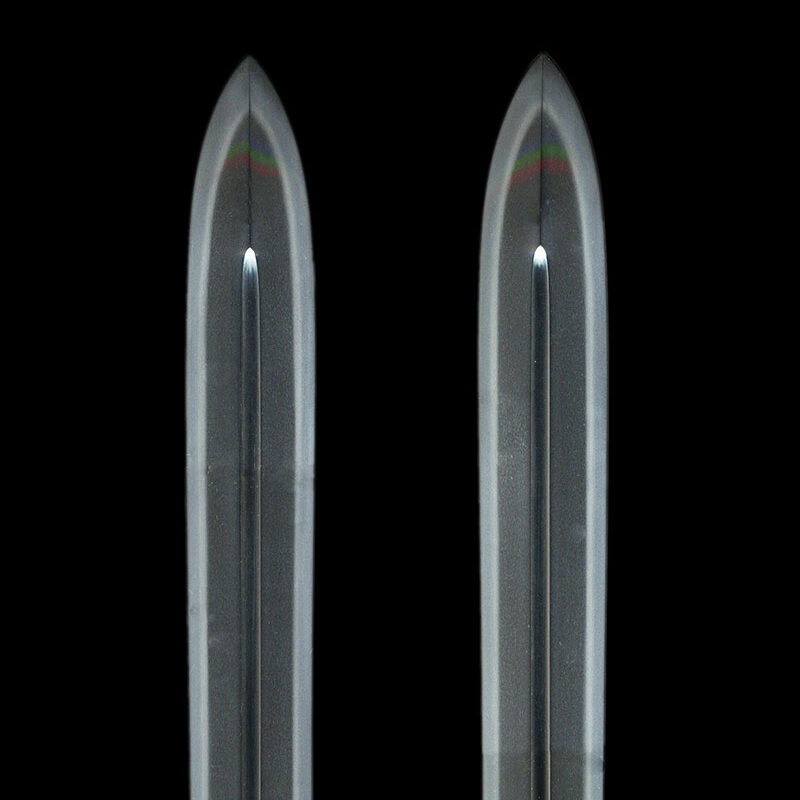
The point of a ken (剣, ken), a straight double-edged blade, from 1997. Photo: dealer in Japan 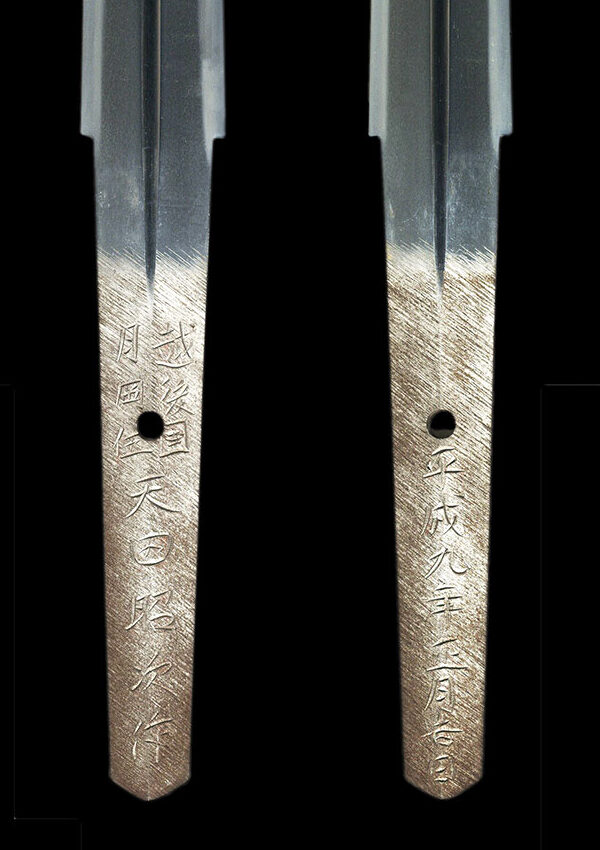
Its tang, signed 越後国月岡住天田昭次作 (Echigo no kuni Tsukioka jū Amata Akitsugu saku) and dated 平成九年正月吉日 (Heisei kyūnen shōgatsu kichijitsu, “an auspicious day in January 1997”). Photo: dealer in Japan