On this page
Training
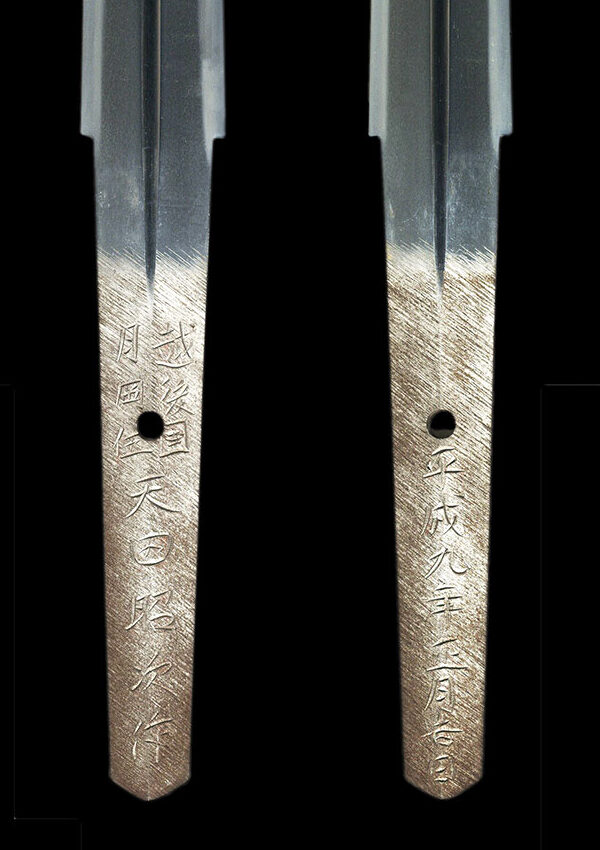
- He was born on 4 August 1927 in Honda, in the Kita-Kanbara district, now the city of Shibata (Niigata), the first son of the smith 天田貞吉 (Amata Sadakichi; the English Wikipedia calls him Sadayoshi).
- His father died in 1937. On the third anniversary of his death, 栗原昭秀 (Kurihara Akihide), a swordsmith and promoter of the revival of the sword, invited him to Tokyo, and in 1940, on finishing primary school, he entered his 日本刀鍛錬伝習所 (Nihontō Tanren Denshūjo, school of Japanese sword forging).
- It was a seven-year apprenticeship, during which he studied at night. His senior at the school was 宮入昭平 (Miyairi Akihira), later Miyairi Yukihira.
His own iron
- In 1952 he forged his first work, one of the swords authorised to commemorate the San Francisco peace treaty (講和記念刀, kōwa kinentō), and that same year he assisted Miyairi Akihira with the ritual sword of the Ise shrine.
- In 1954 he received his swordsmith’s licence and in 1955 he won a prize of excellence at the first exhibition of forging technique, in 8th place out of 93 swordsmiths.
- In 1958 he decided to make his own iron (自家製鉄, jika seitetsu), because the iron in use did not reach the level of the old blades of Masamune and Sadamune. In 1960 he fell ill and stopped forging for eight to ten years.
- In 1968 he went back to forging and settled in Tsukioka, with a forge and a smelting furnace. In 1972 he received the Kunzan prize (薫山賞, Kunzanshō) in its first edition, which was also given to Sumitani Masamine (隅谷正峯), for his research on a small furnace, and in 1976 he published a study on reconstructing the old iron with a natural-draught furnace.
Maturity and recognition
- In 1978 Niigata prefecture declared him the holder of an intangible cultural property. In 1990 he was president of the swordsmiths’ association 全日本刀匠会 (Zen Nihon Tōshōkai).
- On 23 May 1997 he was named a Living National Treasure. In 1999 he received the Order of the Rising Sun (勲四等旭日小綬章, kun-yontō kyokujitsu shōjushō) and in 2003 he became an honorary citizen of Shibata.
- In 2004 he published the book 『鉄と日本刀』 (Tetsu to Nihontō, “Iron and the Japanese sword”). In 2012, for the fifteenth anniversary of his designation, an exhibition showed eleven of his works.
- He died on 26 June 2013, at the age of 85. His younger brother and apprentice, 天田兼定 (Amata Kanesada), worked with him in Tsukioka, where the museum that bears his name stands, the 刀剣伝承館・天田昭次記念館 (Tōken Denshōkan Amata Akitsugu Kinenkan).