The Onimaru
The tachi 鬼丸国綱 (Onimaru Kunitsuna) appears in the Kyōhō meibutsuchō (享保名物帳) of 1719 as “Meibutsu Onimaru”; it has been an imperial object (gyobutsu) since the Imperial House accepted it on 14 November 1871, and it is administered by the Imperial Household Agency, according to Japanese Wikipedia. The “Shoke Meikenshū” places it first among five outstanding swords of the realm.
It is one of the Tenka Goken, the five swords under heaven; all five appear in the Kyōhō meibutsuchō, and the term is documented at least from the late 17th century, according to English Wikipedia. Satō Kanzan, in a list of his own, replaces the Onimaru with the Ichigo Hitofuri.
Its traditional route goes from the Hōjō to Nitta Yoshisada, according to the Taiheiki, and from there to the Ashikaga, to Hideyoshi, to the Hon'ami house and to the Imperial House. Japanese Wikipedia warns that several stretches have no primary sources and are mixed with legend.
Being an imperial object, it has been exhibited very few times: in 1929, in 1947 at the Tokyo National Museum, in 1958, in 1986 in Tokyo and Kyoto, in 1997 in Tokyo and in 2002 at the “Masamune” exhibition, in Tokyo. No publishable photo of the blade, which belongs to the Imperial House, has been found; that is why it is shown here in an old drawing.
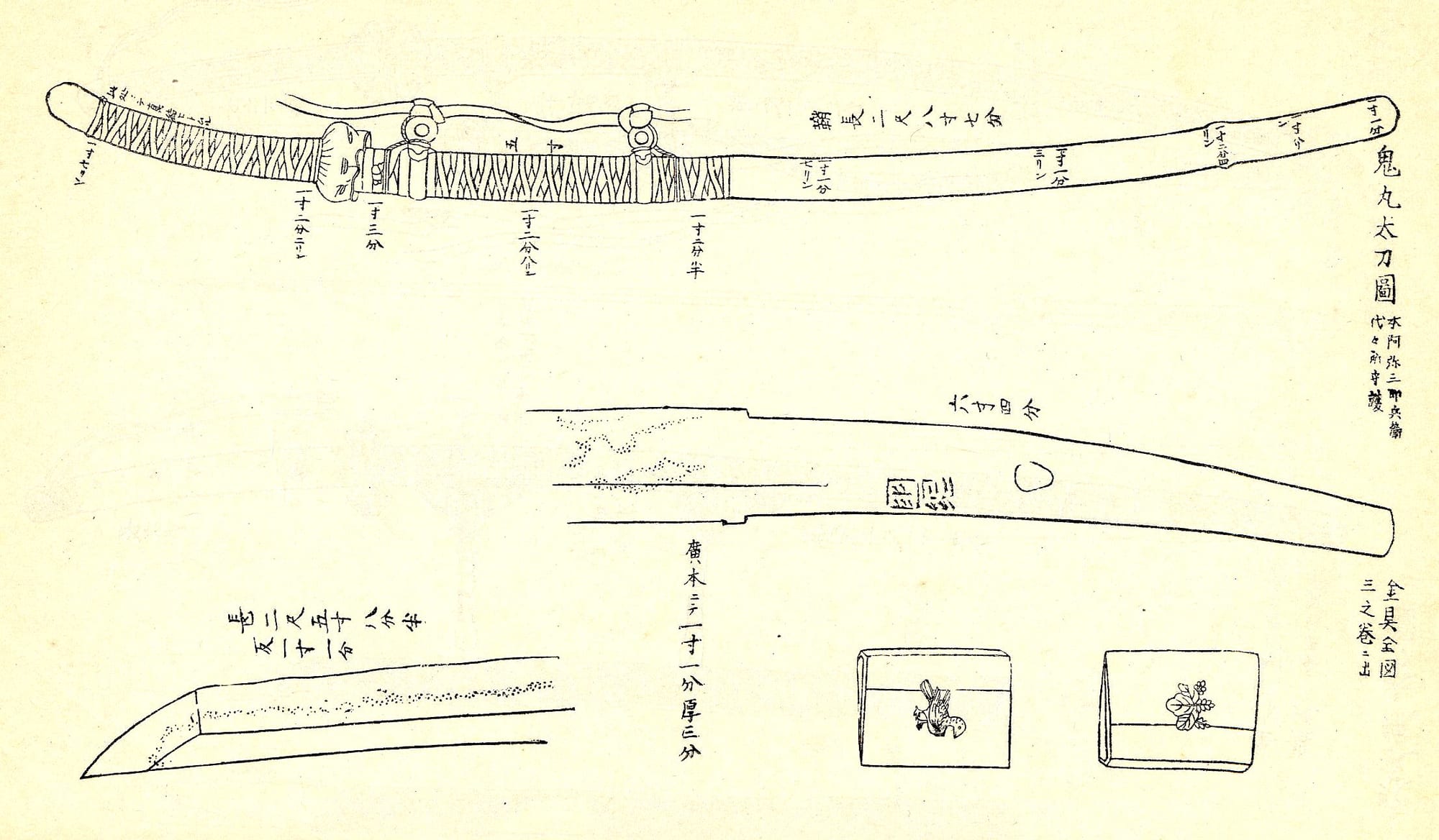

His designated blades
| Work | Rank | Where it is | Details |
|---|---|---|---|
| Tachi 鬼丸国綱 (Onimaru Kunitsuna) | Imperial collection (gyobutsu); Kyōhō meibutsuchō; one of the Tenka Goken | Imperial Household Agency | 78.2 cm, sori 3.2 cm |
| Tachi 太刀 銘国綱 (tachi mei Kunitsuna) | Important Cultural Property (重要文化財, jūyō bunkazai), since 29 August 1950 | Tokugawa Art Museum (Tokugawa Bijutsukan), Nagoya | 65.0 cm, sori 2.0 cm; used by the shōgun Yoshimune and Ienari |
| Tachi 太刀 銘国綱 (tachi mei Kunitsuna) | Important Cultural Property, since 29 August 1950 | Hie shrine (Hie Jinja), Tokyo | 69.4 cm, suriage, with horimono; there were doubts as to whether it was by another Kunitsuna, and today it is accepted as his, according to Sesko |
| Tachi signed Kunitsuna | Important Cultural Property | Iinoya-gū, Hamamatsu | 79.8 cm; donated by Ii Naonori. The official record gives it as “Kunitsuna, Kamakura, province unknown”: it is not certain that it is his |
| Signed tachi, formerly of the Nishitakatsuji family (Dazaifu Tenmangū) | Tokubetsu jūyō tōken (NBTHK) | Not recorded | 85.8 cm, in a style close to the Onimaru |
| Signed tachi, slender and curved | Tokubetsu jūyō tōken (NBTHK) | Not recorded | 67.3 cm, with jifu-utsuri |
| Signed tachi, heirloom of the Date, who received it from Konoe Motohiro | Jūyō tōken (NBTHK) | Not recorded | 68.6 cm; attributed to Awataguchi with caution |
| Ōdachi 太刀 銘鎌倉住藤六左近国綱 建長五年八月日 (tachi mei Kamakura-jū Tōroku Sakon Kunitsuna, Kenchō go-nen hachigatsu hi), of 1253 | Important Art Object (重要美術品, jūyō bijutsuhin), before the war | Whereabouts unknown; lost since the occupation, according to the Uesugi tradition | 114.5 cm. Sesko warns that the signature cannot be judged and that that designation weighed the house of origin more than the quality |
The “Kunitsuna” that are not his or may not be
The NBTHK exhibited a tachi signed Kunitsuna, an Important Art Object, of 70.2 cm and from a private collection, as a Ko-Bizen work: it is by another Kunitsuna, not by Awataguchi.
The Kitano Tenmangū shrine, in Kyoto, holds a tachi signed Kunitsuna, with the names 髭切 (Higekiri) and 鬼切 (Onikiri), which was piece no. 166 of the exhibition “Kyō no katana” (Kyoto National Museum, 2018) and which the exhibition list gives as an Important Cultural Property. The list does not say which Kunitsuna it is by.