Sugata
Early style: the tachi of the Tokugawa Art Museum that is an Important Cultural Property, of 65.0 cm with a sori of 2.0 cm, is short and slender, with koshizori and a marked funbari, according to Sesko. The official record describes it as shinogi-zukuri, iori-mune and with koshizori.
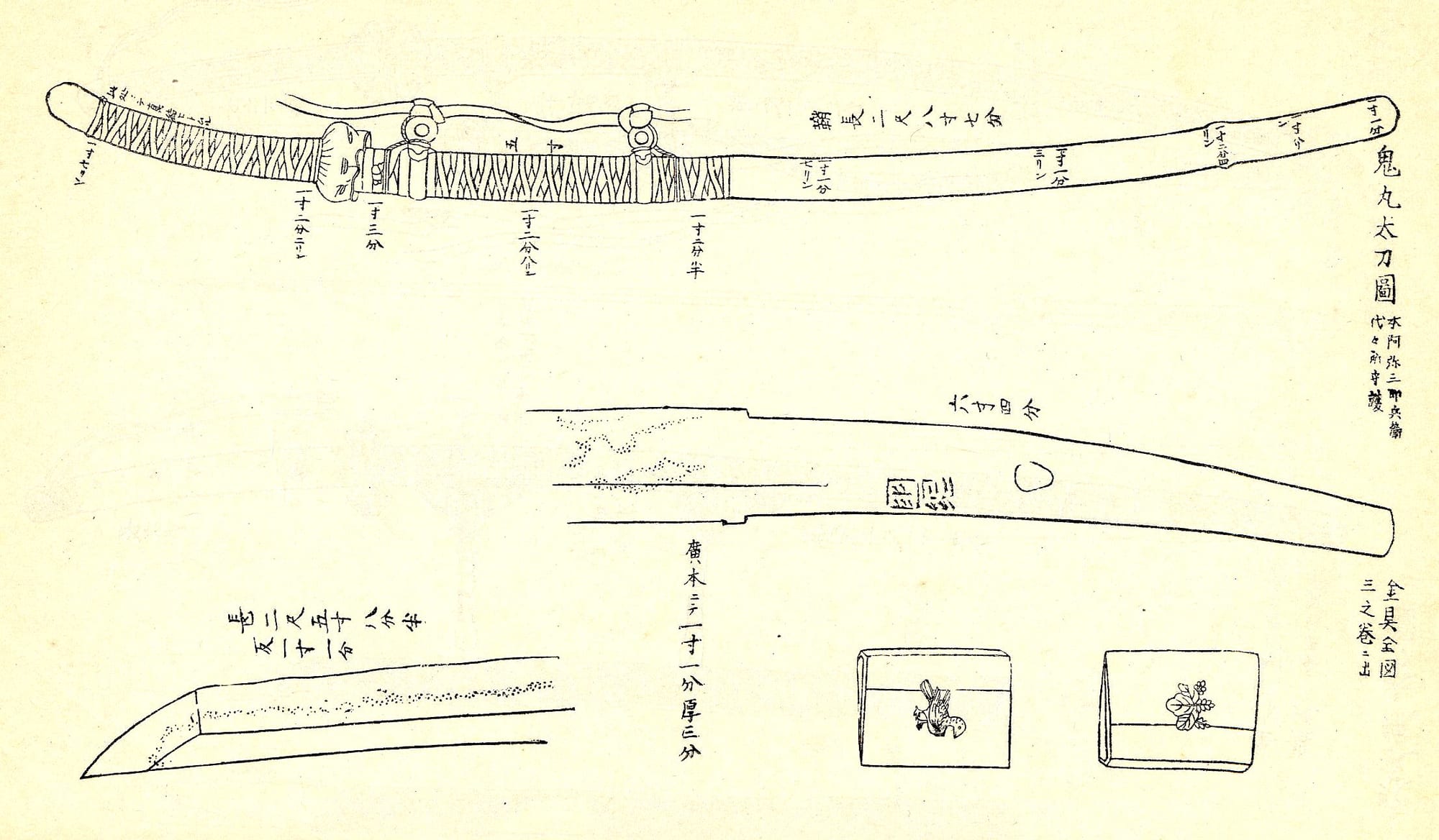
Kamakura style: the Onimaru is wide and magnificent, with a deep toriizori, a marked funbari, a lot of hira-niku and a chū-kissaki that tends towards a kamasu-kissaki. Japanese Wikipedia gives it 78.2 cm of nagasa and 3.2 cm of sori, according to the “Meitō taizen”.
Jihada
In the early style, a dense ko-itame with a lot of ji-nie and nie-utsuri. On the Onimaru, ko-itame with ko-mokume, a lot of ji-nie and jifu. In the late works, an itame with nagare and ō-hada stands out, with ji-nie and a mizukage-type nie-utsuri at the base that turns into jifu-utsuri.
Hamon
In the early style, a ko-nie ko-midare with kinsuji, and more nie from the monouchi upwards. The official record of the tachi of the Tokugawa Art Museum speaks of a ko-midare of nie and nioi with kinsuji. On the Onimaru, a wide notare-based midareba of ko-nie with chōji, ko-ashi and yō, and a koshiba: a diagonal yubashiri above the habaki-moto.
In the late works, a wide suguha-chō with notare, ko-chōji, thick ashi, yō, sunagashi, kinsuji, hotsure, uchinoke and yubashiri. They can look like Ko-Bizen or Ko-Hōki, but the nioiguchi of Ko-Bizen is brighter and the steel of Ko-Hōki blacker and more rustic, according to Sesko.
Bōshi
In the early style, nie-kuzure with ko-maru-kaeri. On the Onimaru, a wide midare-komi with ko-maru-kaeri. On the tachi of the Hie shrine, notare-komi with a wide kaeri and hakikake.
Nakago and mei
In the early style, an ubu nakago, long, in pheasant-thigh shape (kijimomo), with a somewhat smaller two-character signature. That of the Onimaru is ubu, strongly curved, kurijiri, with katte-sagari yasurime; the signature, 国綱 (Kunitsuna), of two characters in a thick chisel, is placed above the mekugi-ana. The nakago of the tachi of the Tokugawa Art Museum is ubu, in kijimomo shape; the official record says that it is extremely rare for a work of his to survive complete.
Horimono
The tachi of the Hie shrine bears two grooves (futasuji-hi) with bonji and suken on the omote, and bonji and shiketsu on the ura; its steel is a dense ko-itame and its temper a chōji-midare with ashi and yō, with more nie in the lower half.