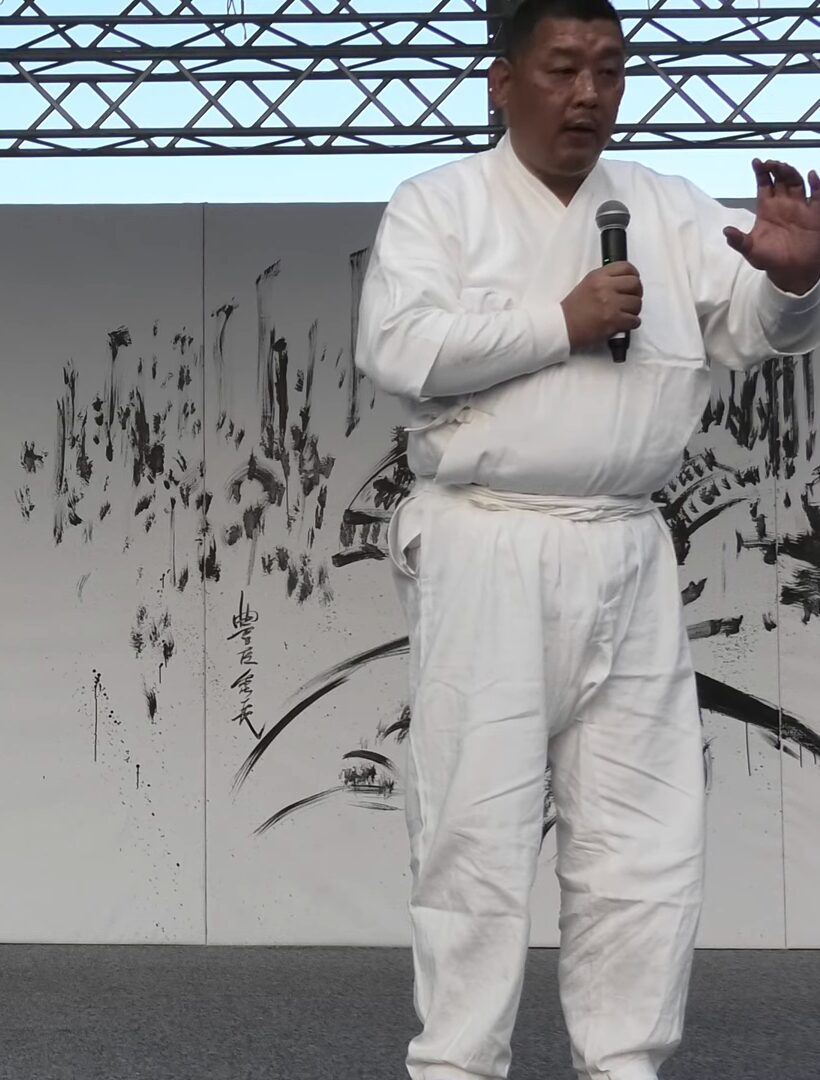
A man dressed in white, with a microphone in his hand, gestures as he speaks on a stage.

Still: A2008B2007C2009 · © A2008B2007C2009

From Nerima to Seki and Kamikawa

Life and forging

An eight-year apprenticeship in Seki, his own forge in Saitama since 2002 and a constant presence at Yasukuni and in the swordsmiths’ association.

On this page
  1. Year by year
  2. How he came to the craft
  3. The Kamikawa forge

Year by year

The sword

History

  1. The sword

    Born in Nerima (Tokyo) AT

    Born in 1974 (Shōwa 49) in Nerima, in Tokyo.

  2. The sword

    Apprentice in Seki AT

    On finishing high school he becomes an apprentice of the twenty-fifth Fujiwara Kanefusa (二十五代藤原兼房, nijūgo-dai Fujiwara Kanefusa), in Seki (Gifu). He learns forging and also blade engraving (刀身彫刻, tōshin chōkoku).

  3. The sword

    Swordsmith’s licence AT

    The Agency for Cultural Affairs (文化庁, Bunkachō) grants him the permit to make swords (作刀承認, sakutō shōnin).

  4. The sword

    First selection AT

    He enters the new-work competition for the first time and is selected (入選, nyūsen). That year he takes the NBTHK courses in the smith’s polishing (鍛冶研ぎ, kaji-togi) and in forging practice (作刀技術実地, sakutō gijutsu jitchi).

  5. The sword

    His own forge in Kamikawa AT

    He sets up on his own and opens his forge in Kamikawa, in the Kodama district (Saitama). He repeats the kaji-togi course in 2002 and the sakutō jitchi course in 2003.

  6. The sword

    Votive forging at Yasukuni AT

    He forges as an offering at the bellows festival (鞴祭り, fuigo matsuri) of the Yasukuni shrine (靖国神社, Yasukuni Jinja).

  7. The sword

    New Year demonstrations AT

    From this year on, every New Year he gives a demonstration at the sword exhibition of the Yūshūkan (遊就館, Yūshūkan), the Yasukuni museum. He is secretary of the Zen Nihon Tōshōkai (全日本刀匠会, Zen Nihon Tōshōkai), the swordsmiths’ association.

  8. The sword

    Director of the association AT

    After serving as treasurer of the Kantō branch (2008) and as vice-president of that branch and treasurer of the board (2010), he becomes executive director and treasurer of the Zen Nihon Tōshōkai.

  9. The sword

    Talks in Ueno HD

    He tells how he became a swordsmith at the 戦国武将 (Sengoku Bushō) EXPO in Ueno Park, in February 2025, and returns in January 2026 (see “Videos”).

How he came to the craft

He became interested in the sword on a school visit to the Tokyo National Museum, in Ueno, in his first year of junior high school, and in the summer of his first year of high school he visited the forge of the twenty-fifth Kanefusa in Seki.

The apprenticeship lasted eight years, from 1993 to 2001, without pay; the law requires a minimum of five years with a licensed swordsmith and the course of the Agency for Cultural Affairs. He says he lost 20 kg and came close to giving up three times: after three months, in the first year and in the third. His master gave him full transmission (免許皆伝, menkyo kaiden) and, with it, the character 房 (fusa) from his own name.

The Kamikawa forge

The forge bears the sign 房宙日本刀鍛錬場 (Fusahiro nihontō tanrenjō, “Fusahiro Japanese sword forge”) and a shimenawa (注連縄, shimenawa) over the door; inside there is a power hammer as well as the hearth. In 2019 he worked with assistants dressed in white, like him.
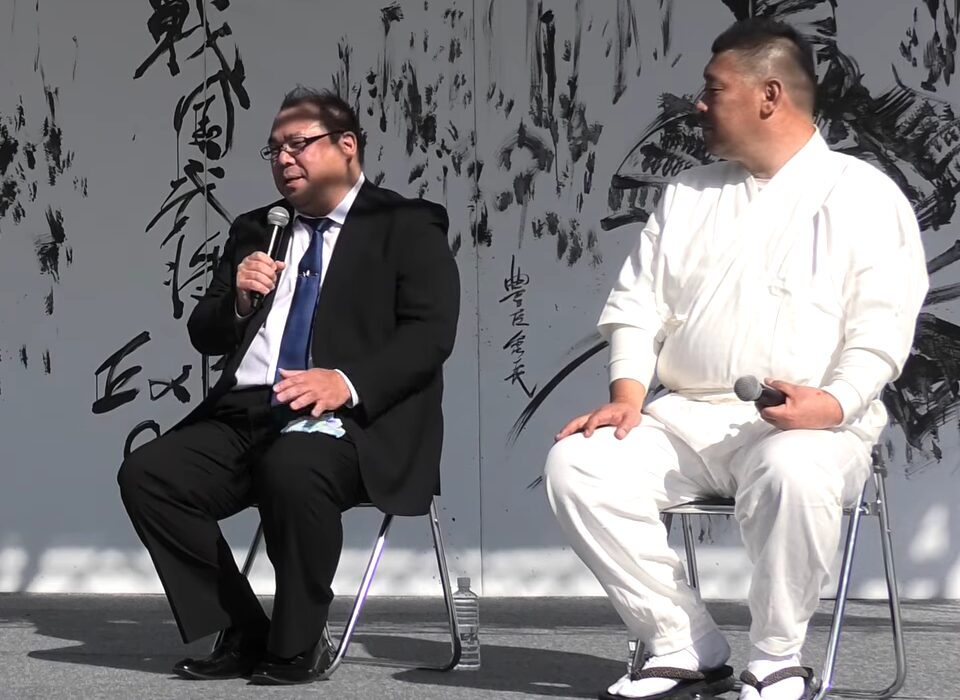
Two men seated on a stage: one in a dark suit speaks into a microphone and the other, in white, listens to him.
With the polisher Ono Takahiro (小野敬博, Ono Takahiro), in the suit, in their conversation at the Sengoku Bushō EXPO of 2026. Still: A2008B2007C2009 · © A2008B2007C2009 · source