
Kantei keys
- Sugata
- Blades almost always heavily shortened (ō-suriage), of about 69 to 72 cm; the Inaba-gō, 70.9 cm, with a sori of 2.0 and a width of 2.9 at the base. HD
- Jihada
- Very tight ko-itame, with fine, dense ji-nie, sometimes mokume and chikei; clear and bright, whereas in the northern smiths it is usually dark. HD
- Hamon
- Of Sagami: notare or ko-notare with gunome, plenty of nie, sunagashi, kinsuji and inazuma, wide and irregular towards the monouchi. There is also a wide suguha with chōji-ashi (Kuwana-gō) and a tight suguha, rare in him (Matsui-gō). Sesko cites him for the wide nioiguchi suguha, extremely rare in kotō. HD
- Bōshi
- Ichimai or almost ichimai, with a round or deep kaeri. HD
- Nakago and mei
- No signature is his own: they are attributions by the Hon'ami, in gold (金象嵌, kinzōgan) on the shortened tang, or in red lacquer (shu-mei 朱銘) if part of the original remains. HD
Signed by others
- The Inaba-gō bears 天正十三十二月日 (Tenshō jūsan jūnigatsu hi) 江 (Gō) 本阿弥磨上之 (Hon'ami suriage kore): a Hon'ami shortened and attributed it in December 1585.
- The Kitano-gō bears 江磨上 光徳 (Gō suriage, Kōtoku), with the monogram of Hon'ami Kōtoku; the Matsui-gō, the red lacquer of Hon'ami Kōjō.
The attributions, on the tang

The Kitano-gō: the gold attribution 江磨上 光徳 (Gō suriage, Kōtoku) and its monogram. Tokyo National Museum, via ColBase · ColBase terms of use · source 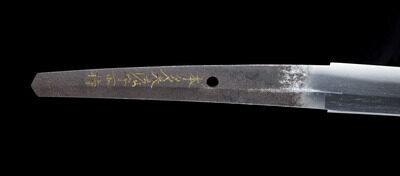
The Kuwana-gō: the gold inscription 本多美濃守所持 (Honda Mino no Kami shoji). Kyoto National Museum, via ColBase (photo: 岡田愛, Okada Ai) · ColBase terms of use · source 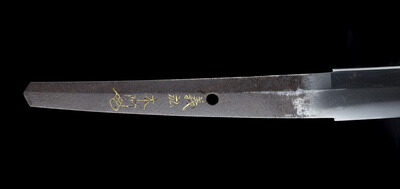
The Kuwana-gō: the gold attribution by Hon'ami Kōtoku. Kyoto National Museum, via ColBase (photo: 岡田愛, Okada Ai) · ColBase terms of use · source 
The same katana: the shortened tang. Tokyo National Museum, via ColBase · ColBase terms of use · source