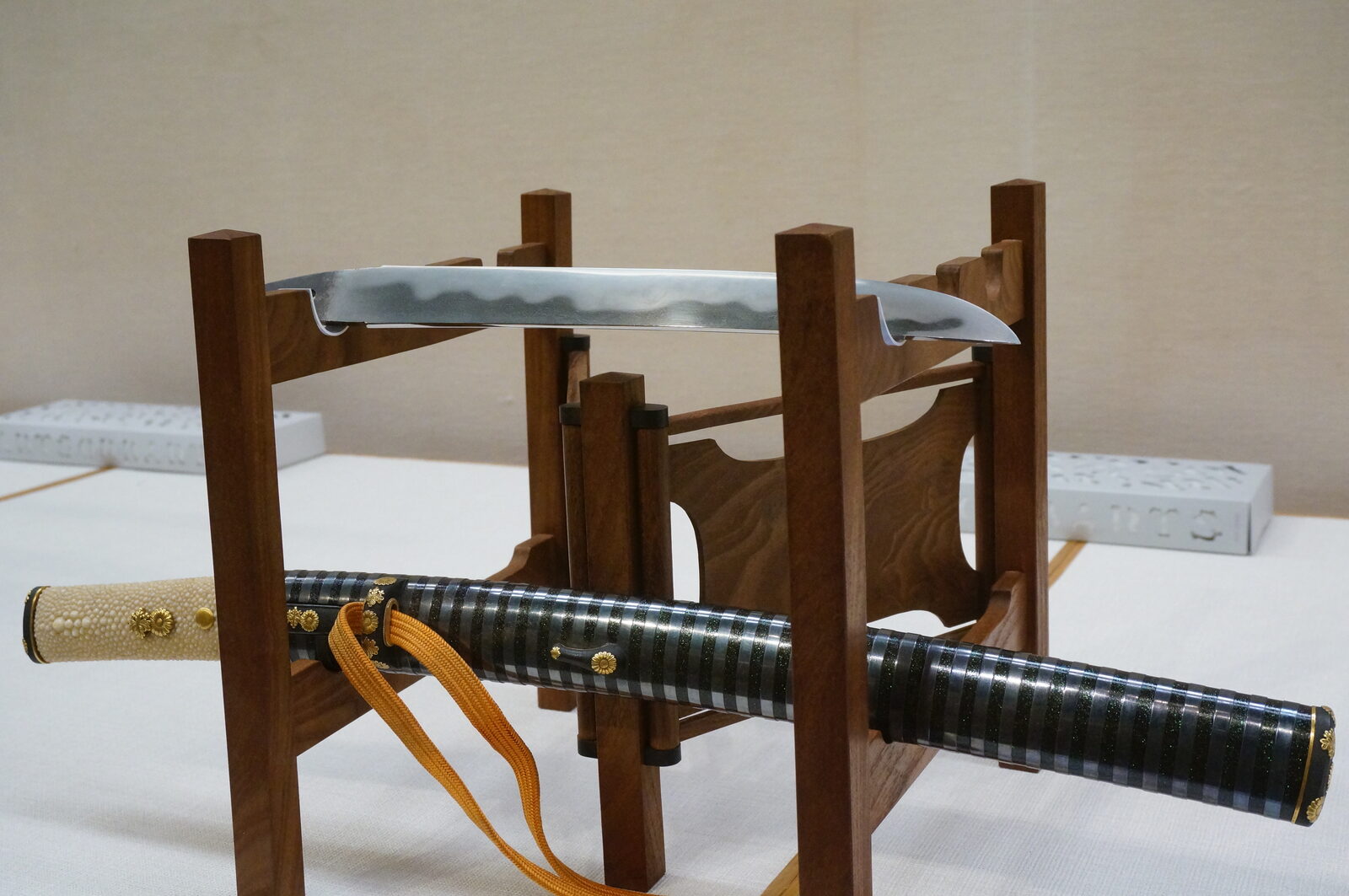
What he forged
According to Sesko, he concentrated on ko-wakizashi and tantō in hira-zukuri. Tachi are rare and signed ones even more so: he knows of three, one dated 1349 of disputed authenticity, one with a folded-over signature (orikaeshi-mei) and one unshortened with a different signature.
Kantei keys
What the NBTHK describes for the school, in issue 808 of its journal:
| Key | What distinguishes it |
|---|---|
| Sugata | Above all tantō and ko-wakizashi in hira-zukuri; tachi are rare. Kasane very thin for its time and mune often rounded (maru-mune) |
| Jihada | Masame along the edge and along the mune, rarely seen in Sōshū |
| Hamon | Notare with gunome, tobiyaki and yubashiri, tending to hitatsura |
| Bōshi | Large and round, with a long turn-back along the mune |
| Nakago and mei | Five-character signature, 長谷部国重 (Hasebe Kunishige), above the mekugi-ana and on the mune side; kurijiri in ha-agari and katte-sagari file marks |
Sesko adds that the masame is sometimes almost pure, that the hamon tends to an almost uniform width, “mirrored” by the muneyaki as in a tuning fork, and that the signature is sometimes placed very low on the tang.
Compared with Hiromitsu
The NBTHK (issues 721 and 758 of its journal) gives the rule: a thin blade, with masame along the edge, a hamon that does not widen in the upper half and a round bōshi with a long turn-back is Hasebe. Hiromitsu has a normal thickness, a hamon of chōji and gunome that widens towards the top, a pointed bōshi and dango-chōji.
Sesko adds that Hiromitsu and Akihiro have more ups and downs in the hamon and more thickness, and not that masame.