On this page
Kantei keys
- Sugata. On the 1629 katana, a sturdy blade of shallow curvature, according to the Tokyo National Museum.
- Jihada. Very tight ko-itame with fine, visible ji-nie, the 小糠肌 (konuka-hada) typical of Hizen; according to the NBTHK, Tadayoshi’s jihada is finer than Yasutsugu’s, with a denser and wider nioiguchi.
- Hamon. That of the school is a chū-suguha of fine nie, with the nioiguchi like a ribbon and ashi, sometimes with a gentle notare or ko-gunome, kuichigai-ba and nijūba. The Tokyo National Museum sees his typical suguha in a wakizashi of around 1627, and in the 1629 katana a chōji temper with nie.
- Bōshi. Parallel to the fukura, with a small round tip (ko-maru) and with a turn-back.
- Nakago and mei. According to the NBTHK, in his Tadayoshi period the tip is kurijiri and the file marks shallow katte-sagari; in his Tadahiro period, the tip is iriyamagata and the file marks kiri.
Horimono
The carvings on the 1629 katana are by Umetada Myōju, on both sides: a dragon coiled around a sword (倶利伽羅, kurikara) and a spear with a banner (hata-hoko). Other blades bear the carvings of 宗長 (Munenaga), who signs next to him, as on the katana in the Tokyo National Museum signed 肥前国忠吉 (Hizen no kuni Tadayoshi) / 同国刳物宗長 (dōkoku kurimono Munenaga).
The iron of the southern barbarians
A katana in the Tokyo National Museum dated 1628 bears on the tang 南蛮鉄 (nanban-tetsu), the iron imported by the Europeans, next to the signature 肥前国住人忠吉作 (Hizen no kuni jūnin Tadayoshi saku). The record does not say which generation it is by.
How to tell the generations apart
- By the signature. The first signed Tadayoshi until 1624 and Tadahiro afterwards; according to Japanese Wikipedia, the second always signed Tadahiro and never Tadayoshi, and the third went back to Tadayoshi as Mutsu no Kami.
- By the style. According to the Japanese Sword Index, the second perfected the classic Hizen-tō, of suguha and konuka-hada, looking to the Yamashiro school of the Kamakura period, above all to the Rai, whereas the first tried various old styles.
- By the nakago. The kurijiri tip and the katte-sagari file marks belong to the first’s Tadayoshi period; the iriyamagata tip and the kiri file marks, to his Tadahiro period and to the second.
- As against other suguha of the Keichō period. According to the NBTHK, the jihada of Yasutsugu, of Echizen, is darker and with a rough nioiguchi, and the suguha of Masatsune, of Owari, has more hotsure and ko-ashi and looks mixed with ko-gunome.
His fame for cutting and for beauty attracted many forgeries, above all of the five-character signature, according to the Japanese Sword Index.
Gallery

Katana of 1629 signed 武蔵大掾藤原忠広 (Musashi Daijō Fujiwara Tadahiro), an Important Art Object, with carvings by Umetada Myōju. Tokyo National Museum. Tokyo National Museum, via ColBase · ColBase terms of use · source 
The upper half of the 1629 katana, with the temper and the point. Tokyo National Museum, via ColBase · ColBase terms of use · source 
The tang of the 1629 katana, with the signature, and the carvings on the blade: the dragon coiled around a sword (kurikara) and a spear with a banner. Tokyo National Museum, via ColBase · ColBase terms of use · source 
Katana signed 肥前国忠吉 (Hizen no kuni Tadayoshi) and dated 1600, the earliest dated signature of his that is known. Tokyo National Museum. Tokyo National Museum, via ColBase · ColBase terms of use · source 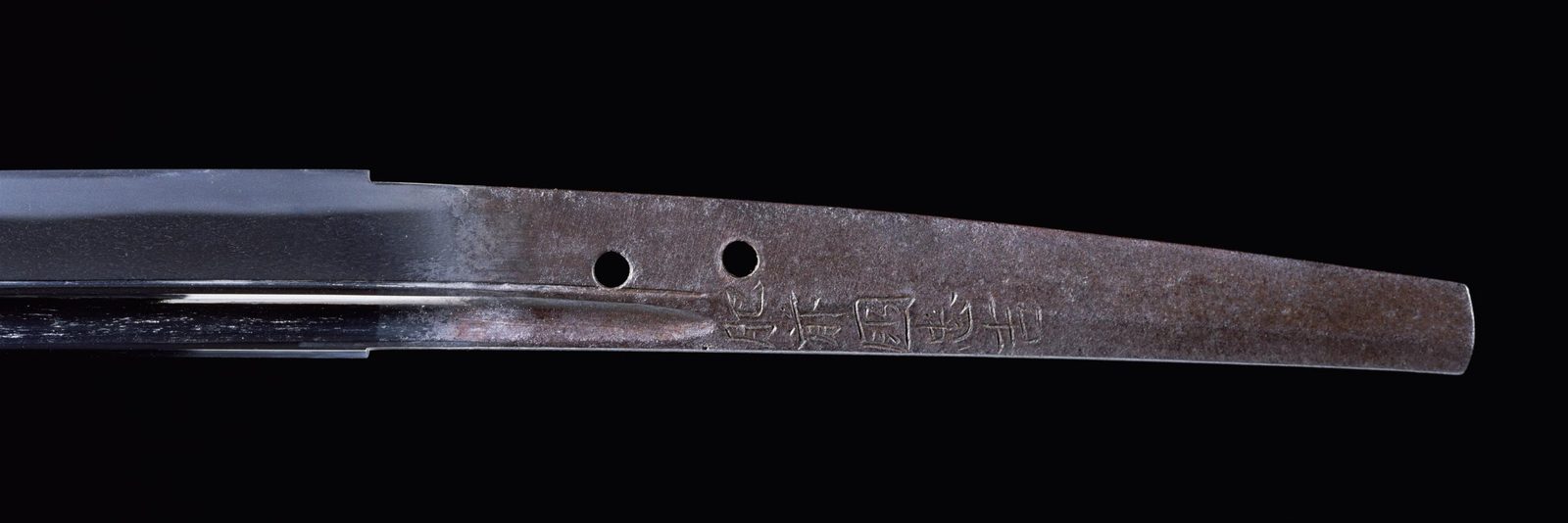
The tang of the 1600 katana, with the five-character signature 肥前国忠吉 (Hizen no kuni Tadayoshi). Tokyo National Museum, via ColBase · ColBase terms of use · source 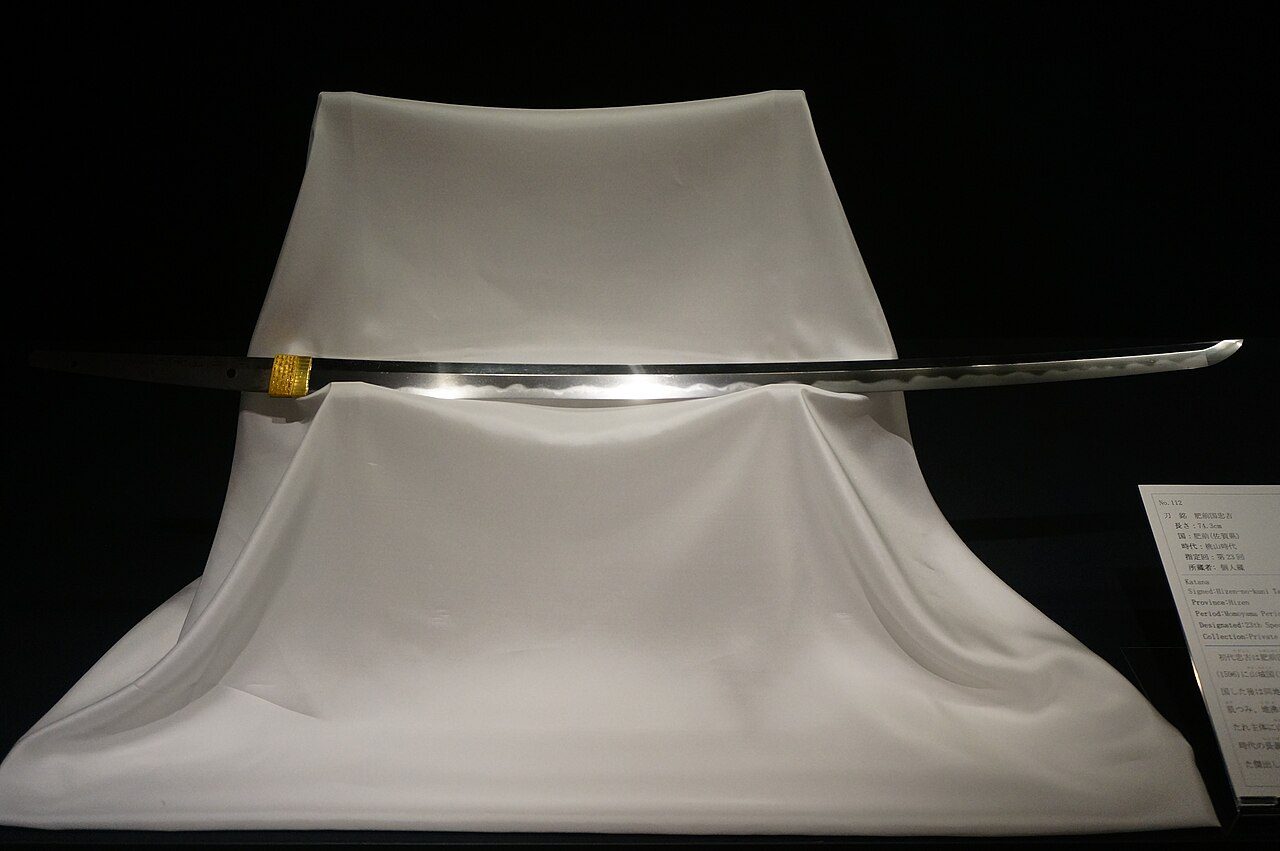
Katana signed 肥前国忠吉 (Hizen no kuni Tadayoshi), of the Momoyama period, 74.3 cm, at an exhibition. SLIMHANNYA, CC BY-SA 4.0, via Wikimedia Commons · CC BY-SA 4.0 · source
