On this page
A warrior family
According to Japanese Wikipedia, he was born in 1572 (Genki 3) in Nagase, in Hizen, into a warrior family serving the Ryūzōji, of the Shōni branch. In 1584 the battle of 沖田畷 (Okita-nawate) put an end to the Ryūzōji and to his grandfather and his father; he was thirteen, the family lost its stipend and turned to the sword.
In Kyoto, with Umetada Myōju
According to Japanese Wikipedia, he learnt first with 田貫善兵衛 (Tanuki Zenbei), swordsmith to Katō Kiyomasa, and in 1596 (Keichō 1) he entered, on the orders of the Nabeshima, the workshop of Umetada Myōju in Kyoto, where he studied for three years. The record of the Chōkokan Museum on Bunka Isan Online confirms the journey: he entered Myōju’s workshop in 1596, returned to Saga in Keichō 3, was engaged by the lord Nabeshima Katsushige and worked in Nagase street (長瀬町, Nagase-machi). Kotobank only says that he was swordsmith to the Saga domain and that he studied with Myōju.
In 1629 he wrote it himself on the tang of a katana: “this Tadahiro is a pupil of Umetada Myōju, the carvings by Myōju at the age of 72”.
The title of 1624
In 1624 he received the title of Musashi Daijō, changed his name from Tadayoshi to Tadahiro and his signature surname from Minamoto to Fujiwara. Japanese Wikipedia dates it to Genna 10 and Bunka Isan Online to Kan'ei 1, which is the same year.
His signatures, by period
- 五字忠銘 (goji chū-mei), the five-character signature 肥前国忠吉 (Hizen no kuni Tadayoshi).
- 秀岸銘 (Shūgan-mei), written in the hand of a monk, according to Japanese Wikipedia.
- 住人銘 (jūnin-mei), 肥前国住人忠吉作 (Hizen no kuni jūnin Tadayoshi saku).
- From 1624, 忠広 (Tadahiro), as in 肥前国住武蔵大掾藤原忠広 (Hizen no kuni jū Musashi Daijō Fujiwara Tadahiro). On the blades for the Nabeshima he omitted the title: this is the presentation signature, 献上銘 (kenjō-mei).
His death
He died on the 15th day of the eighth month of 1632 (Kan'ei 9), aged 61 by the traditional reckoning given by Kotobank. His grave is at the temple 新覚寺 (Shinkakuji), in Saga, according to Japanese Wikipedia.
The generations
- First
- Tadayoshi and, from 1624, Musashi Daijō Tadahiro, 1572–1632 AT
- Second
- Ōmi Daijō Tadahiro, 1614–1693; Ōmi Daijō in 1641 AT
- Third
- Mutsu no Kami Tadayoshi, 1637–1686; Mutsu Daijō in 1660 AT
- From the fourth to the ninth
- Until 1880; the eighth also directed the domain’s cannon foundry from 1850, and the ninth stopped forging after the 1876 ban on wearing swords AT
The eldest son or the youngest?
Kotobank says that the second Tadahiro was the first’s eldest son; the Tokyo National Museum calls him his youngest son, as does Japanese Wikipedia. The sources agree that he received the title of Ōmi Daijō in 1641.
The Saga school
According to Japanese Wikipedia, more than a hundred swordsmiths came out of the school until the end of the Edo period, and the name 肥前刀 (Hizen-tō) for its swords was fixed by the book 西肥遺芳 (Saihi ihō), of 1917. Alongside the main line worked branches such as that of Kawachi Daijō Masahiro, Yukihiro and Harima Daijō Tadakuni, according to the Japanese Sword Index.
Gallery
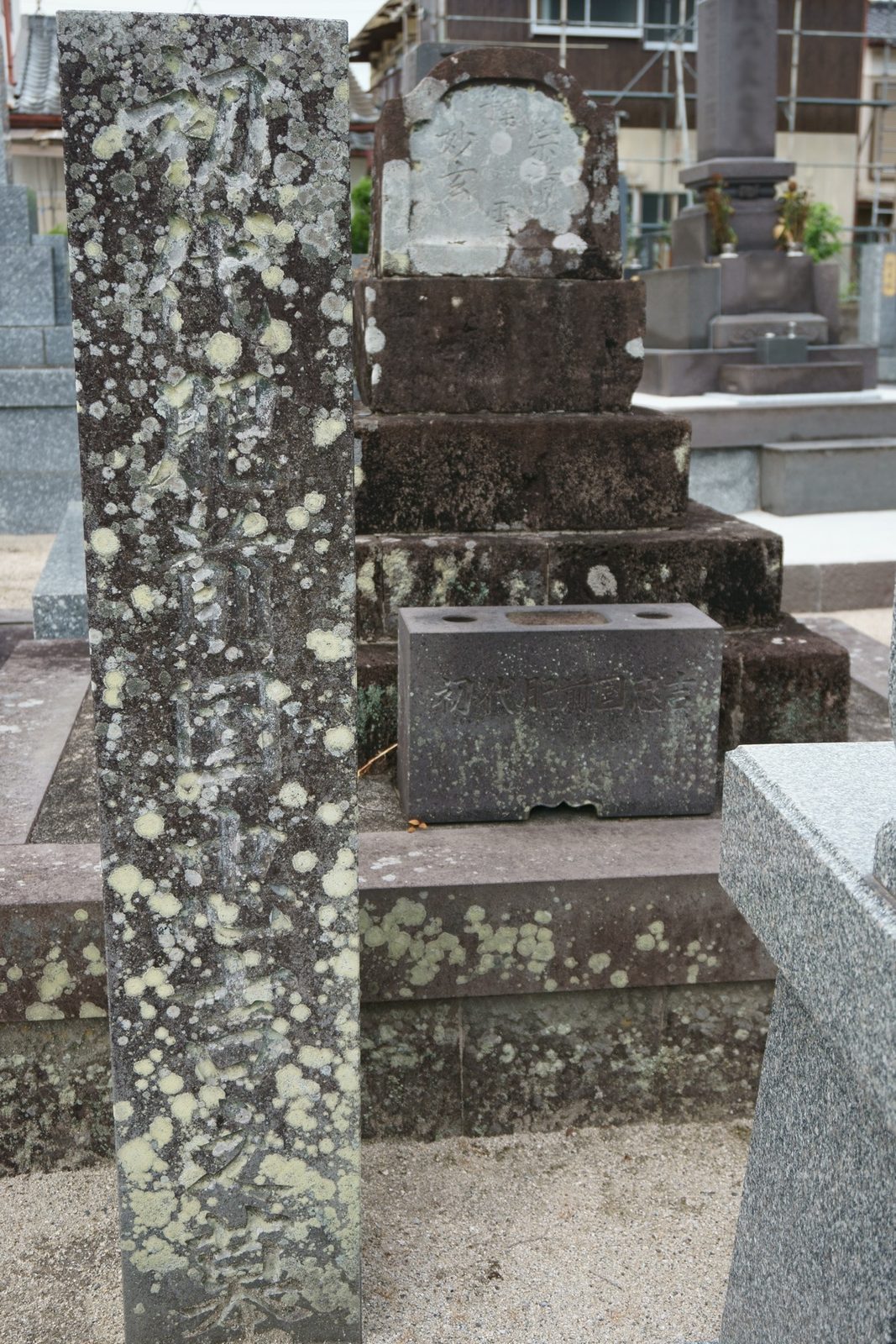
The grave of the first Tadayoshi at the temple 新覚寺 (Shinkakuji), in Saga; the stone in front reads 初代肥前国忠吉 (shodai Hizen no kuni Tadayoshi). Pekachu, CC BY-SA 4.0, via Wikimedia Commons · CC BY-SA 4.0 · source 
Katana signed 肥前国忠吉 (Hizen no kuni Tadayoshi) and dated 1600, the earliest dated signature of his that is known. Tokyo National Museum. Tokyo National Museum, via ColBase · ColBase terms of use · source 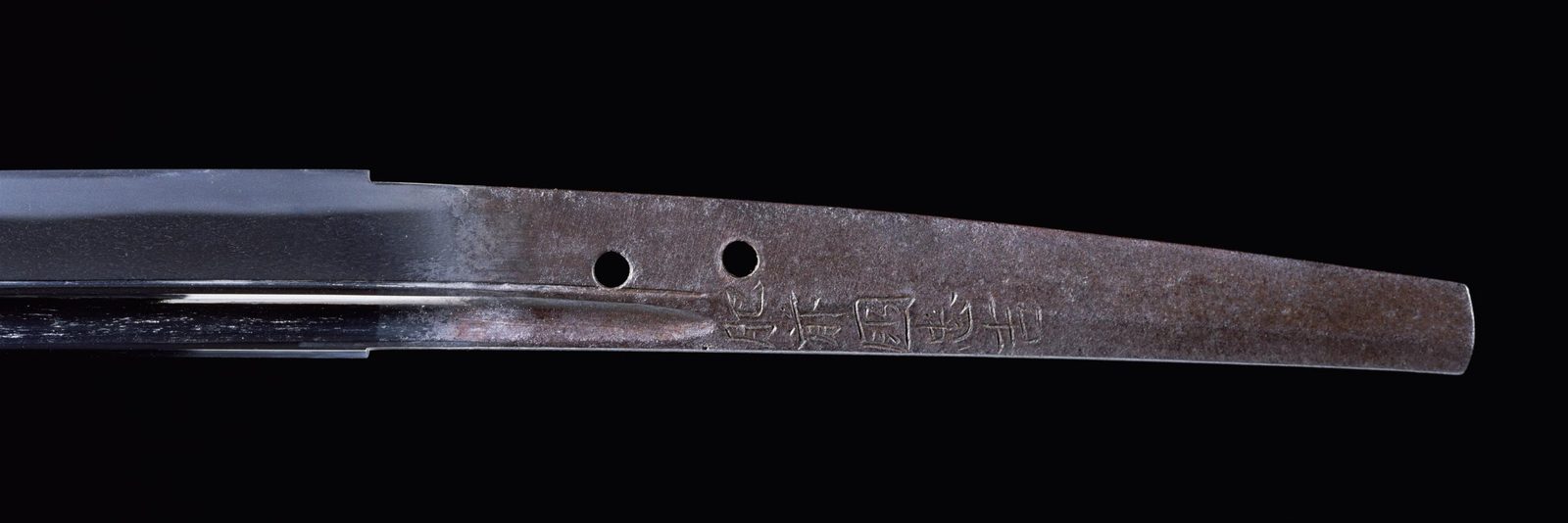
The tang of the 1600 katana, with the five-character signature 肥前国忠吉 (Hizen no kuni Tadayoshi). Tokyo National Museum, via ColBase · ColBase terms of use · source
