His work
Tsuneishi Hideaki, quoted by the Japanese Wikipedia, writes that his work did not live up to his theory and that it falls well below that of his contemporaries Suishinshi Masahide and Minamoto Kiyomaro.
Jihada
In the video of the Kōchi Castle museum, the katana of 1853 shows a well-forged, tight ko-itame (よくつんだ小板目, yoku tsunda ko-itame), with narrow grain.
Hamon
The same katana has a suguha that the museum, in its video, gives as an example of a straight hamon. Sesko counts him, with Taikei Naotane, Tsunatoshi, Koyama Munetsugu and Gassan Sadakazu, among the shinshintō swordsmiths who hardened a saka-chōji (逆丁子), the slanting chōji.
Sugata
The tantō in the Kyoto National Museum is a short hira-zukuri blade, slightly curved, as its photo shows. The Kōchi museum announced in its video the display of an ōdachi of his, which it calls “Nankaitarō’s big one”.
Nakago and mei
At first he signed 友尊 (Tomotaka) and 朝高 (Tomotaka); later 朝尊 (Tomotaka), 朝尊造 (Tomotaka tsukuru), 山城国西陣住朝尊 (Yamashiro no kuni Nishijin jū Tomotaka), 森岡朝尊作 (Morioka Tomotaka saku) and 山城国幡枝寓朝尊 (Yamashiro no kuni Hataeda gū Tomotaka). In his early works he signed with the surname Fujiwara. The tantō in the Kyoto National Museum bears this last signature, from his years in Hataeda, and two mekugi holes.
The Kōchi katana of 1853 has the longest signature in the museum’s collection, 83 characters: the client, Taniwaki Kageyu Fujiwara Shigeyuki (谷脇勘解由藤原重之), a descendant of the lords of Haruki castle; the swordsmith’s birthplace, Kuroiwa; his surname and his name, Morioka Nankaitarō Tomotaka; the place of forging, in Horikawa Ichijō (堀川一條), in Kyoto, and the date, the twelfth month of 1853 (Kaei 6).
One name, several generations
None of the sources consulted compares the founder’s blades with those of his successors. The signature is the guide: Tomokuni signs 朝国 (Tomokuni), and the great-grandson, Nankaitarō Masataka.
Details
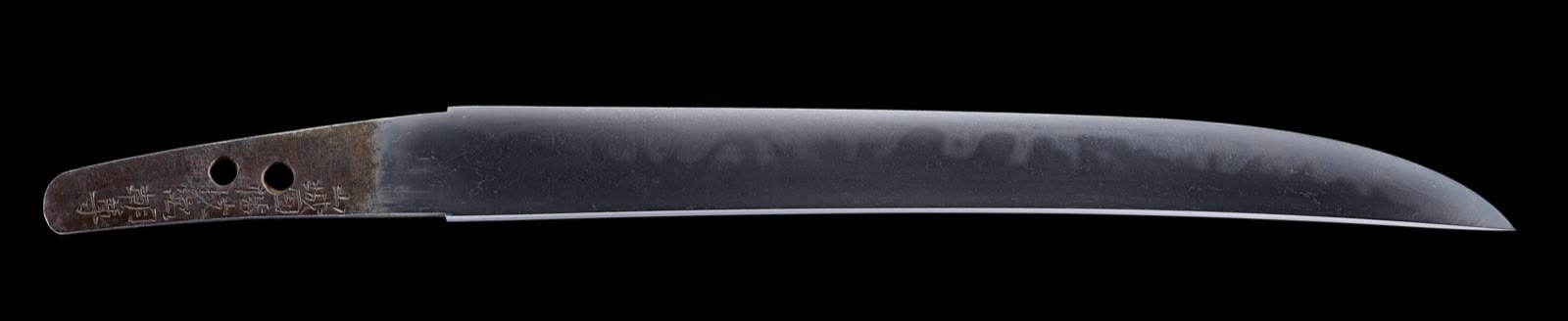
Tantō signed 山城国幡枝寓朝尊 (Yamashiro no kuni Hataeda gū Tomotaka), from his last years in Hataeda. Kyoto National Museum. Kyoto National Museum, via ColBase · ColBase terms of use · source