On this page
Sugata
The katana of 1793 described by the NBTHK measures 2 shaku 3 sun 5.5 bu (about 71.4 cm), with a little over 6 bu of sori; it is shinogi-zukuri with an iori-mune, wide, with a long chū-kissaki, plenty of ha-niku and heavy in the hand. Sesko counts him among the swordsmiths of the end of the Edo period who made moderate shapes in the manner of the middle Nanbokuchō, and among those who revived the wide hira-zukuri of 39 to 43 cm of the Enbun and Jōji eras.
Jihada
On that katana, a tight ko-itame with thick, abundant ji-nie, many chikei and, in the lower half, chikei of different iron (kawari-tetsu). The NBTHK points out that in Motohira the white welding lines that mark Masayuki’s jigane are hardly seen.
Hamon
A tight yakidashi at the base and, above it, a wide ko-notare with gunome and togariba, with long ashi, a dense nioiguchi, strong nie with uneven ara-nie, fine sunagashi, kinsuji and nie-suji. For the NBTHK, the distinguishing feature is that near the yakidashi the nioiguchi is narrower than in the upper half of the blade.
Bōshi
On the katana of 1793, a wide midare-komi, with the tip in komaru and yakizume.
Nakago and mei
Before receiving the title he signed 薩州住元平 (Satsushū jū Motohira), as on the spear in the Kyūshū National Museum; afterwards, 奥大和守平朝臣元平 (Oku Yamato no Kami Taira no Ason Motohira), as on the katana of 1796 in the Tokyo National Museum. The second signed 薩陽奥元平 (Satsuyō Oku Motohira).
The spear has a long tang for the blade, file marks on one side and sensuki on the other, a shallow kurijiri and a single hole.
Who he is confused with
With Hōki no Kami Masayuki, his Satsuma contemporary: both make wide, heavy blades with a wide nioiguchi and a tight midare. The NBTHK tells them apart as follows: Masayuki prefers more dynamic shapes, with funbari and an ō-kissaki, and his jigane shows long white welding lines; Motohira keeps to normal shapes, with a long chū-kissaki, and his nioiguchi narrows near the yakidashi. For Satsuma shinshintō in general, the NBTHK adds a peculiar jihada, large, rough nie and wide, frequent kinsuji.
One name, several generations
The signature is the guide: the title of Yamato no Kami and the formula Taira no Ason belong to the first; 薩陽奥元平 (Satsuyō Oku Motohira), to the second. Sesko has not seen blades signed Motomitsu or Juan, the second’s other names.
Details
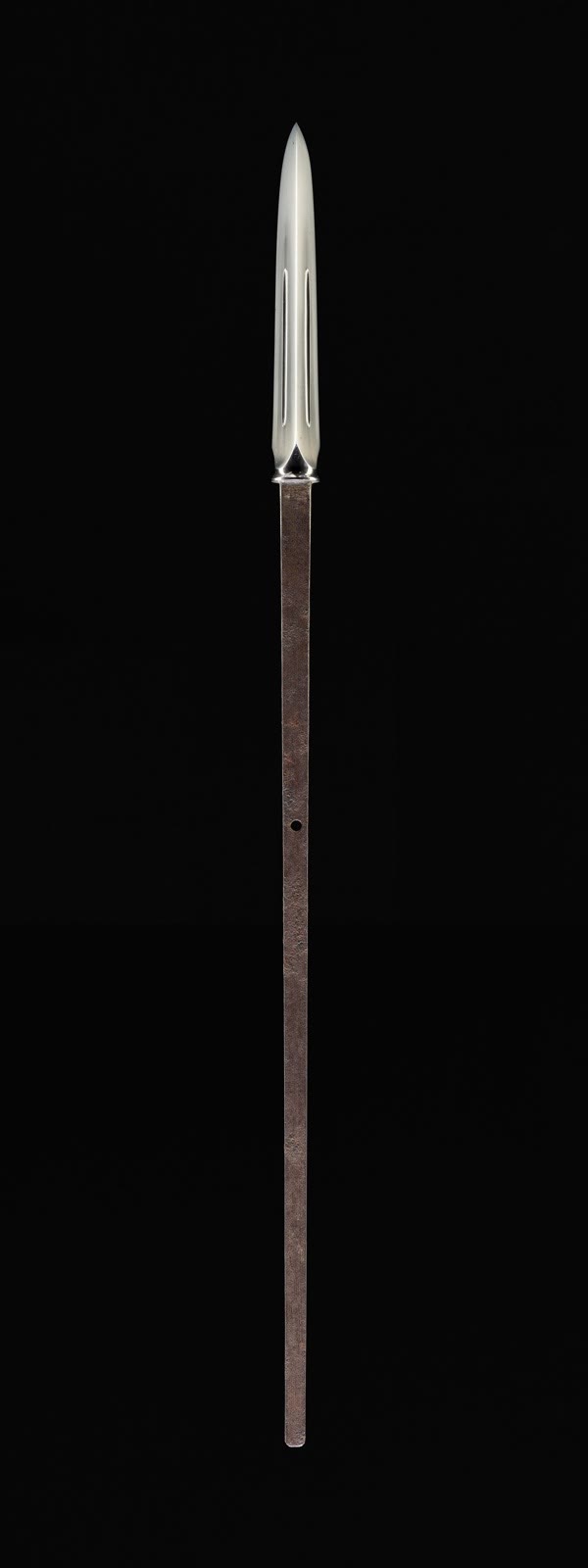
Spear (槍, yari) signed 薩州住元平 (Satsushū jū Motohira), by the first Motohira, before 1789. Kyūshū National Museum. Kyūshū National Museum, via ColBase · ColBase terms of use · source 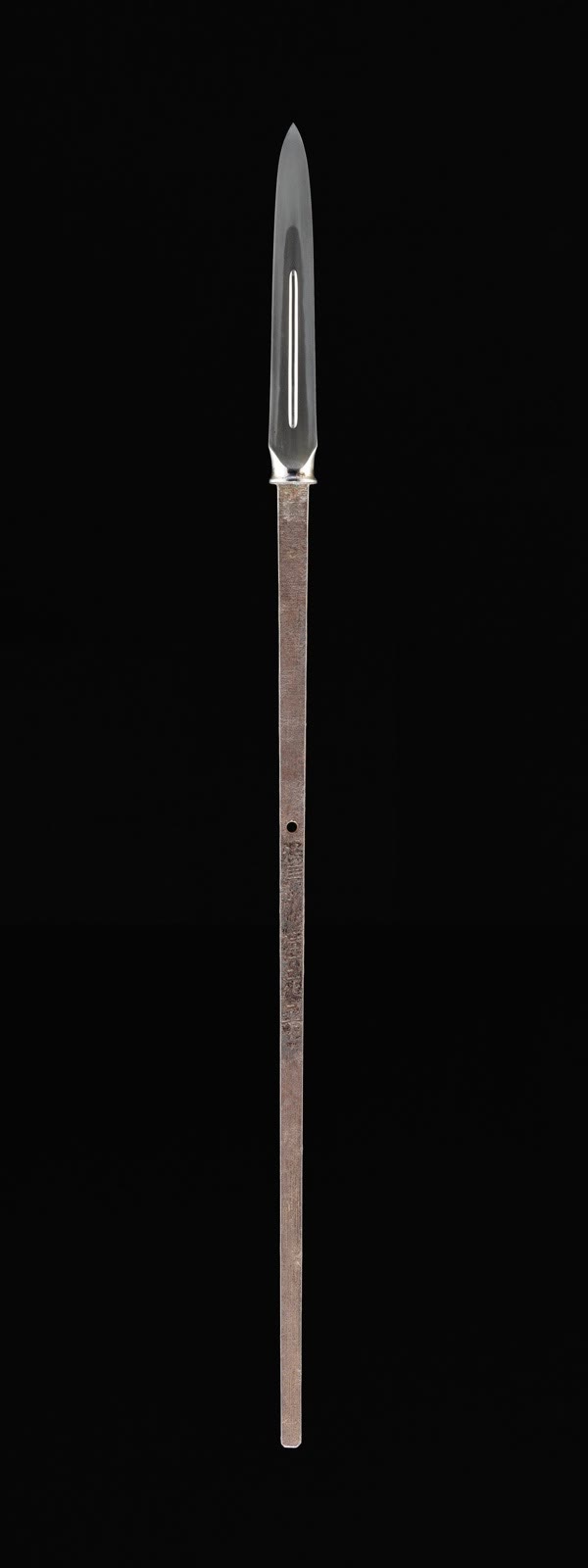
The same spear from the other side, with the signature on the tang. Kyūshū National Museum, via ColBase · ColBase terms of use · source