On this page
Documented works
| Work | Designation | Where it is |
|---|---|---|
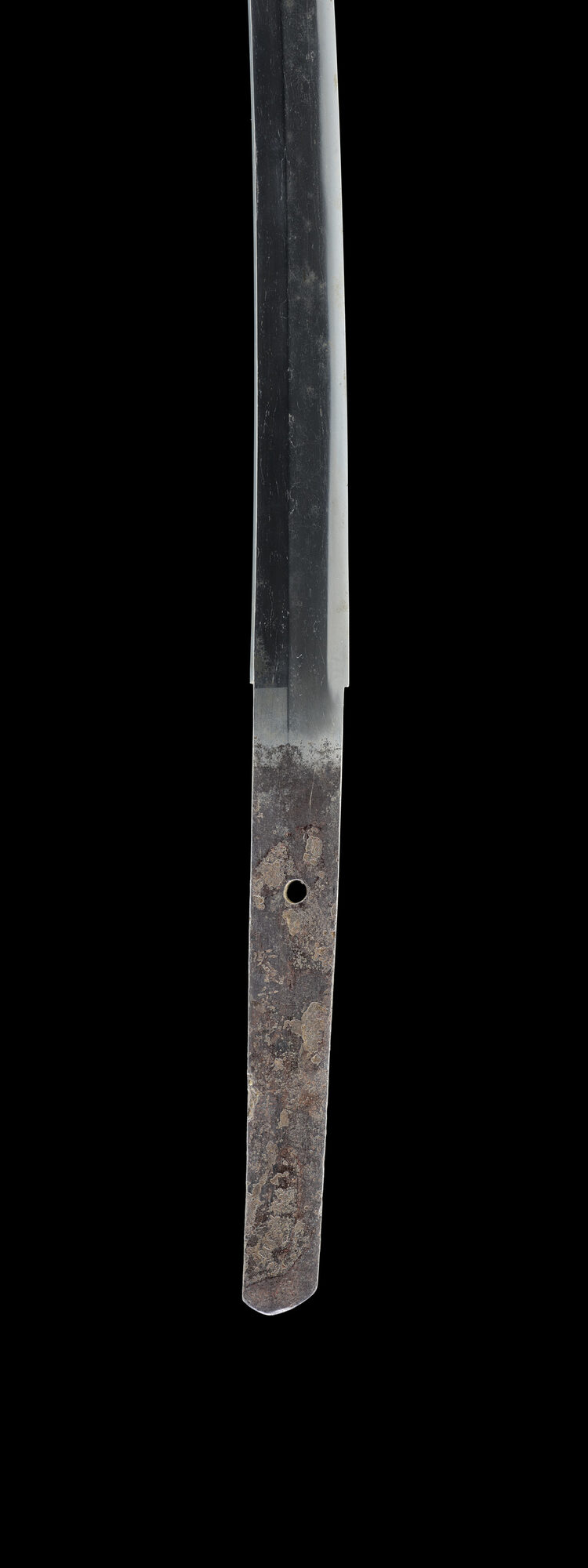
| Katana 備前国住長船清光作 (Bizen no kuni-jū Osafune Kiyomitsu saku), dated 天文十九年八月 (Tenbun jūkyūnen hachigatsu), 1550: blade of 69.7 cm and 1.8 cm of curvature | Not designated; gift of Ōkura Motohiro | Kyūshū National Museum, Dazaifu (F104) |
| Katana 備前国住長船五郎左衛門尉清光 (Bizen no kuni-jū Osafune Gorōzaemon-no-jō Kiyomitsu), dated 1555: 2 shaku 2 sun 6.5 bu, about 68.5 cm | NBTHK study blade | Private collection |
| Tachi signed Kiyomitsu and dated 1533 according to the museum record, with a 19th-century mounting: 66.9 cm cutting edge and 1.8 cm of curvature | Bequest of George C. Stone, 1935 (36.25.1694) | The Metropolitan Museum of Art, New York |
The katana in the Kyūshū National Museum
It measures 87.4 cm with the tang. For the museum it is a typical example of the Sue-Bizen of the Tenbun era.
The katana of 1555, made at Tatsuno
The NBTHK published it as a study blade. It does not bear the name of the place, but it was forged at Tatsuno. Itame with mokume and nagare, a visible hada, ji-nie, plenty of chikei and a pale utsuri; an open-valley gunome with chōji, double gunome in some stretches and an intricate midare, with ashi, yō, tobiyaki, muneyaki, kinsuji and sunagashi. Below the yokote, “Kiyomitsu’s drool” is clearly visible.
Of the ten or so blades he forged at Tatsuno, the NBTHK says that he signed many together with Akamatsu Masahide or for him; the sources consulted do not identify them one by one.
In the old lists
- In the cutting list of Yamada Asaemon, the 懐宝剣尺 (Kaihō Kenjaku), 五郎左衛門清光 (Gorōzaemon Kiyomitsu) and 勝兵衛清光 (Shōbei Kiyomitsu) are in the rank of 業物 (wazamono), the fourth of four, according to the Japanese Wikipedia. In the same rank is 播磨大掾清光 (Harima Daijō Kiyomitsu), who is the one from Kanazawa, not the one from Osafune.
- The sources consulted record no blade of his designated National Treasure or Important Cultural Property. It remains to be checked whether any is in the Kyōhō meibutsuchō (享保名物帳).