Style
In his early years he made Bizen-type hamon, midare and chōji; around 1968 he moved to the suguha of the Yamato and Yamashiro traditions and of the Aoe of Bitchū, and for that he was called “Ōsumi of the suguha” (直刃の大隅, suguha no Ōsumi). The Japanese Wikipedia, which draws on the obituary in the Asahi newspaper, says that, apart from his first works, he forged suguha blades of tamahagane all his life.
According to the Tōbunken obituary, his ideal was the Rai (来, Rai) of Kyoto of the late Kamakura period and the Aoe (青江, Aoe) of Bitchū. His tachi have a deep sori and a ko-itame jihada; the hamon is a ko-nie suguha, in the manner of Rai Kunitoshi and Rai Kunimitsu, with ko-gunome and ko-ashi, or a suguha with a narrow nioiguchi and slanting ashi (逆足, sakaashi), in the Aoe style.
The steel
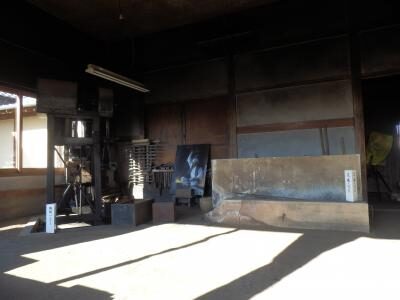
He worked with tamahagane and with iron he resmelted himself (卸し鉄, oroshigane): iron sand from the Tone river, nanban-tetsu of the Edo period and old nails. His museum holds some thirty tools he made himself, according to the City of Ōta leaflet on how a sword is made.
Works
He forged tachi, katana and tantō, tachi of more than 3 shaku (90 cm), an ōdachi of 3 shaku and 7 sun (112 cm) held by Ōta, and chokutō for the Ise shrine. Tōbunken cites among his representative works the suguha tachi of his Masamune Prizes and a tachi in the Tokyo National Museum.
- Tachi signed 大隅俊平作 (Ōsumi Toshihira saku), dated 10 July 1998, 76.4 cm long with a sori of 3.2 cm, owned by the Agency for Cultural Affairs: no. 39 of the NBTHK exhibition 平成の名刀・名工展 (Heisei no Meitō Meikōten), in 2019.
- Tantō signed 俊平 (Toshihira), dated March 1999, 25.7 cm long and without sori, also owned by the Agency for Cultural Affairs: no. 40 of the same exhibition.
- A tachi of his was shown in the polishing section (研磨の部, kenma no bu) of the NBTHK’s 2025 Gendai Tōshokuten, polished by 臼木良彦 (probable reading: Usuki Yoshihiko). The blade bears the signature 大隅俊平作 (Ōsumi Toshihira saku) and the date August of the year 55 of Shōwa, that is, 1980.