On this page
Training
He was born on 23 January 1932 in Tomizawa, in the village of Sawano in Nitta district, today part of the city of Ōta (太田市, Ōta-shi), in Gunma. In July 1952, at twenty, he became a pupil of Miyairi Akihira in Sakaki (坂城, Sakaki), in Nagano. In 1957 he obtained his swordsmith’s licence from the Ministry of Education, and in 1958 his first work submitted to the NBTHK technical forging competition (作刀技術発表会, Sakutō Gijutsu Happyōkai) won a prize of excellence (優秀賞, yūshūshō), which led people to say that the Miyairi school had a talent. The fine arts yearbook published by the Tokyo National Research Institute for Cultural Properties (Tōbunken) calls that prize the highest of the competition.
His forge in Ōta
In 1960 he finished his apprenticeship and returned to Tomizawa to work on his own; difficult years followed. The German Wikipedia gives 1958 for his return; the Japanese Wikipedia, Tōbunken and the City of Ōta, 1960. In 1979 he moved to Yura-chō, also in Ōta, where his museum is today.
His motto was “a simple life, a luxurious work” (生活は質素に、仕事は贅沢に, seikatsu wa shisso ni, shigoto wa zeitaku ni): all his time, his material and his labour went into each piece. He devoted 57 years to forging, according to his city.
The workshop
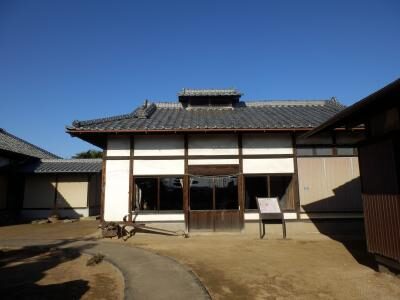
The exterior of his workshop, preserved at the museum. Photo: City of Ōta · © City of Ōta · source 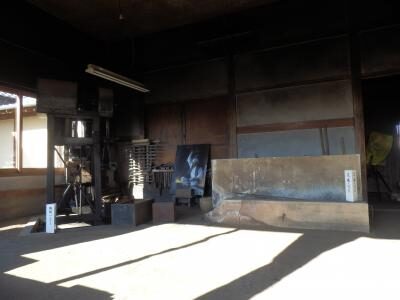
The interior of the workshop, with the anvil and the forge. Photo: City of Ōta · © City of Ōta · source 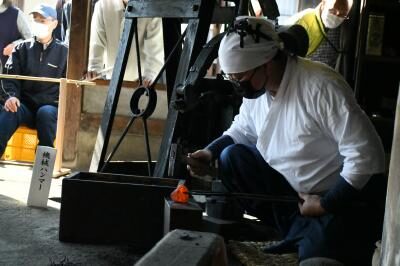
A forging demonstration at the museum; it is not him. Photo: City of Ōta · © City of Ōta · source
Ise and the imperial household
For the ritual transfers of the Ise shrine (式年遷宮, shikinen sengū) he forged chokutō, straight swords: three in 1971, two in 1984, four in 2005 and two in 2006, and hoko (鉾, hoko): two in 1989 and six in 2009, the year of his death. He forged protective swords (守り刀, mamori-gatana) for the household of Prince 高松宮 (Takamatsu-no-miya) in 1981, and a tachi in 1986; for his wife in 1983; a tantō for Princess Aiko in 2001, and a kodachi for the Takamado household in 2007. In 2006 the Sultan of Oman acquired a tachi and a wakizashi of his.
Recognition
In 1977 Gunma Prefecture designated him an intangible cultural property of the prefecture and gave him its cultural merit award; in 1988 he became an honorary citizen of Ōta, and in 1993 he received the prefecture’s merit award. In 1997 the Agency for Cultural Affairs named him a Living National Treasure. He received the Medal with Purple Ribbon (紫綬褒章, shiju hōshō) in 1999 and the Order of the Rising Sun, Gold Rays with Neck Ribbon (旭日中綬章, Kyokujitsu Chūjushō), in 2005.
His death and his museum
He died of stomach cancer at his home in Ōta on 4 October 2009, aged 77. In November 2012 the city opened the Ōsumi Toshihira Museum (大隅俊平美術館, Ōsumi Toshihira Bijutsukan) in his former house and workshop, with his work and some thirty tools made by him. In 2013 his pupil Takano gave a public demonstration there of the forging of a tachi. From 19 September 2026 to 24 January 2027 the museum is showing six ōdachi of his, among them one of 4 shaku and 6 sun, about 1.39 m.
He appeared on television on NHK (2005, about the Ise shrine), in a BS-i programme devoted to him, recorded in 2007, and in a BS-TBS programme on the Living National Treasures (2010).