Kantei keys
- Jihada. Matsukawa-hada: ō-itame or ō-mokume with thick chikei along the layers, like the bark of the pine; Markus Sesko gives “Kashū Sanekage” as an example, alongside Norishige and Ko-Uda. Other descriptions speak of itame-nagare with abundant ji-nie and marked chikei, and of a somewhat blackish steel.
- Hamon. On the tantō of 1367, ko-notare with ko-gunome, according to its official record.
- Hamon, on other blades. Ko-notare with nie, and also notare-komidare, gunome-midare and suguha-komidare.
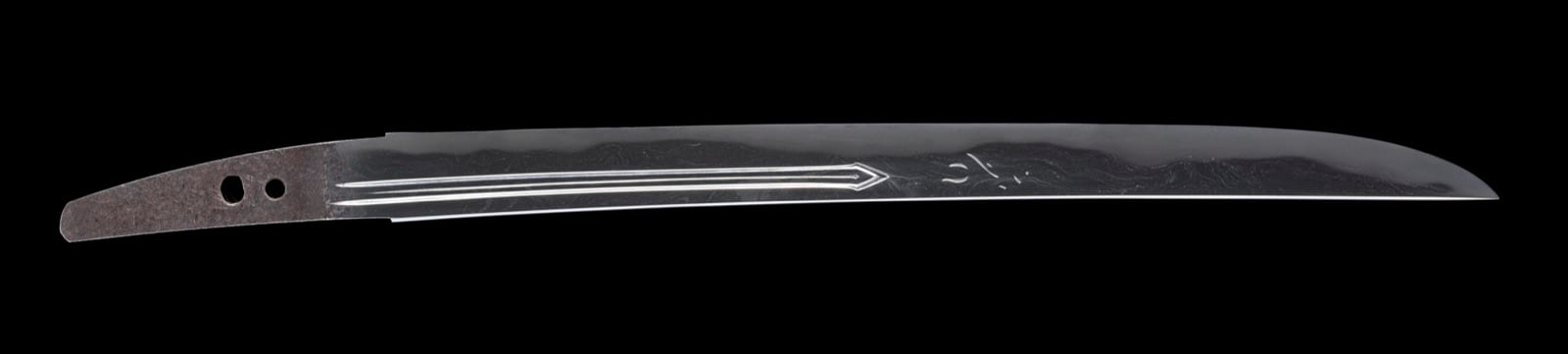
- Sugata. The tantō of 1367 is hira-zukuri and mitsu-mune, 28.5 cm long; the Kyoto one measures 28.8 cm, with 0.3 cm of curvature.
- Nakago. The Kyoto tantō has two holes.
- Mei. 加州住真景 (Kashū jū Sanekage) on the sashi-omote face of the Kyoto tantō; 賀州住真景 (Gashū jū Sanekage), with 賀 (ga) instead of 加 (ka), on the one of 1367.
- Mei, on other blades. Also 加州住藤原真景作 (Kashū jū Fujiwara Sanekage saku) and 藤原真景 (Fujiwara Sanekage).
The tantō of the Kyoto National Museum
The museum’s photograph shows, on the blade, a hi ending in a point and a small engraving (horimono).
His katana
The katana attributed to him are usually much shortened (ō-suriage) and unsigned, with a kurijiri tang tip, kiri file marks and two holes.