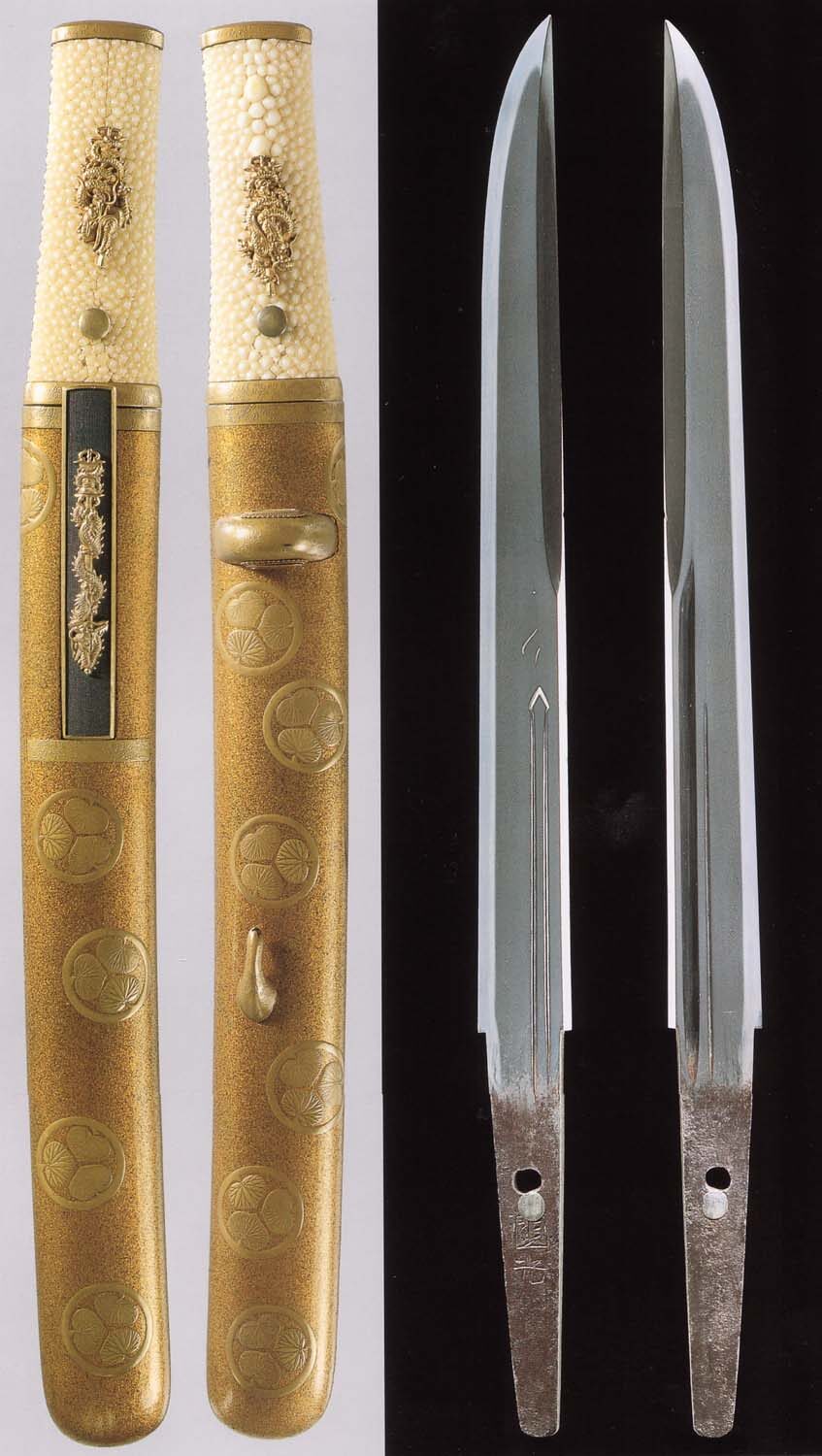
The Aizu Shintōgo
- Tantō 銘国光 (mei Kunimitsu), with the name 名物会津新藤五 (meibutsu Aizu Shintōgo): a National Treasure under the old law since 23 January 1933 and under the new one since 9 June 1951. It is in the Fukuyama Museum of Art, in Hiroshima.
- The official record says it is healthy and strong, and that “as a whole, it represents the work of Kunimitsu”.
- It is listed in the Kyōhō meibutsuchō (享保名物帳), the register of famous swords that the Hon'ami family drew up in the Kyōhō era (1716–1736).
- The Japanese Wikipedia records the opinion that, with those of Awataguchi Yoshimitsu, it is among the finest tantō of all time.
- Its history, according to the Japanese Wikipedia: it belonged to Gamō Ujisato, lord of Aizu, from whom it takes its name, and to his grandson Tadasato; then to Morikawa Han'ya and to Maeda Toshitsune; in 1702 it passed to Tokugawa Tsunayoshi, and in 1707 it was given to the son of Tokugawa Ienobu; it stayed in the Tokugawa house, then belonged to Nakajima Kiyoichi and other owners, and lastly to Komatsu Yasuhiro, whose collection was donated to the city of Fukuyama in 2018.
His designated works
The list is that of the Japanese Wikipedia; only the Aizu Shintōgo has been checked in the official database.
| Work | Designation | Where it is |
|---|---|---|
| Tantō 銘国光 (mei Kunimitsu), the 会津新藤五 (Aizu Shintōgo) | National Treasure | Fukuyama Museum of Art (ふくやま美術館, Fukuyama Bijutsukan), Hiroshima |
| Tantō 銘国光 (mei Kunimitsu), with a sword and the Sanskrit letter of Fudō Myōō carved on it | National Treasure | Private collection, Osaka |
| Tantō 銘国光 (mei Kunimitsu), which belonged to 徳川慶喜 (Tokugawa Yoshinobu) | National Treasure | Private collection |
| Tantō 鎌倉住人新藤五国光作 (Kamakura jūnin Shintōgo Kunimitsu saku), 永仁元年十月三日 (Einin gannen jūgatsu mikka): 1293 | Important Cultural Property | A foundation, Kanagawa |
| Tantō 銘国光 (mei Kunimitsu), of the Date house | Important Cultural Property | Tokyo National Museum |
| Tantō 銘国光 (mei Kunimitsu), kanmuri-otoshi | Important Cultural Property | Sano Art Museum (佐野美術館, Sano Bijutsukan), Shizuoka |
| Tachi 銘国光 (mei Kunimitsu) | Important Cultural Property | Seikadō Bunko Art Museum (静嘉堂文庫美術館, Seikadō Bunko Bijutsukan), Tokyo |
| Tantō 銘国光 (mei Kunimitsu), 徳治三年 (Tokuji sannen): 1308, with the rest of the date cut off | Important Cultural Property | Atsuta Jingū (熱田神宮, Atsuta Jingū), Aichi |
| Three tantō 銘国光 (mei Kunimitsu) | Important Cultural Property | Tsuchiura City Museum; Myōkokuji, Osaka; Kongōbuji, Wakayama |
| Tantō 銘国光 (mei Kunimitsu), 元応二年三月廿日 (Gen'ō ninen sangatsu hatsuka): 1320 | Important Cultural Property | Whereabouts unknown |
| Tantō 鎌倉住新藤五國光法名光心 (Kamakura jū Shintōgo Kunimitsu hōmyō Kōshin), of the Shōwa era (1312–1317) | Important Art Object (重要美術品, jūyō bijutsuhin) | Kurokawa Institute of Ancient Cultures |
In the treatises
- In the two genealogies of the Kanchi-in-bon Meizukushi he is the central figure of the Kamakura swordsmiths.
- A kantei text of the Takeya system, from between Momoyama and the beginning of Edo, translated by Markus Sesko, gives him in the Sagami section the grade of 上作 (jōsaku), “high work”: the same as Kunitsugu, while Masamune is 別上 (betsujō) and Yukimitsu, 無上 (mujō).
- The Aizu Shintōgo is in the Kyōhō meibutsuchō (享保名物帳).