On this page
His evolution
Kotobank (Nipponica) describes three stages: first ō-midare; then tōran-ba in the manner of Tsuda Sukehiro, of the Ōsaka shintō; and, after his theory of the return to the old ways, work in the Bizen and Sagami traditions on the models of the Kamakura and the Nanbokuchō. The NBTHK attributes to his theory the revival of the old schools in shinshintō, above all of Bizen.
Sugata
The katana of 1808 in the Tokyo National Museum measures 73.3 cm, with 2.0 cm of sori. Another katana of the same year, from the eighth month, which the NBTHK analysed in its kantei of 2015, measures 2 shaku 2 sun 9.5 bu and has 6 bu of sori, shinogi-zukuri with an iori-mune. The NBTHK sums up the shape of the shinshintō that imitates Sukehiro: a narrow shinogi-ji, little hiraniku and a long kissaki.
Jihada
On the kantei katana, a tight ko-itame with dense ji-nie and fine chikei. In general, the NBTHK sees in these blades a jihada that is too tight, almost without pattern, like a mirror steel.
Hamon
On the kantei katana, a straight yakidashi and, above it, round-headed ō-gunome in tōran-midare, with a wide nioiguchi, plenty of nie and, in some stretches, rough nie. The photos of the Tokyo katana of 1808 show a hamon of gentle waves with ashi.
Bōshi
Straight, with komaru and a somewhat long turn-back, on the kantei katana.
Nakago and mei
The Tokyo katana of 1808 is signed 水心子正秀 (Suishinshi Masahide) with a monogram, dated the second month of 1808 and made to the order of Nakagi Koretaka (中木維長). A wakizashi of 1819 in the Tokyo National Museum also bears the seal 日天 (Nichiten). Other signatures: 英国 (Terukuni), 川部儀八郎藤原正日出 (Kawabe Gihachirō Fujiwara Masahide), 秋元臣川部儀八郎藤原正秀作 (Akimoto shin Kawabe Gihachirō Fujiwara Masahide saku), 羽州山形之臣川部儀八郎藤原正秀 (Ushū Yamagata no shin Kawabe Gihachirō Fujiwara Masahide), 水心藤原正秀 (Suishin Fujiwara Masahide) and 水心正日出 (Suishin Masahide); he sometimes wrote the name 正日出 (Masahide), and the gō, 水神子 (Suishinshi).
Horimono
The katana of 1808 bears on one side a dragon in relief inside a frame and, on the other, a groove and a vajra engraving, as its photos show.
Who he is confused with
With Tsuda Sukehiro, the creator of the tōran-ba. In the kantei of that other katana of 1808, the NBTHK tells them apart as follows: in Sukehiro each gunome has one gentle slope and one steep one, the yakidashi widens towards the point and the nie is fine and even; in Masahide the two slopes are equal, the yakidashi keeps the same width and runs parallel to the edge, and the nie is less fine and bright. The journal dates that katana to 1809, but Bunka 5 is 1808.
One name, several generations
The signature 天秀 (Tenshū), which Kotobank reads Amahide, is the first’s from 1818. There are works made jointly by the first and the second, and workshop pieces with several names: the 2025 catalogue includes a daishō of 1817 forged by Sadahide and hardened by Masahide, at the age of 68.
Details
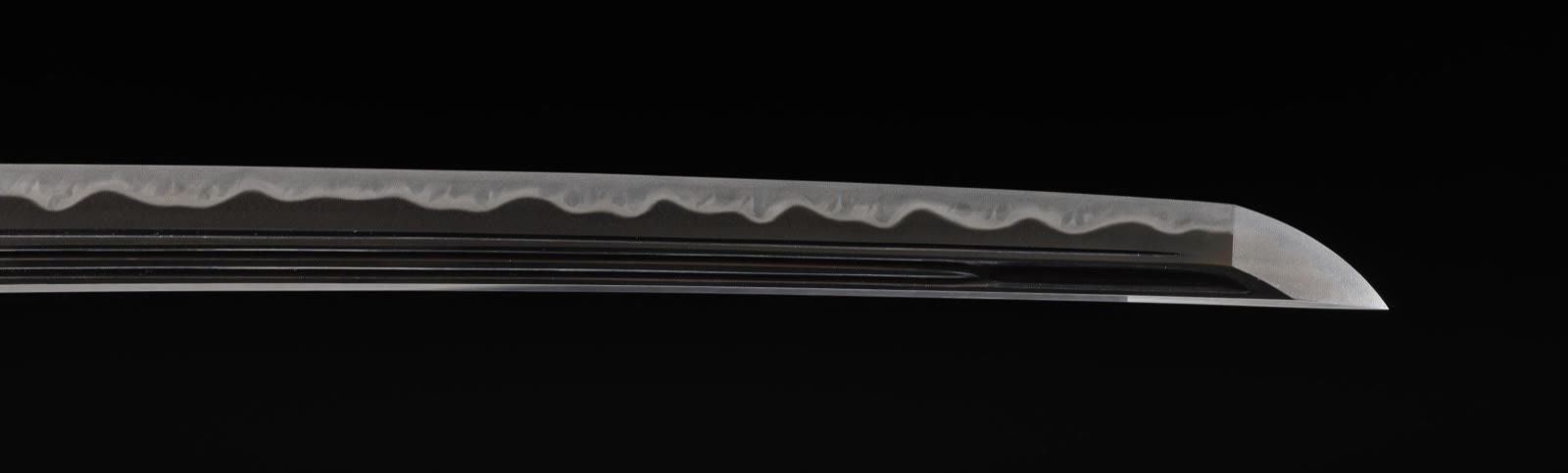
The point of the katana of 1808, with its undulating hamon and the bōshi. Tokyo National Museum, via ColBase · ColBase terms of use · source 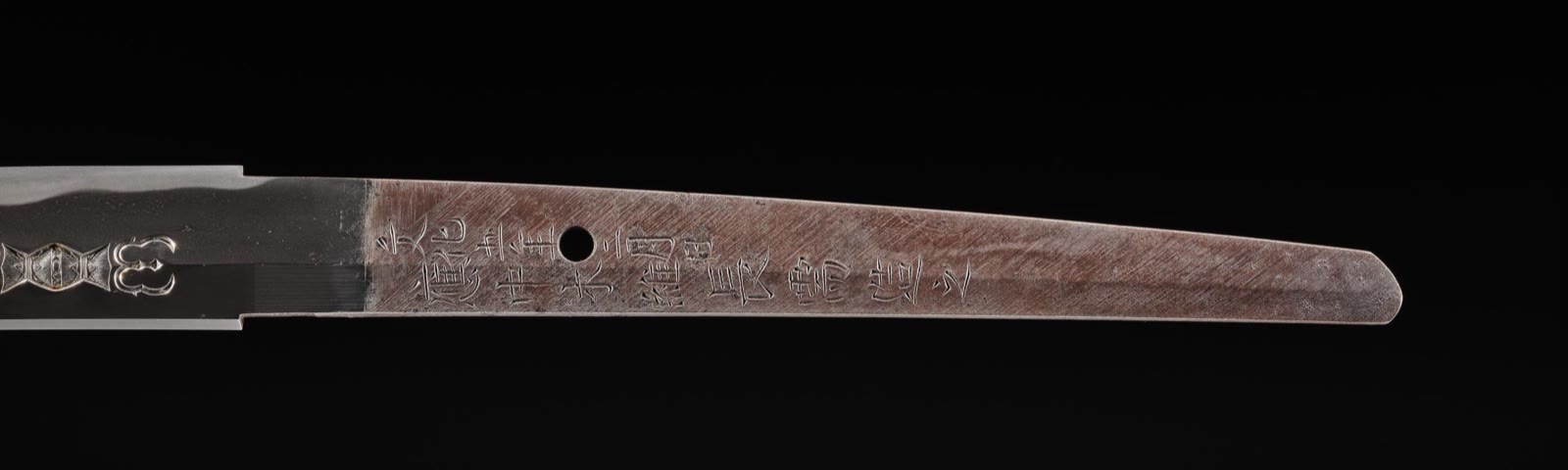
The tang of the katana of 1808, with the date 文化五年二月日 (Bunka gonen nigatsu hi) and the commission of Nakagi Koretaka (中木維長). Tokyo National Museum, via ColBase · ColBase terms of use · source 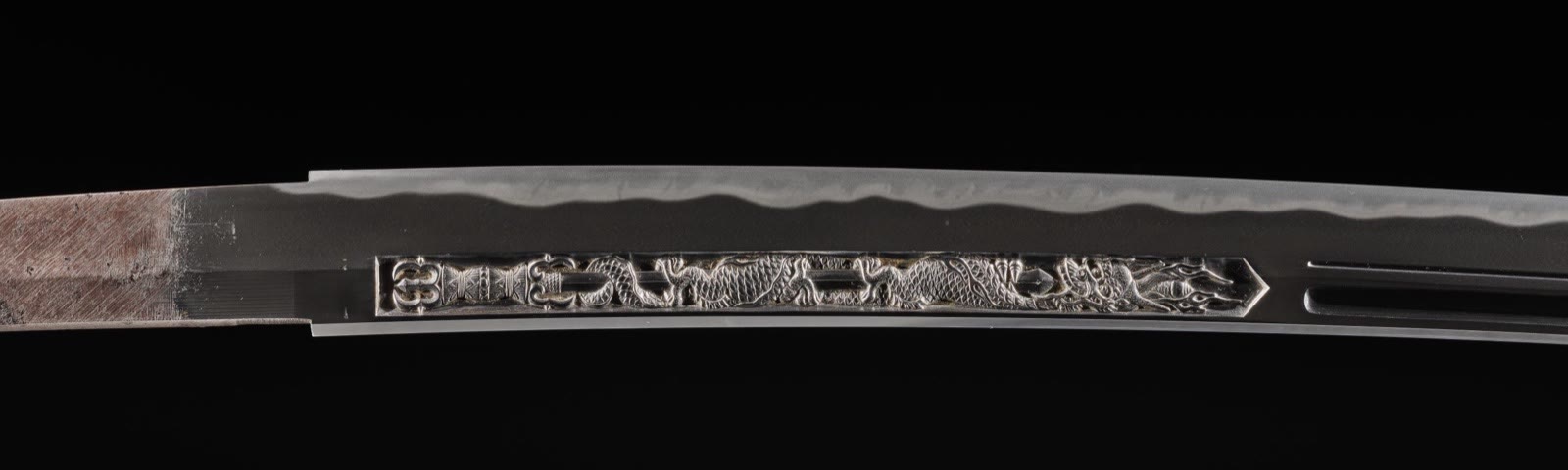
The dragon engraved at the base of the katana of 1808. Tokyo National Museum, via ColBase · ColBase terms of use · source 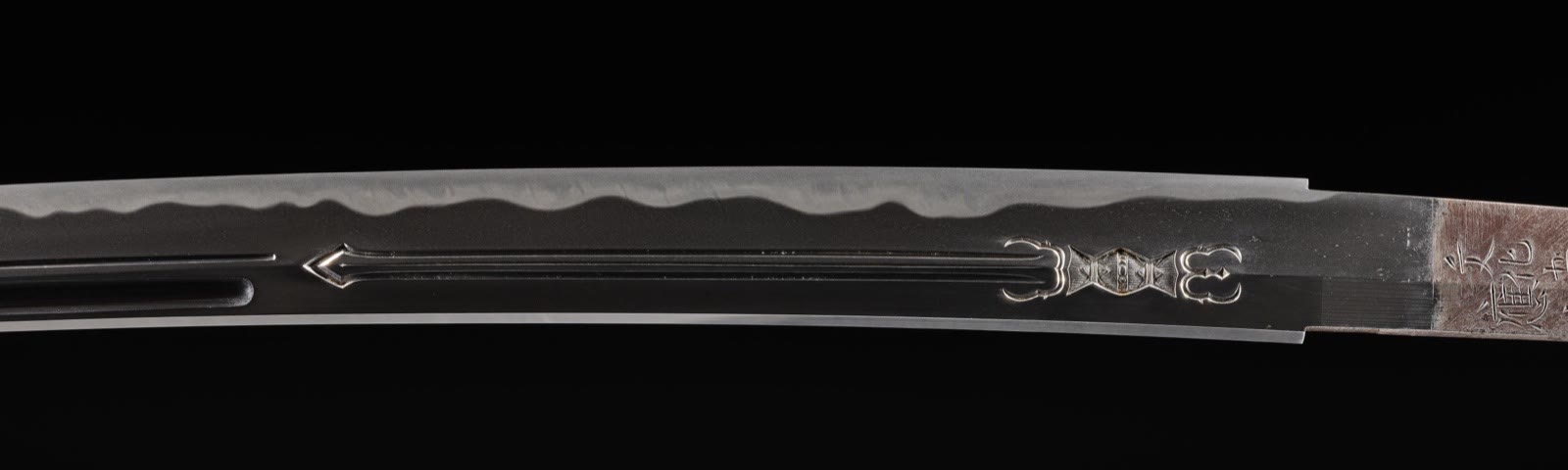
The other side of the base of the katana of 1808, with the groove and the engraving. Tokyo National Museum, via ColBase · ColBase terms of use · source