On this page
Style
He specialised in the Bizen style of the Kamakura period and perfected a chōji of his own, broad and luxuriant, known as the Sumitani chōji. His work ranges from the tachi to the tantō and from the spear to the chokutō; he made his own steel, as in Kamakura, and reproduced the small tōsu and kogatana of the Shōsōin and the Shitennōji. The city of Hakusan describes his works as robust and elegant and calls him the man who raised the sword to an art.
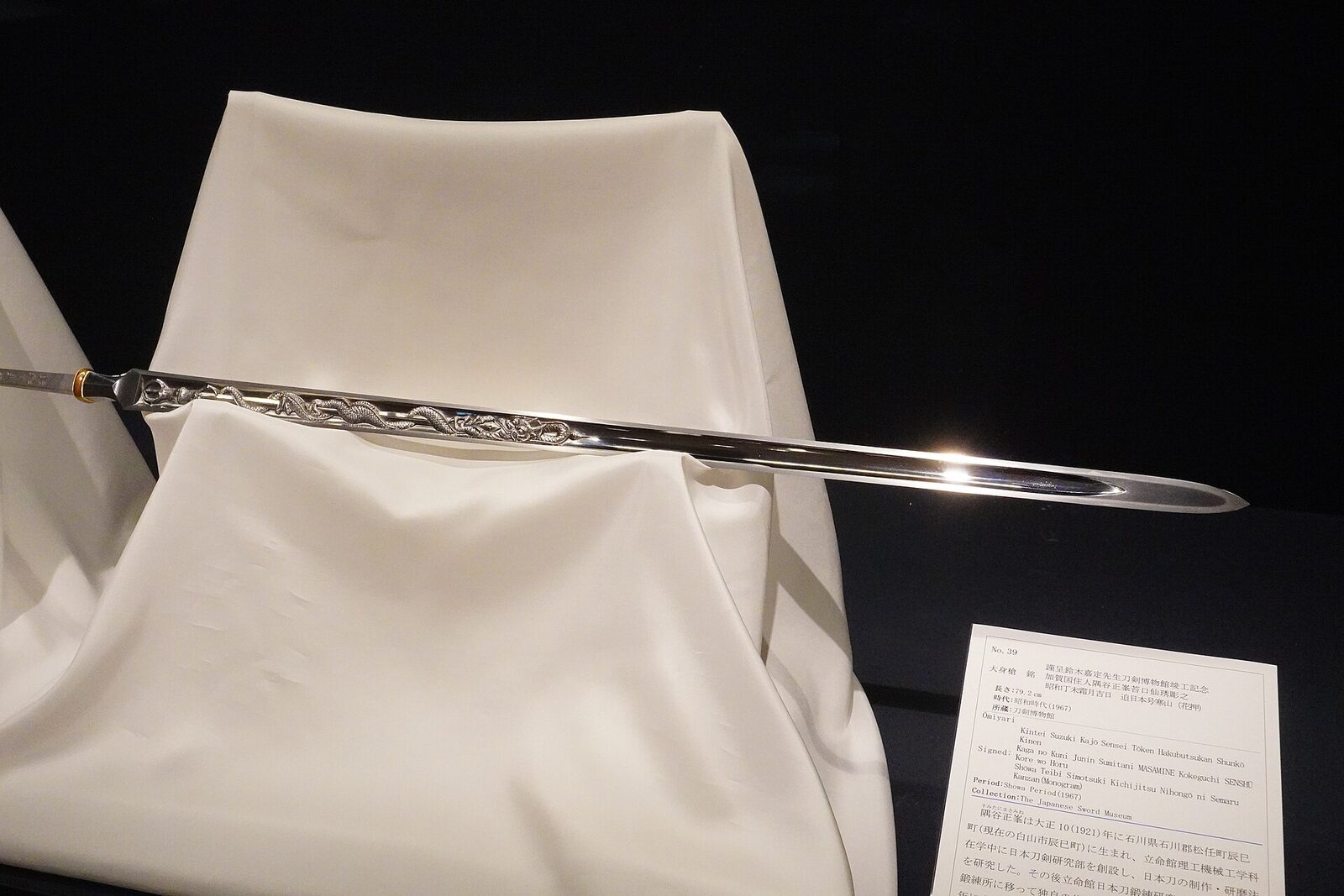

The Nihongō spear
His replica of the 日本号 (Nihongō) spear, forged in 1967 and carved by 苔口仙琇 (Kokeguchi Senshū), is considered the best of the existing copies, according to the Japanese Wikipedia. The label of the Japanese Sword Museum, which can be read in the photo, describes it as a 大身槍 (ōmi-yari), a large-bladed spear, 79.2 cm long, of 1967, from the museum’s collection. The inscription offers it to 鈴木嘉定 (Suzuki Kajō) in memory of the completion of the Sword Museum, and bears the phrase 迫日本号 (Nihongō ni semaru, “on a par with the Nihongō”) with the monogram of 寒山 (Kanzan).
Notable works
- Tachi signed 傘笠正峯作之 (Sanryū Masamine kore o tsukuru), dated August 1993, 74.8 cm long with a sori of 2.8 cm, named 勸進帳 (Kanjinchō), owned by the Hayashibara Museum (林原美術館, Hayashibara Bijutsukan): no. 36 of the NBTHK exhibition 平成の名刀・名工展 (Heisei no Meitō Meikōten), in 2019.
- Chokutō of 1983, a copy of the seven-star sword (七星剣写, Shichiseiken utsushi), signed Sanryū Masamine, at the Ishikawa Prefectural Museum of Art, which also holds pieces of his from 1965 and 1995.
- The swords for the Ise shrine, from the tachi of 1964 onwards, and the protective swords of Princesses Mako, Masako and Kako.