On this page
Style
- Kotobank describes him as a master of the Bizen tradition (備前伝, Bizen-den) and, above all, of blade engraving (刀身彫刻, tōshin chōkoku), and calls him the foremost figure among modern swordsmiths.
- He engraved dragons, often with a plum tree, the Kurikara dragon (倶利伽羅, Kurikara), Daikokuten, Fudō Myōō and Sanskrit letters (梵字, bonji). His engraved blades bear 彫同作 (hori dōsaku, “engraved by the same maker”), and his chisels, made by himself, are kept at the Ehime Museum of History and Culture.
- He made copies of old masters: a tantō 庖丁正宗写 (Hōchō Masamune utsushi) in 1962 and a katana engraved in the manner of 一竿子忠綱 (Ikkanshi Tadatsuna) in 1963.
In museums and at the NBTHK
- The NBTHK catalogue 平成の名刀・名工展 (Heisei no Meitō Meikōten) (2019) exhibits, among the holders of the intangible cultural property “Japanese sword”, a katana of 74.4 cm, with a sori of 2.7 cm, and a wakizashi of 35.6 cm, with a sori of 0.5 cm, both of February 1958 and “at the request of Ehime prefecture” (応愛媛縣需, ō Ehime-ken ju). He signs them 重要無形文化財指定 刀匠 龍泉貞次 (jūyō mukei bunkazai shitei tōshō Ryūsen Sadatsugu) and they belong to the 愛媛県美術館 (Ehime-ken Bijutsukan, Ehime Prefectural Museum of Art).
- ColBase records six works of his in the Tokyo National Museum; among them, a katana of 1958 of 74.0 cm, polished by 本阿弥日洲 (Hon'ami Nisshū), a tachi of 1959, a wakizashi of 1960 and two tantō of 1962, one of 25.1 cm and the 庖丁正宗写 (Hōchō Masamune utsushi), of 21.7 cm.
- Bunka Isan Online describes the 1960 tachi in the Tokyo National Museum: 80.2 cm, sori of 3.3 cm, signed 龍泉貞次造 (Ryūsen Sadatsugu zō), with his kaō, and with the inscription 皇孫殿下御守刀以余鉄精鍛之 (Kōson denka omamori-gatana yotetsu o motte kore o seitan su, “forged with the iron left over from the protective sword of His Highness the grandson of the emperor”).
Gallery
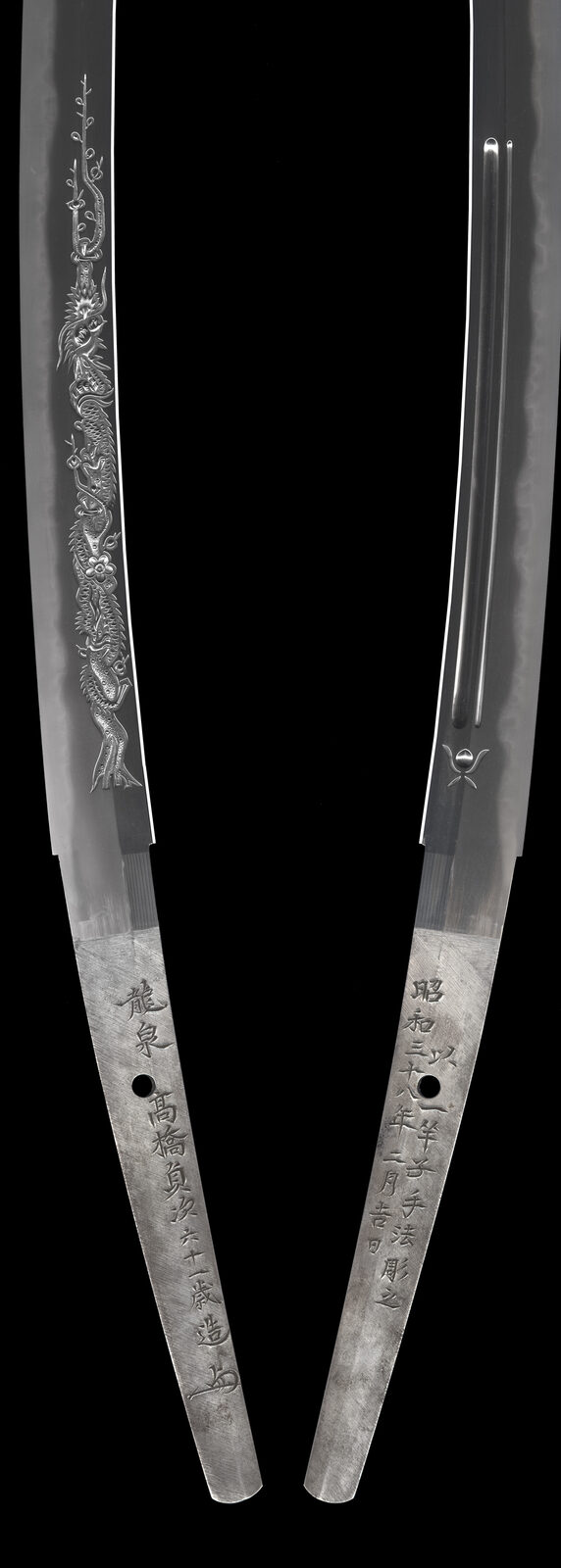
Katana of 1963, signed 龍泉 高橋貞次六十一歳造 (Ryūsen Takahashi Sadatsugu rokujūissai zō, “made at the age of 61”) and engraved 以一竿子手法 (Ikkanshi no shuhō o motte, “with the technique of Ikkanshi”). Photo: dealer in Japan 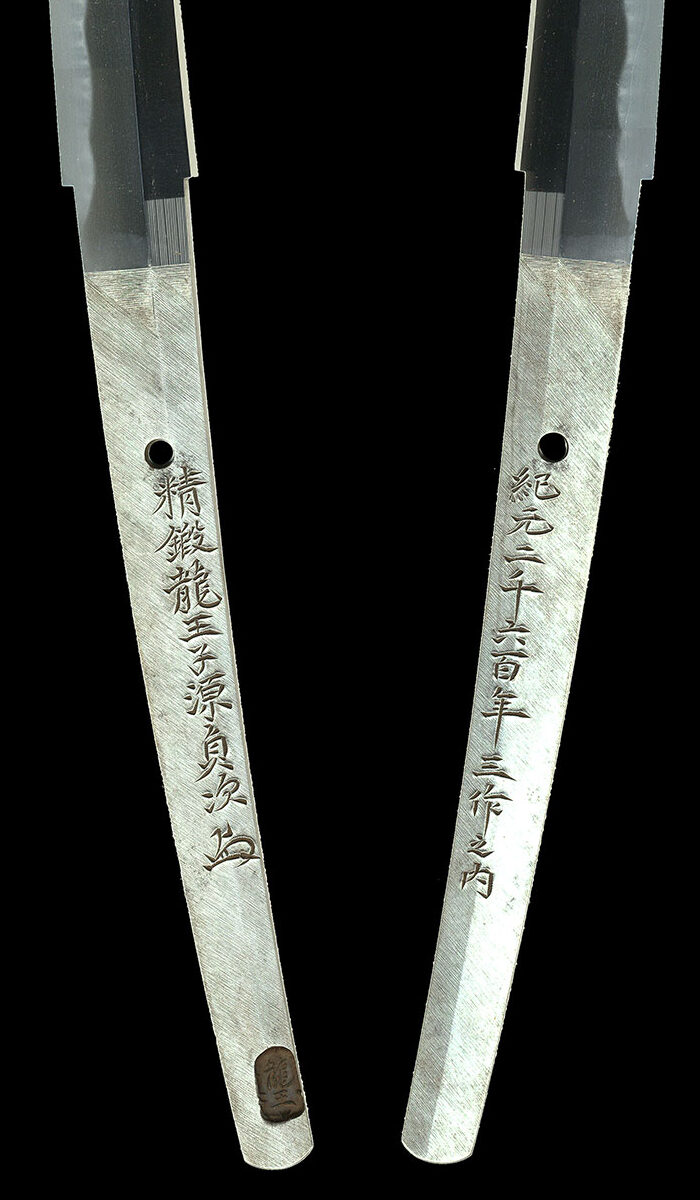
Tang of a katana of 1940, signed 精鍛龍王子源貞次 (Seitan Ryūōji Minamoto no Sadatsugu) and dated in the year 2600 of the imperial calendar (紀元二千六百年, kigen nisen roppyaku-nen). Photo: dealer in Japan 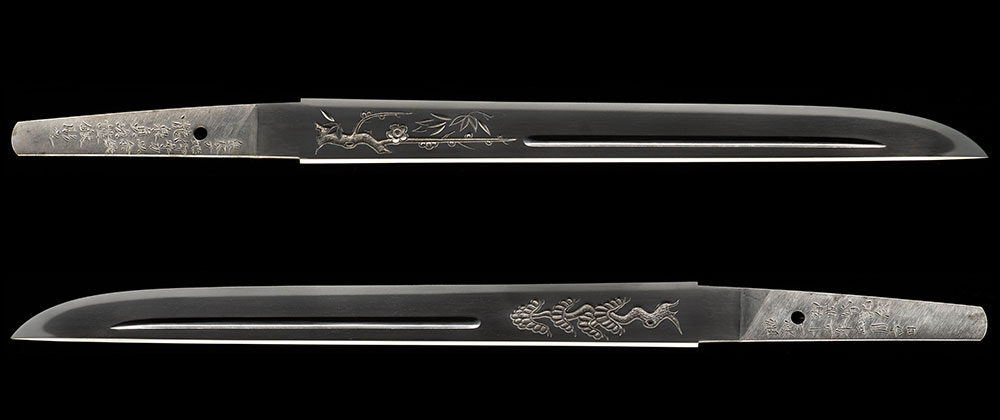
A tantō of his, with a plum tree and a bamboo engraved on one face and a pine on the other. Photo: dealer in Japan 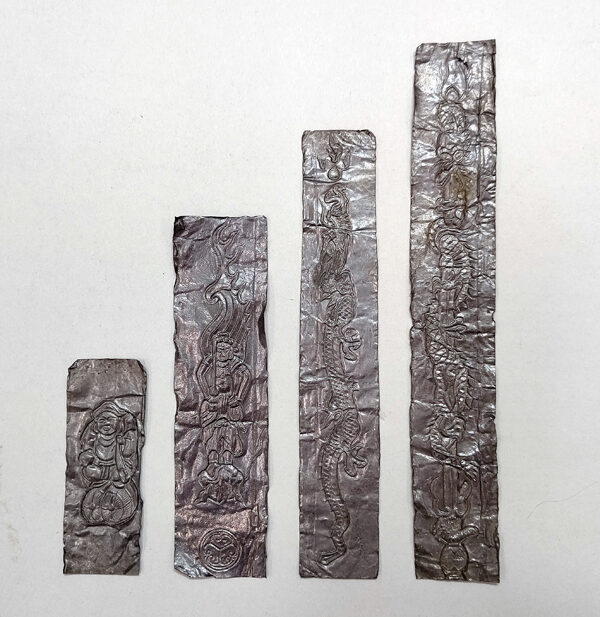
Lead moulds of his engravings: Daikokuten, Fudō Myōō and dragons. Photo: Ehime Museum of History and Culture · © Ehime Museum of History and Culture · source 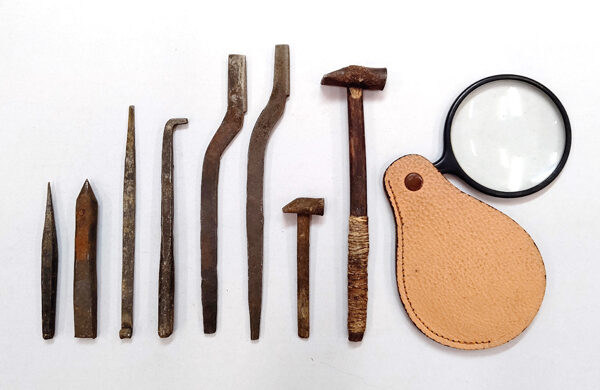
His engraving tools: handmade chisels, hammers and a magnifying glass. Photo: Ehime Museum of History and Culture · © Ehime Museum of History and Culture · source