On this page
Sugata
Almost all are tantō, of balanced shape and ordinary size; some are larger, such as the Gotō Tōshirō and the Hirano Tōshirō, and others have a very thick blade, such as the Atsu Tōshirō, a 鎧通し (yoroi-dōshi), made to pierce armour. The few longer blades are his only tachi, the Ichigo Hitofuri, shortened; two naginata-naoshi, the Honebami and the Namazuo, by their shape; and some ken. The Akita Tōshirō, in the Kyoto National Museum, is the smallest and most delicate: uchizori and a furisode nakago.
Jihada
The tightest ko-itame, which is called 梨子地 (nashiji), with plenty of ji-nie and thread-like yubashiri, according to the Japanese Wikipedia. The NBTHK distinguishes two types: a very fine ko-itame, nashiji, with a moist look, influenced by Rai, and another with barely visible itame; and it adds that the itame or the mokume often look somewhat large. Both with plenty of ji-nie.
Hamon
A suguha of nie with fine ko-midare, plenty of nie inside and a deep nioiguchi (匂口); often, a row of gunome at the base (yakidashi). Some blades have notare (湾れ) with chōji. The old texts speak of his “hand”: a gunome the size of an azuki bean in the koshimoto, according to Heibonsha. For the NBTHK, a clear, well-defined suguha, sometimes ko-gunome-midare, with consecutive ko-gunome in the yakidashi and a narrow hamon in the fukura.
Bōshi
A bōshi (帽子) of strong nie, with the nie “raining” towards the ji, narrowing at the tip, according to the NBTHK. The Hakusan-hime ken, according to the official record, has stronger nie than his tantō.
Nakago and mei
The nakago is almost always unshortened, with the tip in kurijiri or ha-agari kurijiri, shallow katte-sagari file marks and two holes. Signature 吉光 (Yoshimitsu), two large characters with a free stroke, as if written with the tip of the brush: according to the NBTHK, the finest signatures of the Japanese sword. On several blades the katana-hi run down into the nakago and come close to the mune, an Awataguchi trait.
Kantei keys
The NBTHK warns of two confusions. With Kuniyoshi, who has more nashiji and an irregular nijūba. And with 新藤五国光 (Shintōgo Kunimitsu), with more nie, chikei and kinsuji: what counts in deciding for Yoshimitsu are the consecutive ko-gunome in the koshimoto and in the fukura, the narrowing bōshi and the smooth signature, cut with a fine chisel.
The Akita Tōshirō
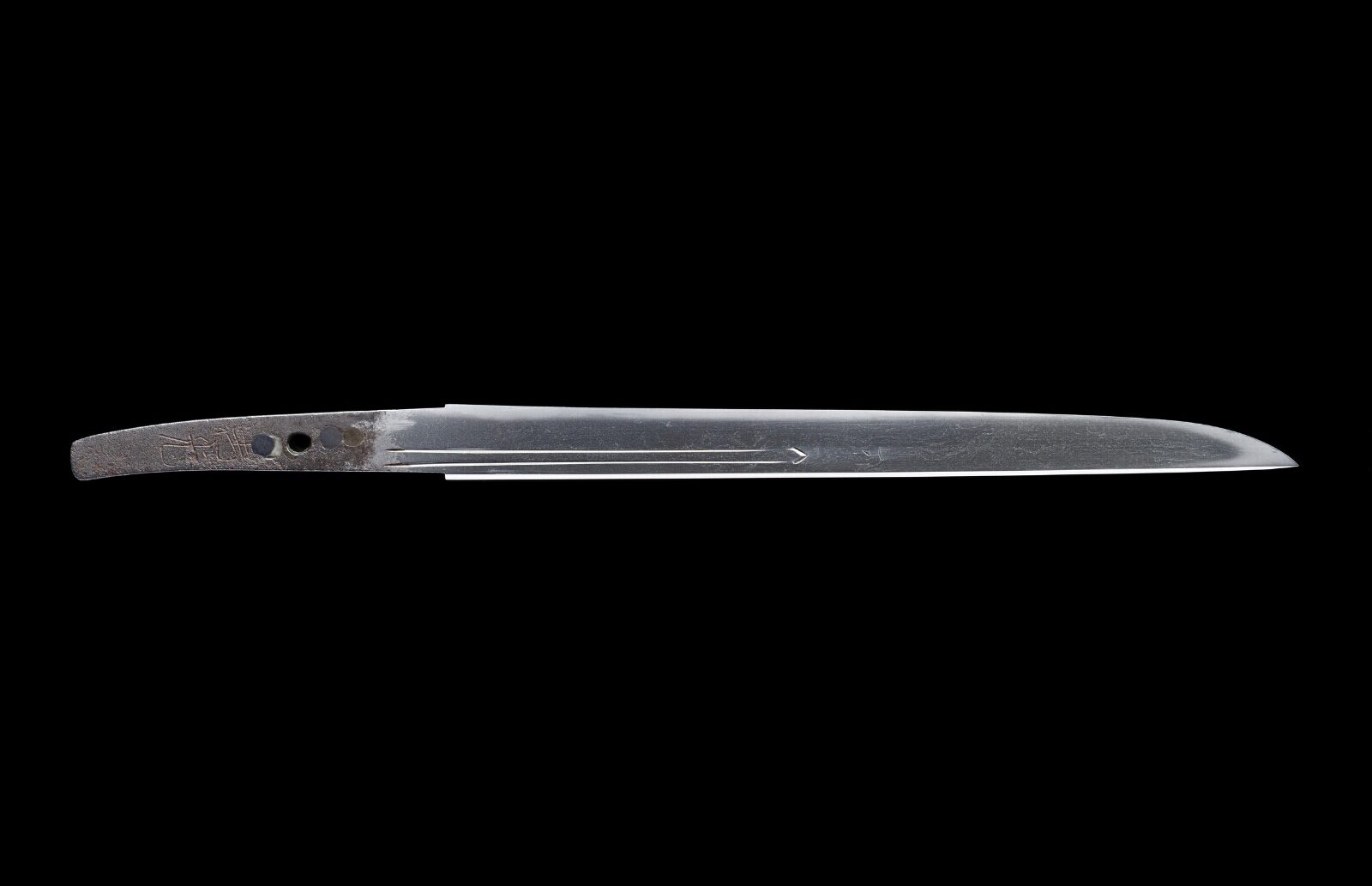
The Akita Tōshirō, a tantō of the Kyoto National Museum. Kyoto National Museum, via e-Museum · ColBase terms of use · source 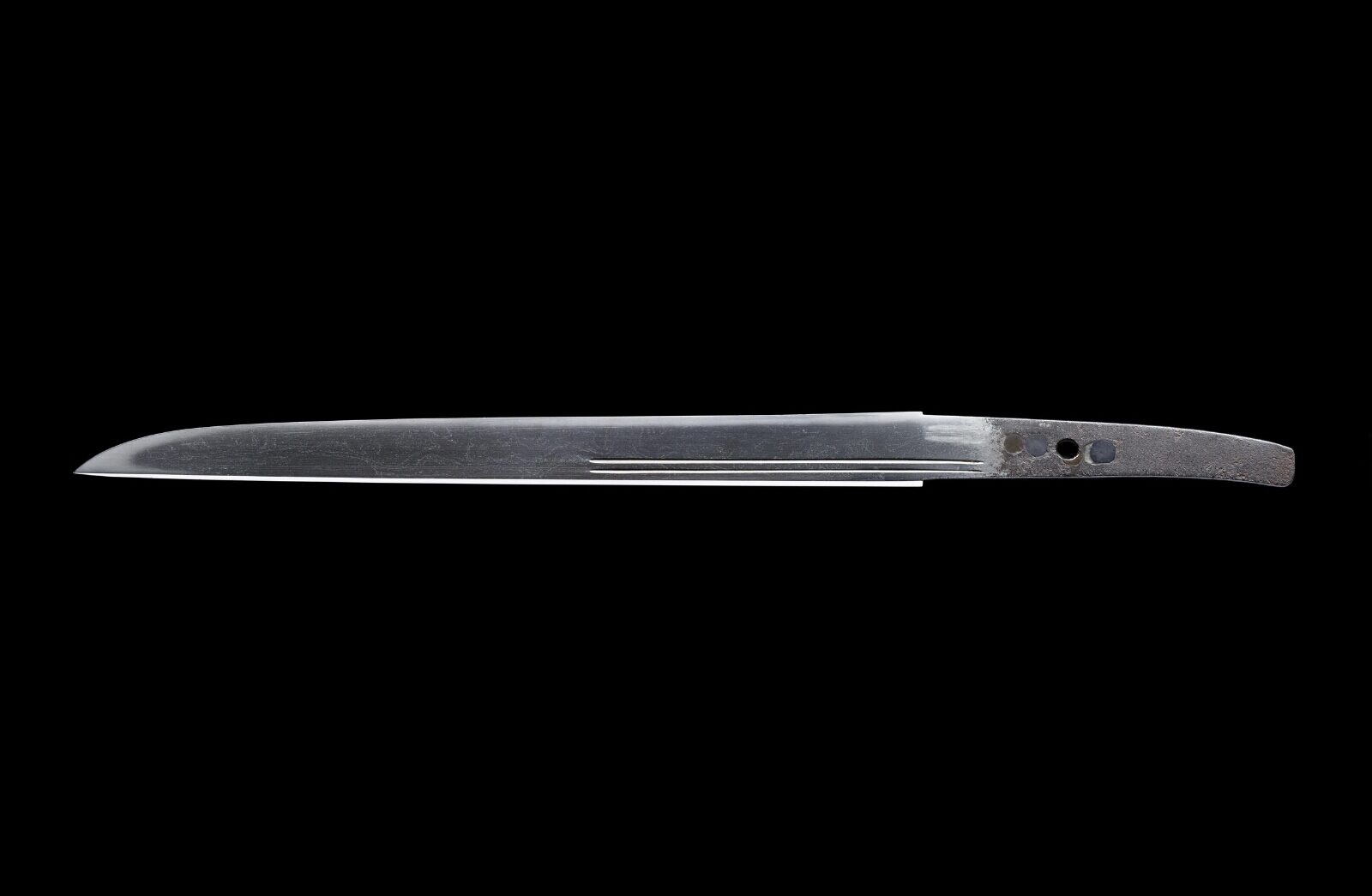
The Akita Tōshirō, in another shot from the museum. Kyoto National Museum, via e-Museum · ColBase terms of use · source 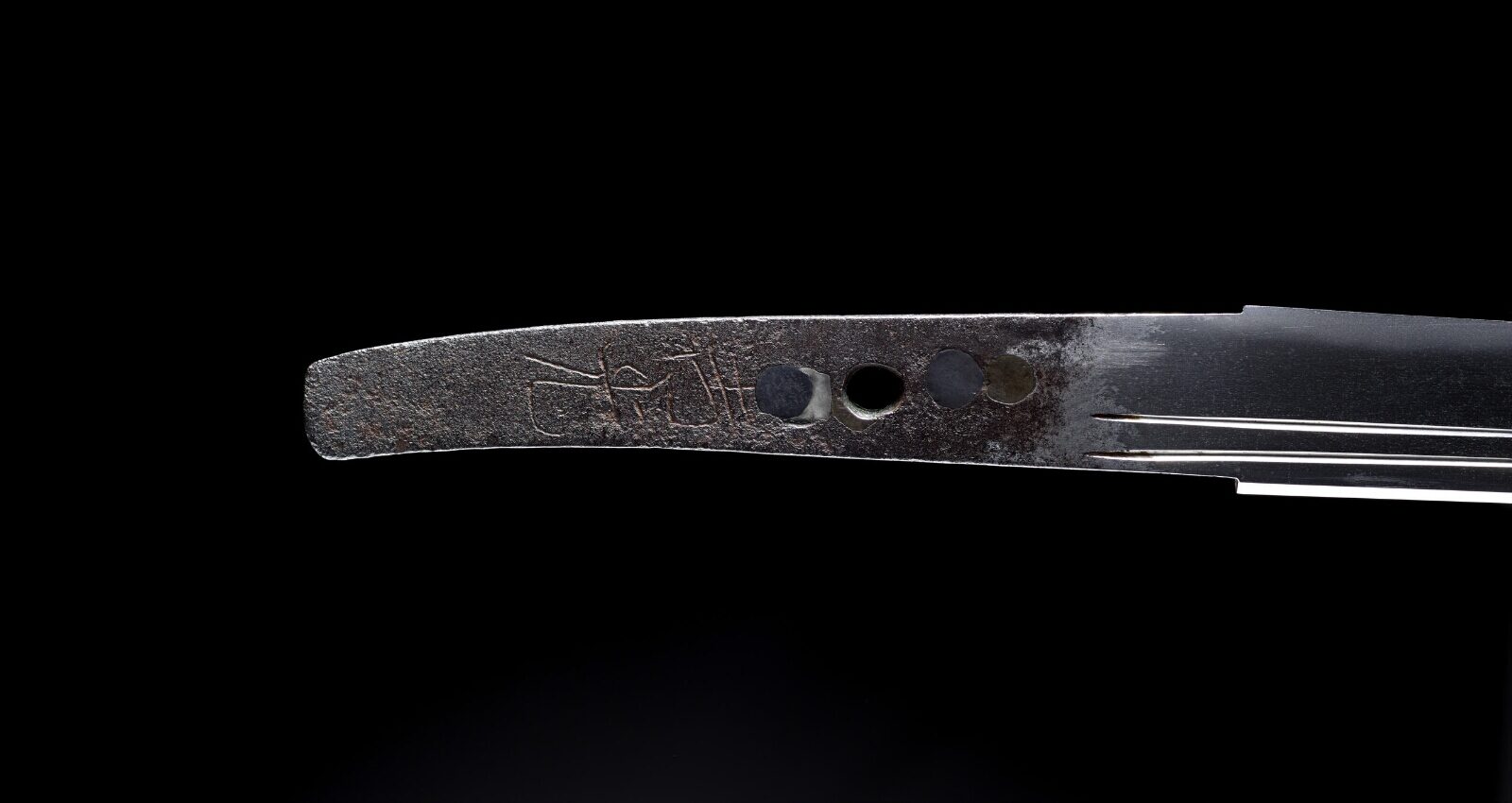
The nakago of the Akita Tōshirō, with the signature 吉光 (Yoshimitsu) and the start of the two hi. Kyoto National Museum, via e-Museum · ColBase terms of use · source
A small, delicate tantō
The e-Museum describes it thus: the smallest and most delicate of his tantō, uchizori, a furisode nakago, a temper in the “koshiba” style with ko-gunome above the habaki, a bonji kān and a ken engraved on the omote side and two hi (futasuji-hi) on the ura.