Documented works
| Work | Designation | Where it is |
|---|---|---|
| Tachi 山城国西陣住人埋忠明寿 (Yamashiro no kuni Nishijin jūnin Umetada Myōju), 1598 (Keichō 3) | Important Cultural Property (1950) | Kyoto National Museum (E甲187); formerly of the Sōma family |
| Brass tsuba with oak leaves, 柏樹文鐔 (hakujumon tsuba), signed; 8.1 by 8.0 cm | Important Cultural Property (1954) | Collection of a company |
| Tsuba with grapes and butterfly, 葡萄蝶文鐔 (budō chō mon tsuba) | Important Cultural Property according to the Japanese Wikipedia; not recorded under its name on Bunka Isan Online | Private collection |
| Tantō dated from 1607 to 1612 (Keichō 12 to 17), with the name of their owner | Not recorded | Private and company collections (list of the “Umetada” exhibition, 2020-2021) |
| Katana by Hizen Tadahiro of 1629 (Kan'ei 6), with a carving by Myōju | Important Art Object | Tokyo National Museum |
| Katana with his name as maker, from the Sakamoto Ryōma holdings | No designation | Kyoto National Museum, M甲159 (M-kō 159) |
| Two tsuba and a kozuka with his name | No designation | Tokyo National Museum, gift of Quincy A. Shaw |
| Iron tsuba with ginkgo leaf, plum blossom and chrysanthemum, and a sanshō branch on the reverse | No designation | Walters Art Museum, Baltimore (51.408) |
Three pieces
The tachi of 1598 was lost until Honma Junji found it in the collection of the Sōma viscounts, of the former Nakamura domain, in Mutsu, according to Markus Sesko. Today it is in the Kyoto National Museum, which probably regards it as his only authentic long blade, and it has been an Important Cultural Property since 29 August 1950.
The tsuba with oak leaves, of brass with inlays and small openwork, has been an Important Cultural Property since 20 March 1954.
The katana in the Kyoto National Museum came with the mementoes of Sakamoto Ryōma, donated by Sakamoto Yatarō, and its record gives Umetada Myōju as the maker. It is not recorded whether the blade is by his hand or only bears his carving, nor what connection he had with Ryōma.
The workshop and the famous swords
The 2020-2021 “Umetada” exhibition brought together, in the part devoted to the work of the house, famous swords from the Kyōhō meibutsuchō (享保名物帳) linked to the workshop, such as the Inaba-gō (稲葉江), the Kuwana-gō (桑名江) or the Wakasa Masamune (若狭正宗). What the workshop did to each of them, whether shortening it or inlaying its attribution, is not recorded in the sources consulted. The same exhibition showed for reference a katana by Gassan Sadakazu II of 1969 that copies a carving by Myōju.
In the lists
Myōju does not appear in the Yamada cutting list (懐宝剣尺, Kaihō Kenjaku, 1797); from his house, Umetada Shigeyoshi (埋忠重義) does appear among the wazamono, according to the English Wikipedia. The Japanese Wikipedia places him among the very best of shintō (新刀最上作, shintō saijō-saku).
Gallery

Tachi by Umetada Myōju dated 1598 (Keichō 3), Important Cultural Property. Kyoto National Museum. Kyoto National Museum, via ColBase · ColBase terms of use · source 
Katana with the name of Umetada Myōju as maker, from the Sakamoto Ryōma holdings. Kyoto National Museum. Kyoto National Museum, via ColBase · ColBase terms of use · source 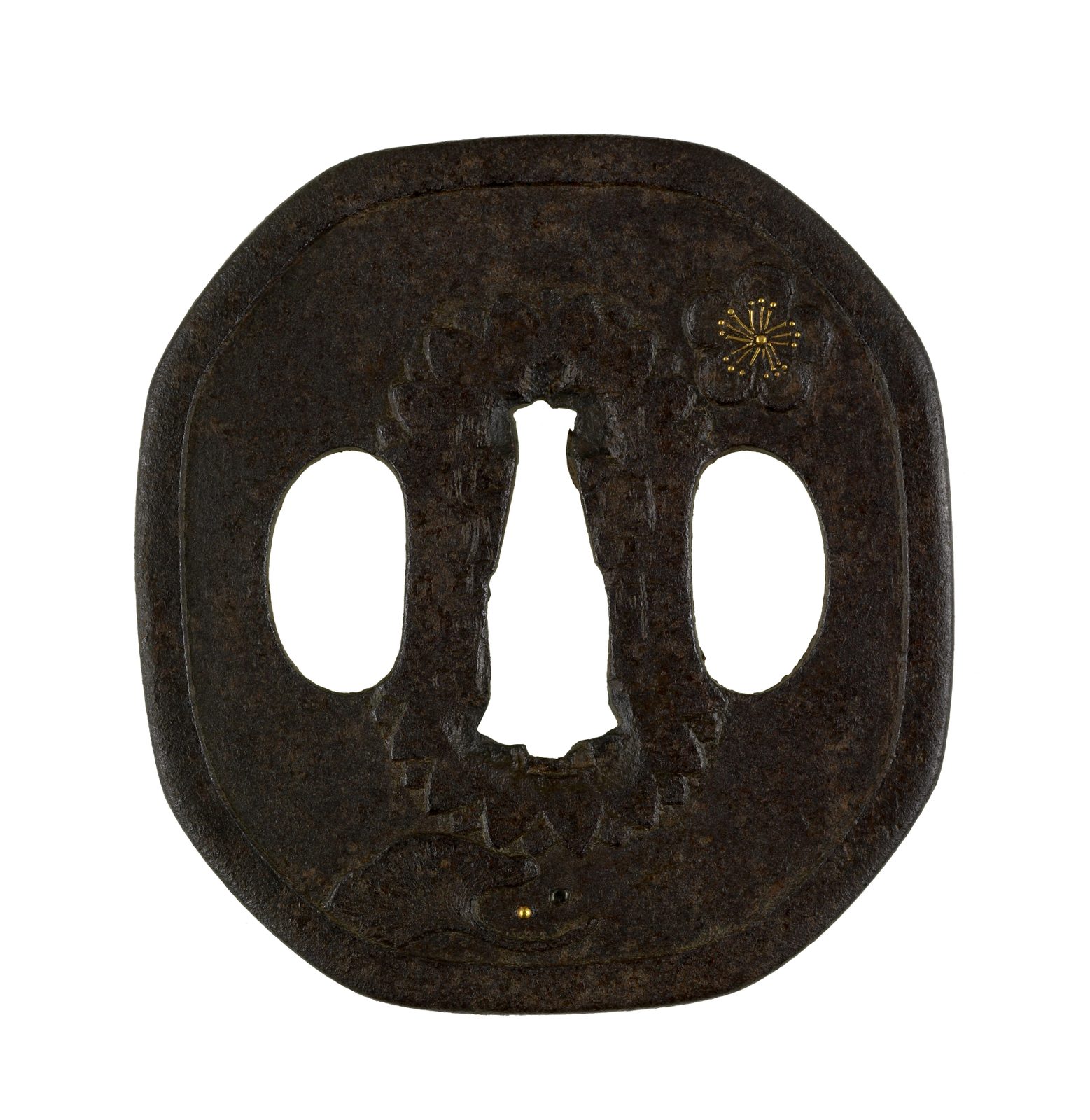
Iron tsuba with ginkgo leaf, plum blossom and chrysanthemum. Walters Art Museum, Baltimore. Walters Art Museum, public domain, via Wikimedia Commons · Public domain · source 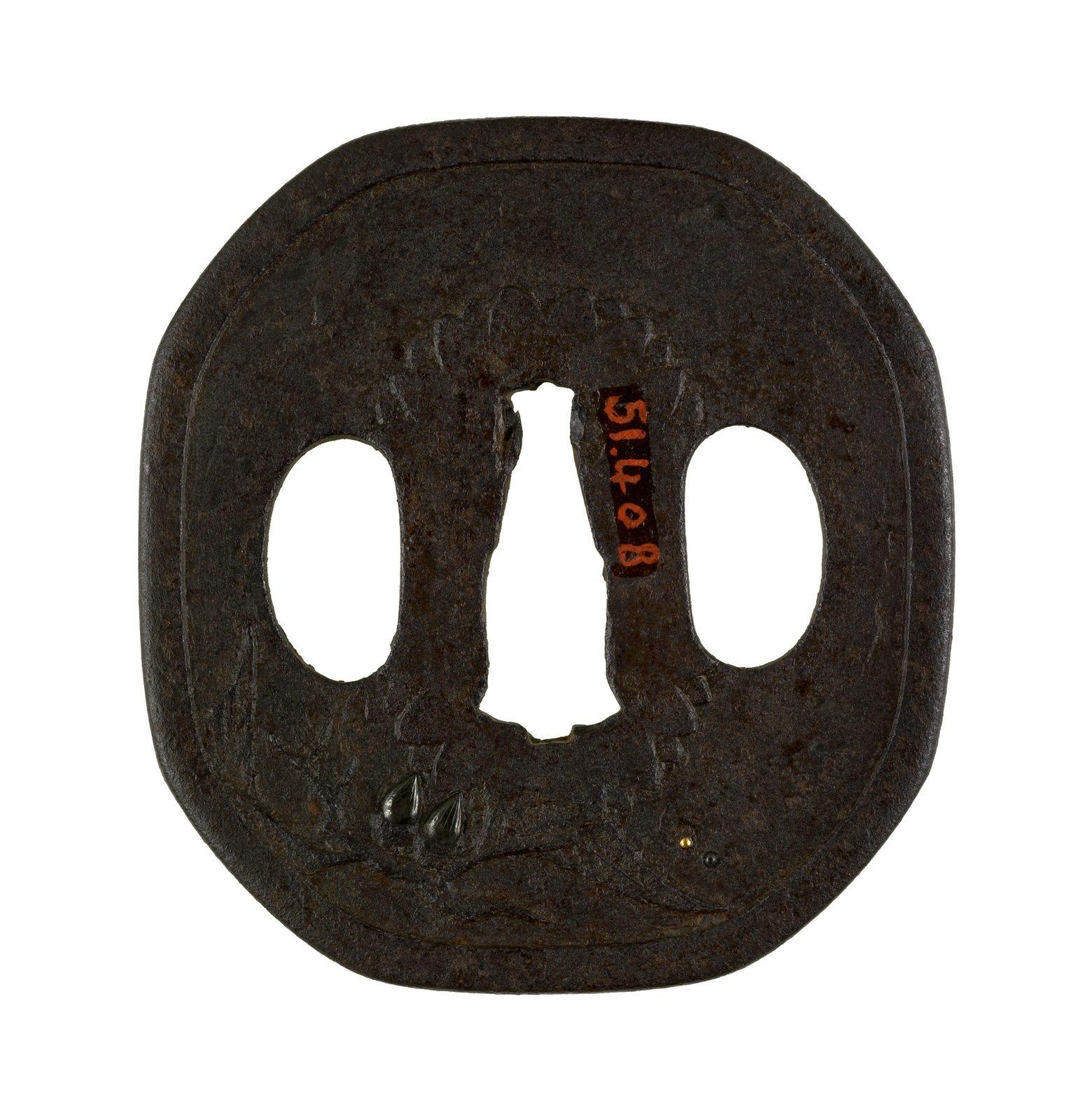
The reverse, with a sanshō branch. Walters Art Museum, public domain, via Wikimedia Commons · Public domain · source 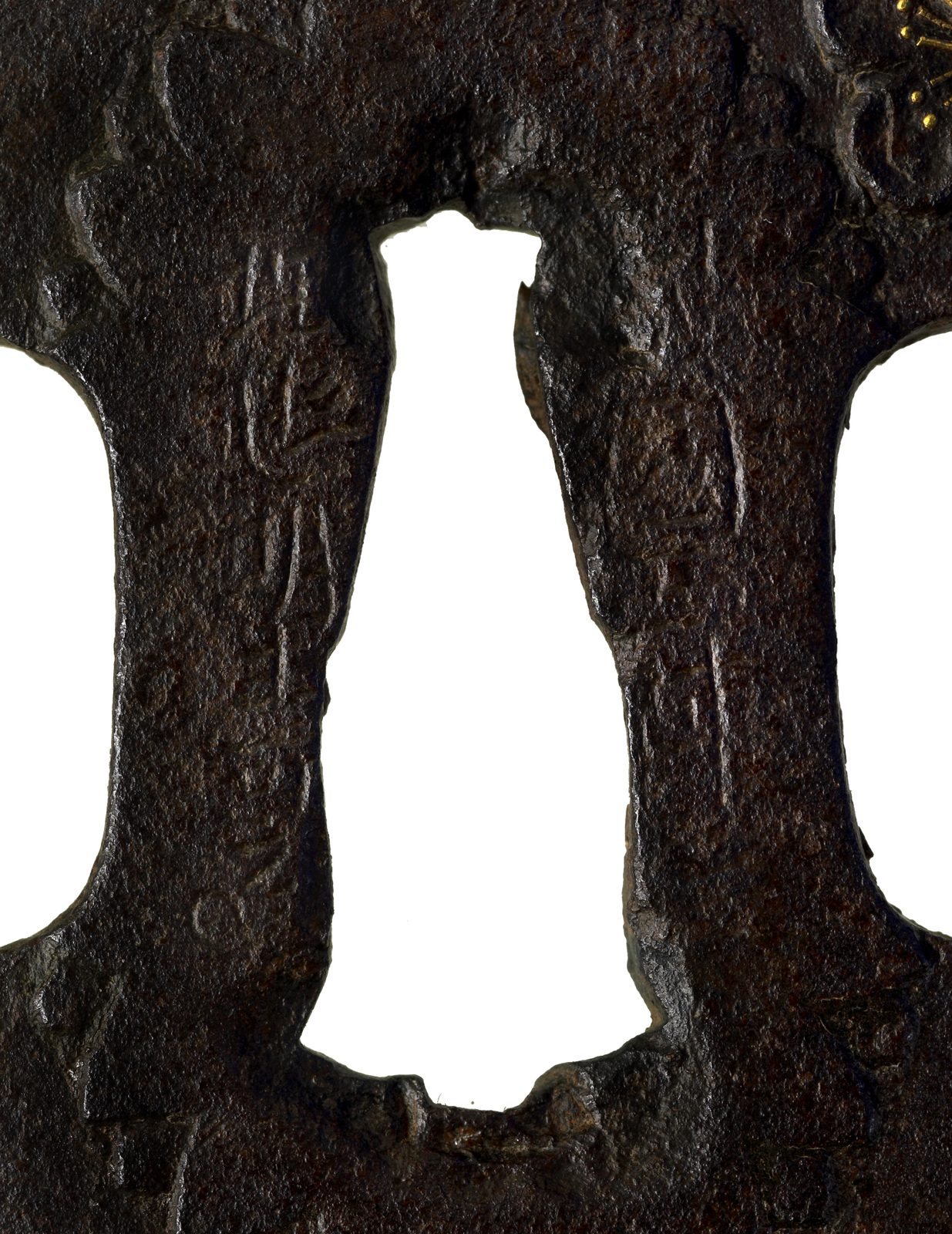
The signature of the tsuba, next to the central hole. Walters Art Museum, public domain, via Wikimedia Commons · Public domain · source


