His blades
The Japanese Wikipedia says that he forged very few blades, because he was above all a metalworker to the Ashikaga: among those that survive, tantō with sumptuous carvings of Fudō Myōō and the Kurikara dragon predominate, and of long blades only the tachi of the Sōma family is known. He tempers in suguha and in notare. The Sekai Daihyakka Jiten considers his tantō the best of his work, and says that he made most of his blades for his own family, as a pastime. None of the sources consulted gives a general rule for his jihada, his hamon or his bōshi by which to recognise his hand: there are only descriptions of particular pieces.
The tachi of 1598
The designation record, on Bunka Isan Online, describes it thus: shinogi-zukuri and iori-mune, shallow sori, elongated point and double machi; jihada of ko-itame with masame and nie; hamon of notare with midare, with a somewhat sunken nioiguchi and nie; in the bōshi, temper on one side and, on the other, midare-komi with a short turn-back. The blade measures 64.7 cm, with 1.4 cm of sori. The Kyoto National Museum adds that, from its shape, it looks at first sight like a heavily shortened blade, but that the carvings in relief within their recess (櫃, hitsu) prove that it is not.
Horimono
The tachi bears a bōhi on both sides and, at the base, a dragon on one side and a standing Fudō with a bonji on the other, in relief within their hitsu. The Sekai Daihyakka Jiten says that he introduced new motifs on the blade, such as the dragon chasing the pearl (玉追龍, tamaoi-ryū) and Fudō. He also carved others’ blades: the katana by Hizen Tadahiro of 1629 in the Tokyo National Museum bears a carving of his, signed at the age of 72.
Nakago and mei
The tachi bears on one side 山城国西陣住人埋忠明寿 (Yamashiro no kuni Nishijin jūnin Umetada Myōju) with his monogram (花押, kaō), and on the other the date 慶長三年八月日 (Keichō sannen hachigatsu hi) and the phrase 他江不可渡之 (ta e watasu bekarazu), “not to be given to others”. Its tang is unshortened (生ぶ, ubu), with a roof-shaped end (山形, yamagata) and two holes. The Kyoto National Museum says that he himself left that phrase to his descendants, as a work to his own taste. His tantō of 1607 to 1612 are signed the same way, with the date and, often, 所持 (shoji), “owned by”, before the name of their owner, according to the list of works of the 2020-2021 exhibition.
The tsuba
The Sekai Daihyakka Jiten places his true worth here: before him tsuba were made only of iron, and he used brass (真鍮, shinchū), shakudō and copper, and enhanced them with inlays of gold, silver, shakudō and copper, in line, flat or in nunome. The Nipponica speaks of bold designs in the Momoyama taste, such as grapes, loquats and pines with bamboo, and of iron openwork with gold; the Britannica, of flat coloured inlays (平象嵌, hira-zōgan). The English Wikipedia says the opposite: that no tsuba survives that can be attributed to him with certainty. Bunka Isan Online, on the other hand, records as an Important Cultural Property a tsuba signed with his name.
Details
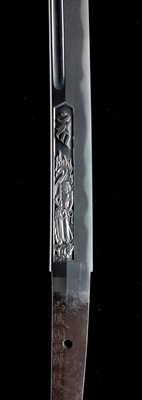
The Fudō in relief on the tachi of 1598. Kyoto National Museum, via ColBase · ColBase terms of use · source 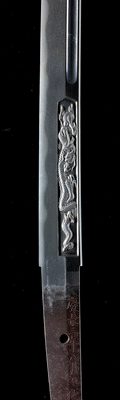
The dragon in relief on the other side. Kyoto National Museum, via ColBase · ColBase terms of use · source 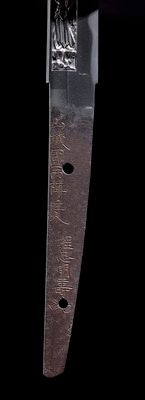
The signature of the tachi of 1598. Kyoto National Museum, via ColBase · ColBase terms of use · source 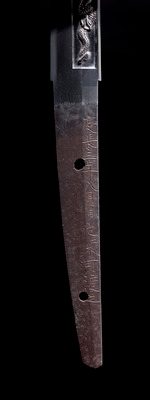
The date and the phrase 他江不可渡之 (ta e watasu bekarazu), on the other side of the tang. Kyoto National Museum, via ColBase · ColBase terms of use · source