The Hitotsuyanagi Yasuyoshi
- The 短刀 銘左安吉 (tantō, mei Sa Yasuyoshi), meibutsu 一柳安吉 (Hitotsuyanagi Yasuyoshi), is in the Tokyo National Museum, which gives it as an Important Cultural Property. It measures 32.0 cm, with a sori of 0.2 cm.
- It takes its name from 一柳直盛 (Hitotsuyanagi Naomori), a warlord of Mino of the late 16th and early 17th centuries who owned it. It later passed to the Maeda house of Kaga, and came to the museum as a donation from Watanabe Seiichirō.
- The museum regards it as a typical work of Yasuyoshi: a large tantō, with a wide blade and a short tang, in the fashion of the mid-14th century.
His designated blades
| Work | Designation | Where it is | Details |
|---|---|---|---|
| Tantō 左安吉 (Sa Yasuyoshi), meibutsu Hitotsuyanagi Yasuyoshi | Important Cultural Property (jūyō bunkazai) | Tokyo National Museum | 32.0 cm; from the Maeda of Kaga |
| Tantō 左安吉作 (Sa Yasuyoshi saku), dated Shōhei 12 (1357) | Important Cultural Property (designated on 3 May 1940 under the old law) | Inuyama Castle (Aichi) | 29.4 cm according to the Japanese Wikipedia; 29.1 according to the NBTHK catalogue; a sankoken inside the hi |
| Tantō 安吉 (Yasuyoshi), meibutsu 日置安吉 (Heki Yasuyoshi) | Important Cultural Property | Seikadō Bunko Art Museum (Tokyo) | 29.5 cm, sori 0.2 cm |
| Tantō 安吉 (Yasuyoshi), with a figurative engraving | Important Art Object (jūyō bijutsuhin) | Kyūshū National Museum (Dazaifu) | 30.6 cm, sori 0.3 cm; openwork gold habaki by 埋忠寿斎 (Umetada Jusai) |
| Tantō 長州住安吉 (Chōshū-jū Yasuyoshi), dated Shōhei 17 (1362) | Important Art Object | Fukuoka City Museum | 27.6 cm; the Nagato signature |
| Tantō 安吉 (Yasuyoshi) | NBTHK jūyō tōken | Sano Art Museum | 30.5 cm, sori 0.4 cm |
| Tantō 銘安吉 (mei Yasuyoshi) | Important Cultural Property (designated in 1949 under the old law) | Toyama Prefecture; whereabouts unknown today | — |
Lists and treatises
- Two of his tantō are meibutsu: the Hitotsuyanagi Yasuyoshi, which is in the 享保名物帳 (Kyōhō meibutsuchō), and the Heki Yasuyoshi, which the NBTHK’s 2019 catalogue also gives as a meibutsu.
- He does not appear in the wazamono list, the one of swordsmiths rated for their cutting, in the sources consulted.
- Samonji appears among Masamune’s ten pupils, the 正宗十哲 (Masamune jittetsu), a list that, according to the Japanese Wikipedia, was drawn up in the late Edo with swordsmiths who did not coincide in time. Yasuyoshi is not in it.
The Gankiri
Markus Sesko records one version of a hunting anecdote in which a wakizashi cut a wild goose and was therefore nicknamed 雁切り (Gankiri), “the goose cutter”. According to that version, the blade was by Yasuyoshi and became an heirloom of the 榊原 (Sakakibara) family. It has not been found in any official record, and its whereabouts today are unknown.
Gallery
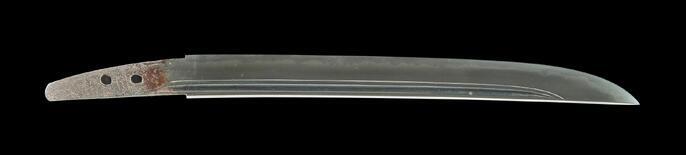
The Hitotsuyanagi Yasuyoshi tantō of the Tokyo National Museum, on one side. Tokyo National Museum, via ColBase · ColBase terms of use · source 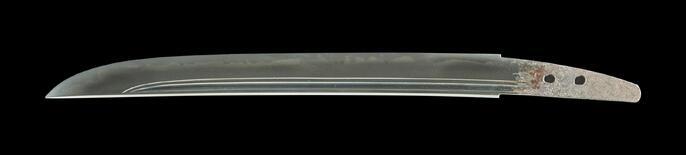
The Hitotsuyanagi Yasuyoshi, from the other side. Tokyo National Museum, via ColBase · ColBase terms of use · source 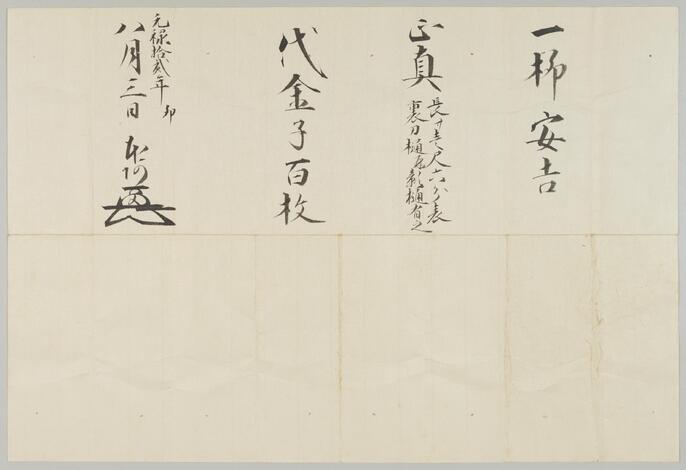
The origami (折紙, origami), the Hon'ami certificate, that accompanies the Hitotsuyanagi Yasuyoshi. Tokyo National Museum, via ColBase · ColBase terms of use · source 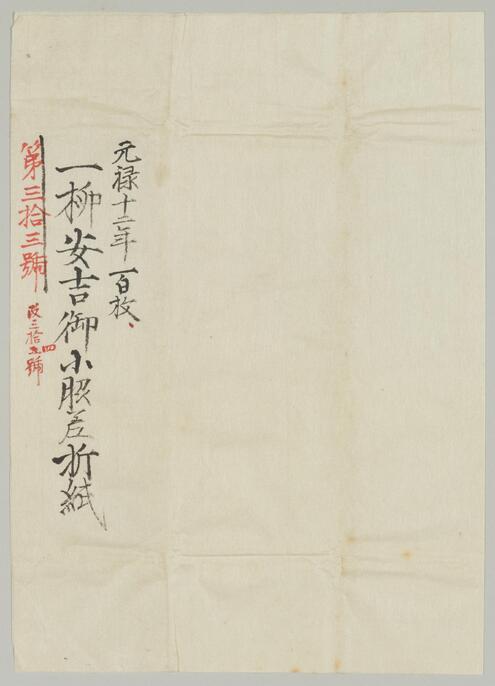
The cover of the origami of the Hitotsuyanagi Yasuyoshi. Tokyo National Museum, via ColBase · ColBase terms of use · source