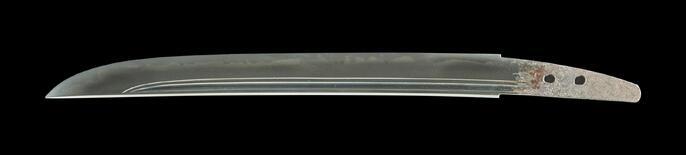
The Samonji school
- The Japanese Wikipedia, drawing on the treatise 往昔抄 (Ōjakushō), gives this genealogy of the school: 良西 (Ryōsai), its founder in the mid-Kamakura; 西蓮 (Sairen); 実阿 (Jitsua); 左 (Sa), that is, Samonji; and Sa Yasuyoshi.
- Samonji signed with a single character, 左 (sa), and the school takes its name from it. Yasuyoshi adds that character to his signature: 左安吉 (Sa Yasuyoshi).
Son or pupil?
- The Tokyo National Museum says that he “is regarded as the son” of Samonji; Kotobank, that he was his son or his pupil. The NBTHK calls him his son outright.
- The NBTHK notes that an old treatise said that Samonji, in old age, called himself Yasuyoshi, but that no work confirms it and that today Ō-Sa (大左, the great Sa) and Yasuyoshi are regarded as two different swordsmiths.
The dates
- There are two dated blades of his: a tantō of Shōhei 12 (1357), at Inuyama Castle, and another of Shōhei 17 (1362), at the Fukuoka City Museum.
- The Shōhei eras belong to the Southern Court. That is why the Tokyo National Museum thinks he worked within that court’s sphere of influence.
- The NBTHK places the core of his activity in the Enbun and Jōji eras (1356–1368), the height of the Nanbokuchō.
From Chikuzen to Nagato
- The tantō of 1362 bears the signature 長州住安吉 (Chōshū-jū Yasuyoshi), “Yasuyoshi, resident of Chōshū”, and the date 正平十七 八月日 (Shōhei jūshichi hachigatsu hi), August of Shōhei 17. Chōshū is Nagato. It is an Important Art Object and measures 27.6 cm.
- Kotobank specifies that he settled in Fuchū, in Nagato, and counts him among the representative swordsmiths of the Nanbokuchō.