On this page
Shape (姿, sugata)
- His blades almost always measure less than one shaku (about 30.3 cm); those of Hiromitsu, more. The NBTHK cites as exceptions a wakizashi of 1 shaku 7 sun (about 51.5 cm) in the Tokyo National Museum and a small tachi. The length of that tachi, “2 shaku 7 bu” in the English translation, has yet to be checked.
- The wakizashi of 1398: hira-zukuri, mitsu-mune, 31.35 cm long, 0.35 cm of curvature, 2.8 cm wide at the base and 0.5 cm thick.
- The unsigned katana attributed to him: 69.9 cm long and 2.25 cm of curvature.
Steel (地肌, jihada)
Itame with mokume, abundant ji-nie and chikei, on the wakizashi of 1398; on the tantō of 1376, itame with somewhat prominent mokume, ji-nie and chikei.
Temper (刃文, hamon)
- The style of Hiromitsu and Akihiro is hitatsura, with chōji with wide, round heads (団子丁子, dango-chōji), tobiyaki, yubashiri and deliberate muneyaki, without looking forced. For the NBTHK it was an innovation followed by the Sue-Sōshū of the Muromachi period and by swordsmiths of other provinces. Pronounced dango-chōji is seen more in Hiromitsu.
- The wakizashi of 1398: gunome with chōji and some ko-notare, in hitatsura, with yubashiri, tobiyaki and some muneyaki, kinsuji and sunagashi. The tantō of 1376: clear kinsuji and inazuma. The attributed katana: large gunome in hitatsura.
- His hitatsura is described as more vertical than that of Hiromitsu, with square gunome and togari-ba.
Point (帽子, bōshi)
On the wakizashi of 1398, a small midare-komi on one side and straight (sugu) on the other.
Engravings (彫物, horimono)
- Almost all his blades bear simple engravings (katana-hi, gomabashi, suken); those that bear none are very rare. Markus Sesko counts Hiromitsu and Akihiro among the post-Masamune Sōshū masters famous for their engravings, above all for their bonji.
- The tantō of 1376 bears on one side a sword (利剣, riken) on a lotus pedestal and on the other the bonji “kān” with two grooves (二筋樋, futasuji-hi), in the Sōshū tradition. The attributed katana bears bōhi on both sides.
Tang and signature (茎・銘, nakago and mei)
- The wakizashi of 1398: unshortened tang (生ぶ, ubu), kurijiri end, katte-sagari file marks and a five-character signature below the first hole.
- His tang is described as short, in tanagobara, with a kurijiri end and kiri file marks. The file marks do not match those of the wakizashi of 1398.
- In the genuine signature, the first stroke of the character 広 (hiro) is horizontal; in that of Hiromitsu, vertical.
The 1376 tantō
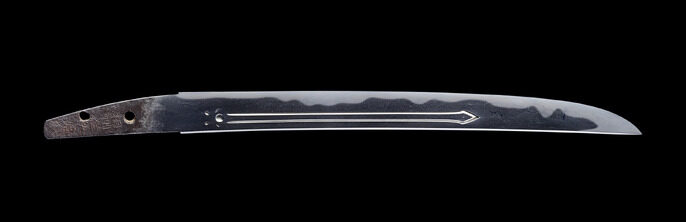
The 1376 tantō (Eiwa 2), on the side with the engraved sword. Kyoto National Museum, via ColBase · ColBase terms of use · source 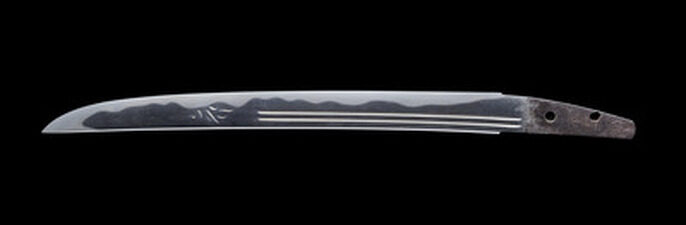
The other side: the bonji and the two grooves (二筋樋, futasuji-hi). Kyoto National Museum, via ColBase · ColBase terms of use · source 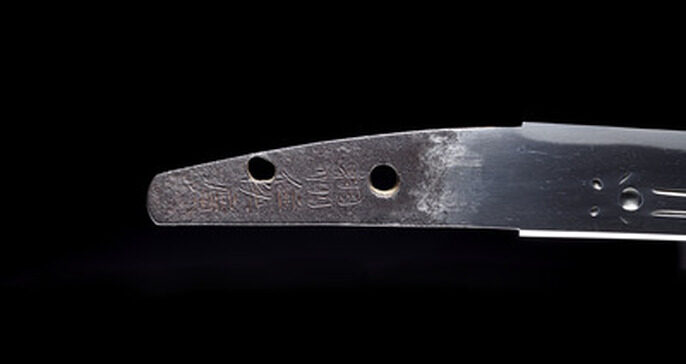
The tang, with the signature 相州住秋広 (Sōshū-jū Akihiro). Kyoto National Museum, via ColBase · ColBase terms of use · source 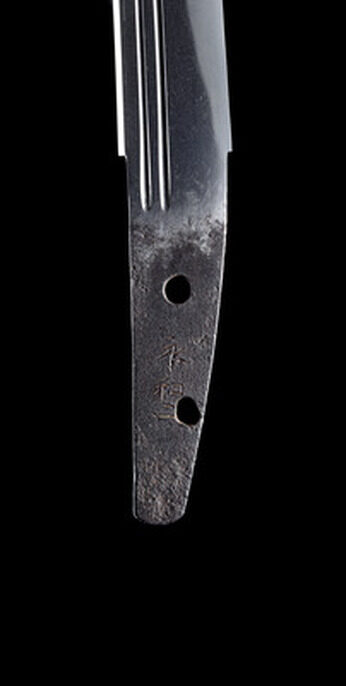
The other side of the tang, with the date 永和二 (Eiwa ni): 1376. Kyoto National Museum, via ColBase · ColBase terms of use · source