In the Sagami forge
- The Kyoto National Museum presents him as one of the legitimate heirs of the Sagami forge, which began with 国光 (Kunimitsu) and continued with Masamune and Sadamune; with Hiromitsu, he represents the Sōshū forge of the Nanbokuchō period.
- The Heibonsha encyclopaedia gives Hiromitsu and Akihiro as the representatives of Sagami in the Nanbokuchō, and says that they created the 皆焼 (hitatsura) temper. The NBTHK credits Hiromitsu with establishing that style.
- The Japanese Wikipedia places him in the Sōshū tradition of Sagami, alongside Sadamune and Hiromitsu. He has no article of his own in the Japanese or the English Wikipedia.
What his dates tell
- Unlike the earlier Sagami swordsmiths, he dates many of his blades. For the Kyoto National Museum, the dated ones run from Enbun 2 (1357) to Meitoku 3 (1392): thirty-five years of work. For the NBTHK, from Enbun 2 (1357) to Shitoku 4 (1387).
- Those of Hiromitsu run from Kan'ō (1350–1351) to Jōji 3 (1364); from this the NBTHK deduces that Akihiro was somewhat younger. For years he was held to be earlier than Hiromitsu, until the dates of the blades showed him to be somewhat later and his contemporary.
- The NBTHK’s wakizashi bears the date Ōei 5 (1398), beyond the limit of 1387 that the NBTHK itself gives; its commentary does not explain it.
Signature
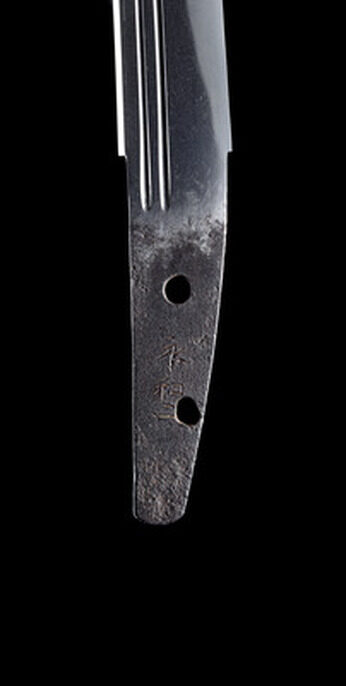
- Before Enbun 2 (1357) he signed, like Hiromitsu, 相模国住人 (Sagami no kuni jūnin, “resident of the province of Sagami”) before his name; the rest of his work bears 相州住秋広 (Sōshū-jū Akihiro).
- On the first dated blades, of the Enbun and Jōji eras, he gives year, month and day. In Ōan 2 and 3 (1369–1370) he alternates that form with another without month or day, and from Ōan 5 (1372) he writes only the era and the year, as in 永和二 (Eiwa ni), 1376.
One generation or two?
Some sources speak of a second Akihiro in the Eiwa era (1375–1379), and a blade with his signature would say it was made in Mariyatsu, in Kazusa, although the same description later says Kōzuke. No academic source deals with the generations of Akihiro, and the date of 1398 has not been explained either.