The apprenticeship
He was born in 1976 in Gifu prefecture. He began forging iron at thirteen, as a hobby, and at twenty, in 1997, he became an apprentice of the twenty-fifth Fujiwara Kanefusa (藤原兼房, Fujiwara Kanefusa), under whom he trained for six years.
He keeps a saying of his master’s, which he quoted in 2020 to the magazine Discover Japan: 「刀は天下泰平を想って打て」 (Katana wa tenka taihei o omotte ute), “forge the sword thinking of peace in the world”. He also tells that, on seeing a sword of his, his master told him it was very good, “perhaps better than mine”.
His own forge
He became independent in 2004 in Seki, in Gifu, and in 2006 he moved the forge to Hashima, in the same prefecture. In 2024 he incorporated it as a company.
In the 2020 interview he tells that, on becoming independent, he thought himself a tengu (天狗, tengu), a conceited man, and that without a master to approve his work he lost his confidence. He spent some five years studying books and references, as a “collector of information”, until he decided to forget it all and look for a style of his own, different from his master’s.
In 2015 he also began making forged knives, and in 2017 he enlarged the forge. In 2020 he said he received some five hundred foreign visitors a year.
Outside Japan
In 2005 he gave a six-day seminar on Japanese forging in Canada, from 27 June to 2 July, with translation by Sébastien Cyr; the Iaido Journal already presented him as Fusatarō, of Seki.
Since 2012 he has given demonstrations and workshops in France (2012, and in 2014 three months at the Citadelle de Besançon), in Canada (2013, 2015 and 2016, at NAIT), in the United States (2013, at the University of Minnesota, and 2016, in Oregon) and in Switzerland (2018, with the “YUGO” project, at the Espace Horloger museum). He says he has trained more than a hundred people outside Japan. In 2020 he gave a forging workshop at the Metal Museum in Memphis, from 28 February to 1 March.
He explains why this way: with the strong yen, Chinese imitations of the Japanese sword were circulating outside Japan, and he wanted to show what the real one is like.
In Japan
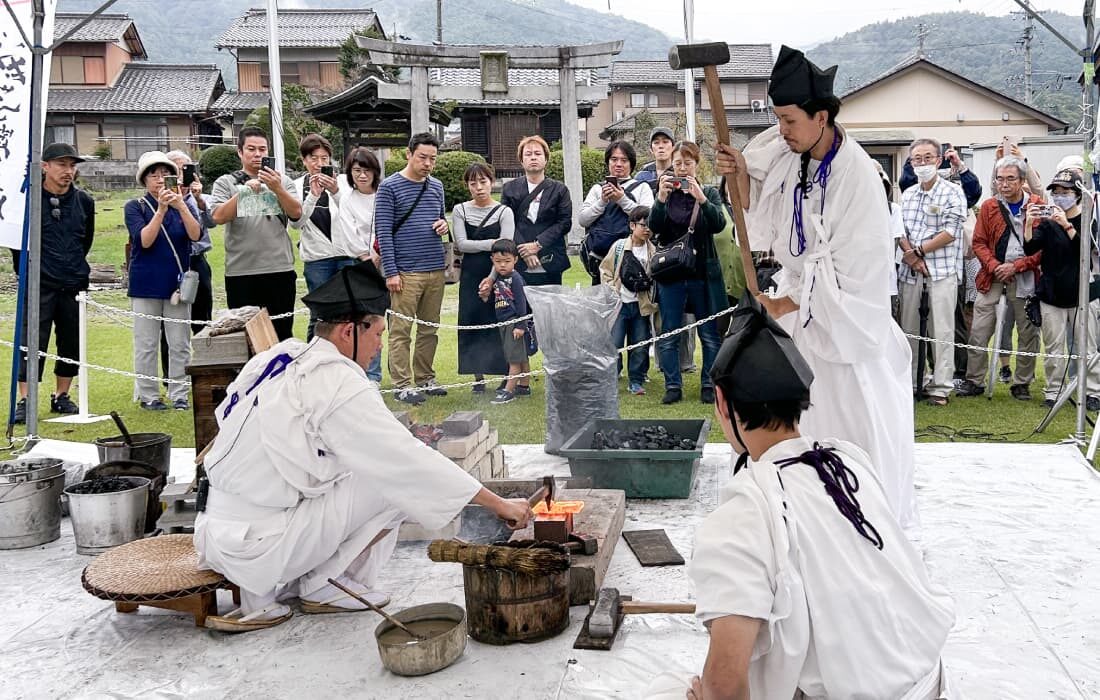
In 2021 he performed a votive forging (奉納鍛錬, hōnō tanren) at the Paralympic flame ceremony in Hashima. In 2022 a tachi of his was shown in the exhibition “Ukiyo-e journey and the gleam of swords”, in Hashima, open until 16 October.
Demonstrations and talks
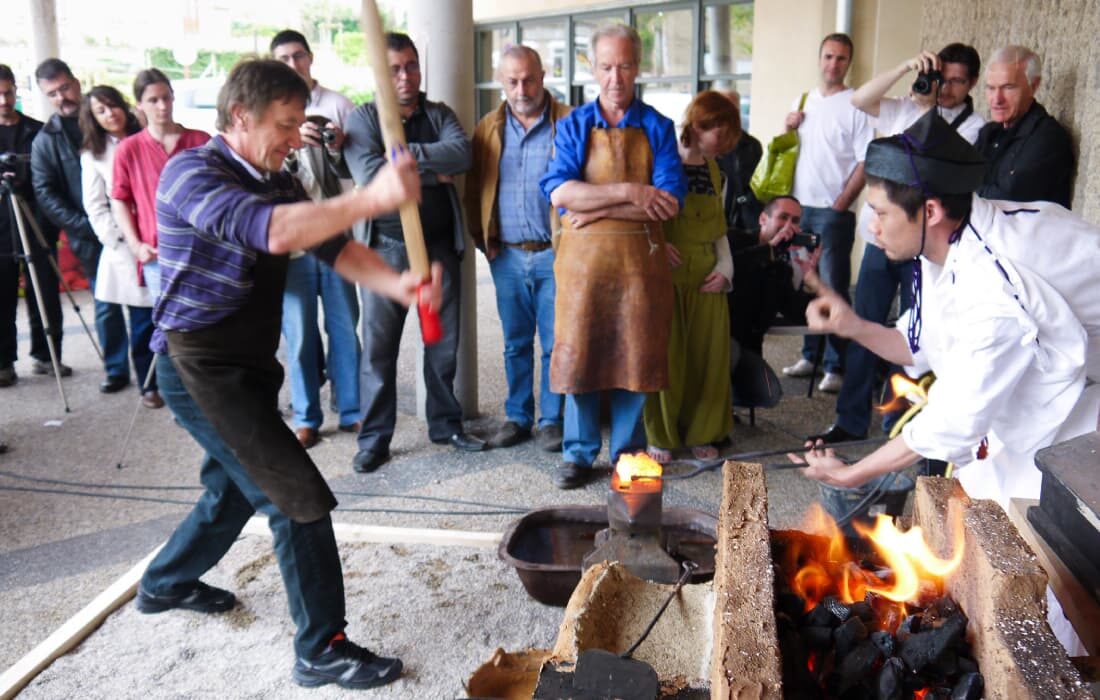
A public forging in France, with a local smith on the sledgehammer; Fusatarō, on the right, in eboshi (烏帽子, eboshi). Photo: the smith himself 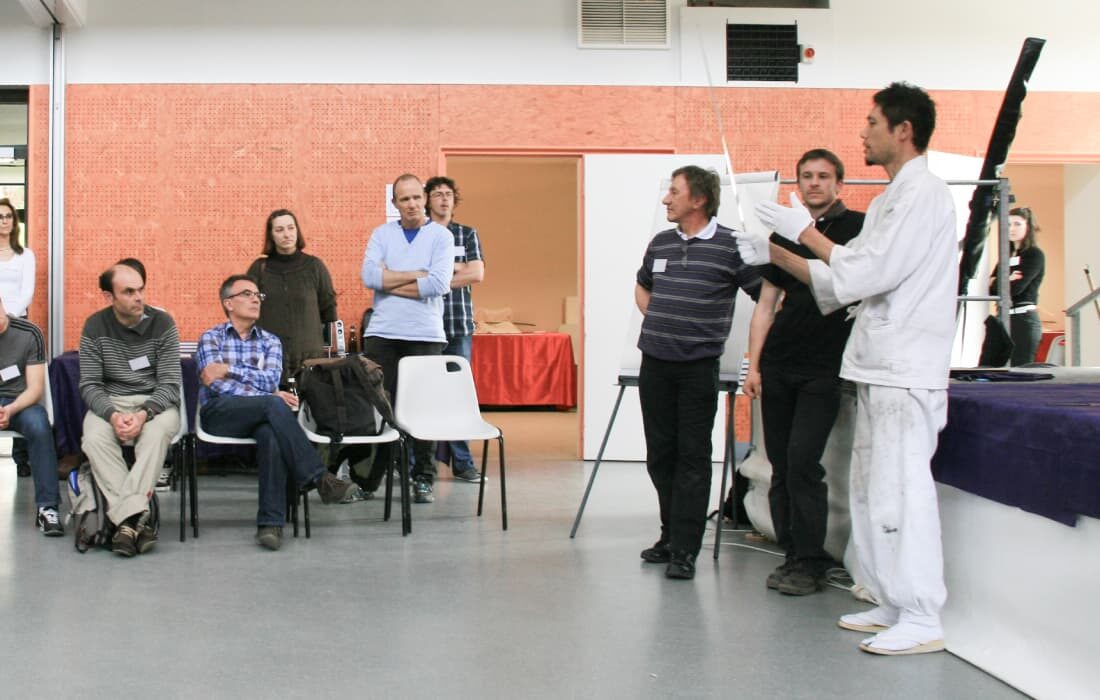
A talk before an audience in a hall. Photo: the smith himself