Jihada
The NBTHK describes the Seki school with ko-itame mixed with itame and nagare-hada, and sees in Owari a relatively white steel and thick blades in the Keichō era. The sources consulted contain no description of Nobutaka’s own jihada.
Hamon
For the NBTHK, Masatsune’s hamon starts “from Nobutaka’s gunome and Ujifusa’s notare”: Nobutaka’s trait is the gunome. Markus Sesko gives him as an example of shintō with ō-notare (大湾れ, ō-notare) and with yahazu-ba (矢筈刃, yahazu-ba), the hardening shaped like an arrow nock, alongside Kanewaka and Teruhiro.
Nakago and mei
The signatures recorded by the museums are 伯耆守藤原信高 (Hōki no Kami Fujiwara Nobutaka), sometimes with 朝臣 (Ason), and those of the retired second generation, 前伯州信高入道 (saki no Hakushū Nobutaka nyūdō), with the age and the date. A katana by the third generation, of 1665, also bears the inscription 河村三之丞 (Kawamura Sannojō).
In the photograph of the blade in the Kyūshū National Museum, 伯耆守藤原信高 (Hōki no Kami Fujiwara Nobutaka) can be read on the tang; the ColBase record registers it as 藤原信高 (Fujiwara Nobutaka). None of the sources consulted describes the shape of the tang or of its file marks.
How to tell the generations apart
The signature is almost the only clue: the age and the 入道 (nyūdō) of the retired second generation, and the civil name of the third. Without them, a signature 伯耆守藤原信高 (Hōki no Kami Fujiwara Nobutaka) can belong to any of the generations.
Details
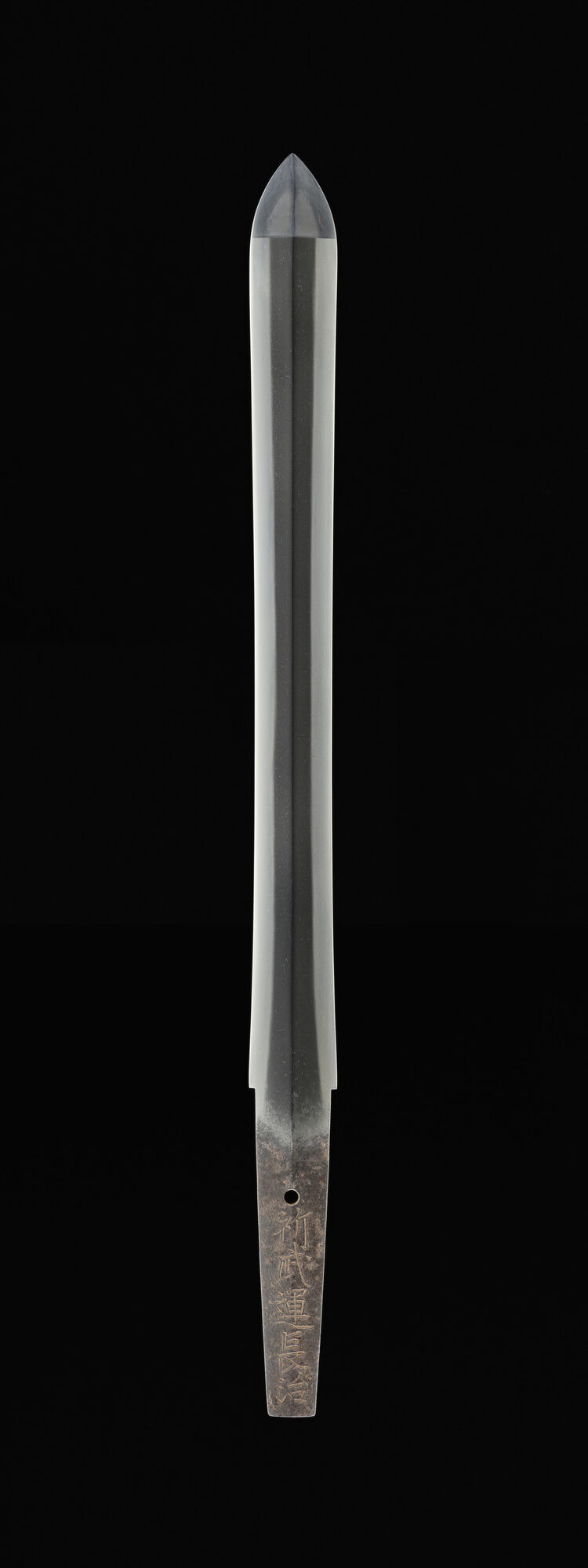
The other side of the tang, with the inscription 祈武運長治 (buun chōji o inoru), a prayer for fortune in arms. Kyūshū National Museum, via ColBase · ColBase terms of use · source