Sugata
The 1842 katana studied by the NBTHK measures a little under 2 shaku 5 sun 5 bu, about 77 cm, in shinogi-zukuri with iori-mune and 8.5 bu (about 2.6 cm) of curvature: wide and heavy, with a narrow shinogi-ji, a large difference in width between the base and the point, a low curve (腰反り, koshizori) and a medium point. The NBTHK says that his shapes usually aim to be those of an old tachi, with a deep curve.
Jihada
Tight itame, with abundant ji-nie and fine chikei, on the 1842 katana.
Hamon
Chōji midare in the Bizen manner, with some square-headed chōji and pointed tips (尖り, togari), many ashi, ko-nie, sunagashi and a bright nioiguchi. Seen up close, the chōji are so close together that they form clusters (重花, jūka); their heads face in different directions and open out like a fan, and some ashi cross. These are, for the NBTHK, the features characteristic of Masayoshi, and another issue of the Sword Journal adds that his temper is soft at the base of the blade.
Bōshi
Midare-komi with a rounded turn-back (小丸, komaru) on the 1842 katana.
Nakago and mei
The signature 作陽幕下士細川正義 (Sakuyō bakka-shi Hosokawa Masayoshi) often comes with a stamped seal (刻印, kokuin) beneath it, as in the Tochigi lists and on the tantō in the photo; Masamori uses it too.
Who he is confused with
In the NBTHK kantei exercise, votes also went to other shinshintō swordsmiths working in the Bizen style. Koyama Munetsugu gives a chōji that repeats a very regular pattern every 3 or 4 sun; Taikei Naotane, a marked reflection (映り, utsuri), square gunome with togari-ba and features slanting backwards, and Unju Korekazu groups his chōji with much nie. Against Naotane’s slanting gunome midare, Masayoshi’s chōji opens out like a fan.
Details
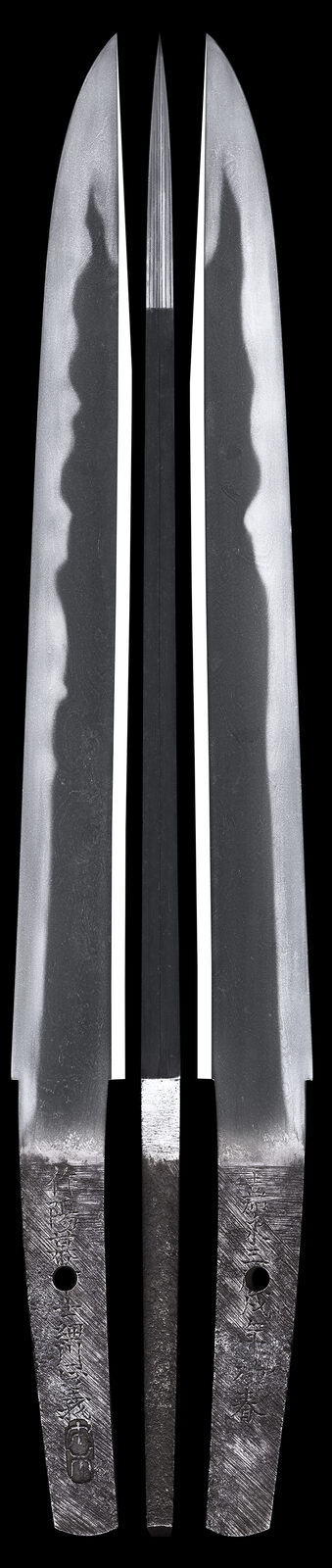
Masayoshi’s tantō, from both sides. Photo: dealer in Japan 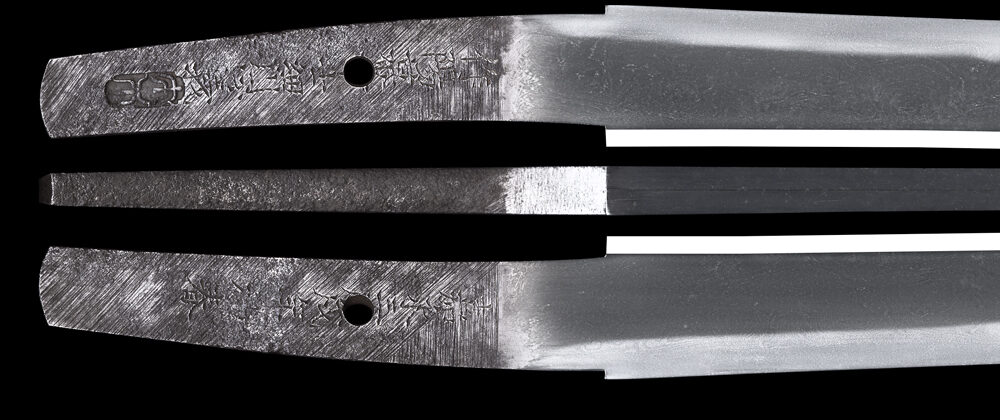
The tang of the tantō: the signature with the seal and, on the other side, the date. Photo: dealer in Japan 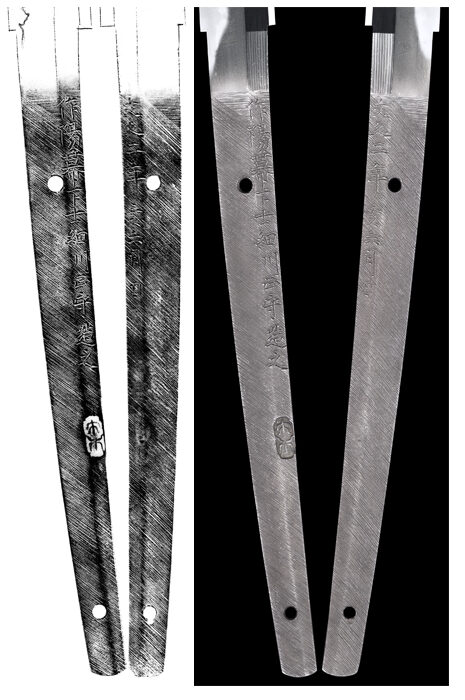
The tang of a katana by Masamori: 作陽幕下士細川正守造之 (Sakuyō bakka-shi Hosokawa Masamori kore o tsukuru), with the seal. Photo: dealer in Japan