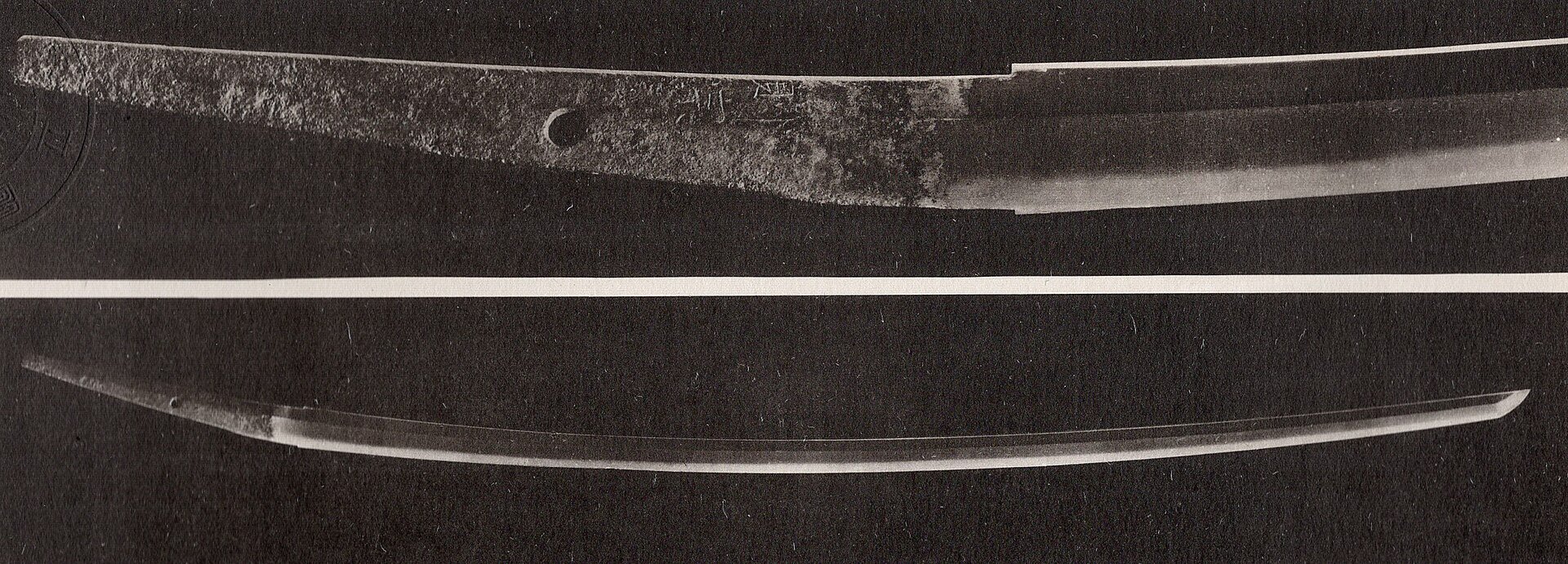
Fukuoka, in Bizen
- Kotobank places him between the end of the Heian and the beginning of the Kamakura, in the Fukuoka district of Bizen province, and gives no dates for his life.
- The school was born in Fukuoka, today’s Osafune in Setouchi (Okayama), on the banks of the Yoshii river, and takes its name from the “一” (ichi, one) that its smiths chiselled on the nakago. Tradition makes Norimune its founder; the Japanese Wikipedia calls him “Norimune of the Ko-Bizen school” and records that some class him separately, as Ko-Ichimonji.
- Kotobank gives Norimune, Go-Toba’s rotating smith, as the founder of the school, and names its smiths: in the early period, 助宗 (Sukemune), 安則 (Yasunori), 成宗 (Narimune), 尚宗 (Naomune) and 宗吉 (Muneyoshi); in the mid-Kamakura, 吉房 (Yoshifusa), 則房 (Norifusa) and 助真 (Sukezane). The same dictionary, in its entry on Sukemune, makes Sukemune his son.
Go-Toba’s rotating smiths
- He is said to have been the first of the rotating smiths, 御番鍛冶 (goban-kaji), of the retired emperor Go-Toba. In the list of 1208, with one smith per month, Norimune holds the first month and Sukemune the ninth; most of them were from Fukuoka.
- The blades that Go-Toba had forged and hardened himself were called Kiku-ichimonji, Gosho-yaki or Kiku no on-saku, and that is why Norimune, head of the rotating smiths, is called Kiku-ichimonji Norimune.
- But no work of his bears a chrysanthemum, and no Kamakura blade survives with the chrysanthemum and the “ichi” together.
The modern legend
A novel by Shiba Ryōtarō led many Shinsengumi enthusiasts to believe that Okita Sōji carried a “Kiku-ichimonji Norimune”. The English Wikipedia points out that, according to history, Okita used a blade by Kiyomitsu of Kaga.