Osafune and its lineage
The Osafune school (長船派, Osafune-ha), in Bizen, is the largest in the history of the Japanese sword. It arises around Mitsutada (光忠, Mitsutada), of the Ko-Bizen line, and his son Nagamitsu, whose first firm date is Bun'ei 11 (1274); from Kagemitsu and his son Kanemitsu comes the main line and, later, Tomomitsu, Masamitsu and Motomitsu.
A biographical dictionary makes him the son of Nagamitsu, father of Kanemitsu and head of the school, active around the Genkō era (1321-1324); his dated blades run from Kagen 4 (1306) to Kenmu 1 (1334). In the signature of the tachi he made with Kagemasa he styles himself 左兵衛尉 (Sahyōe-no-jō). Neither the year of his birth nor that of his death is known.
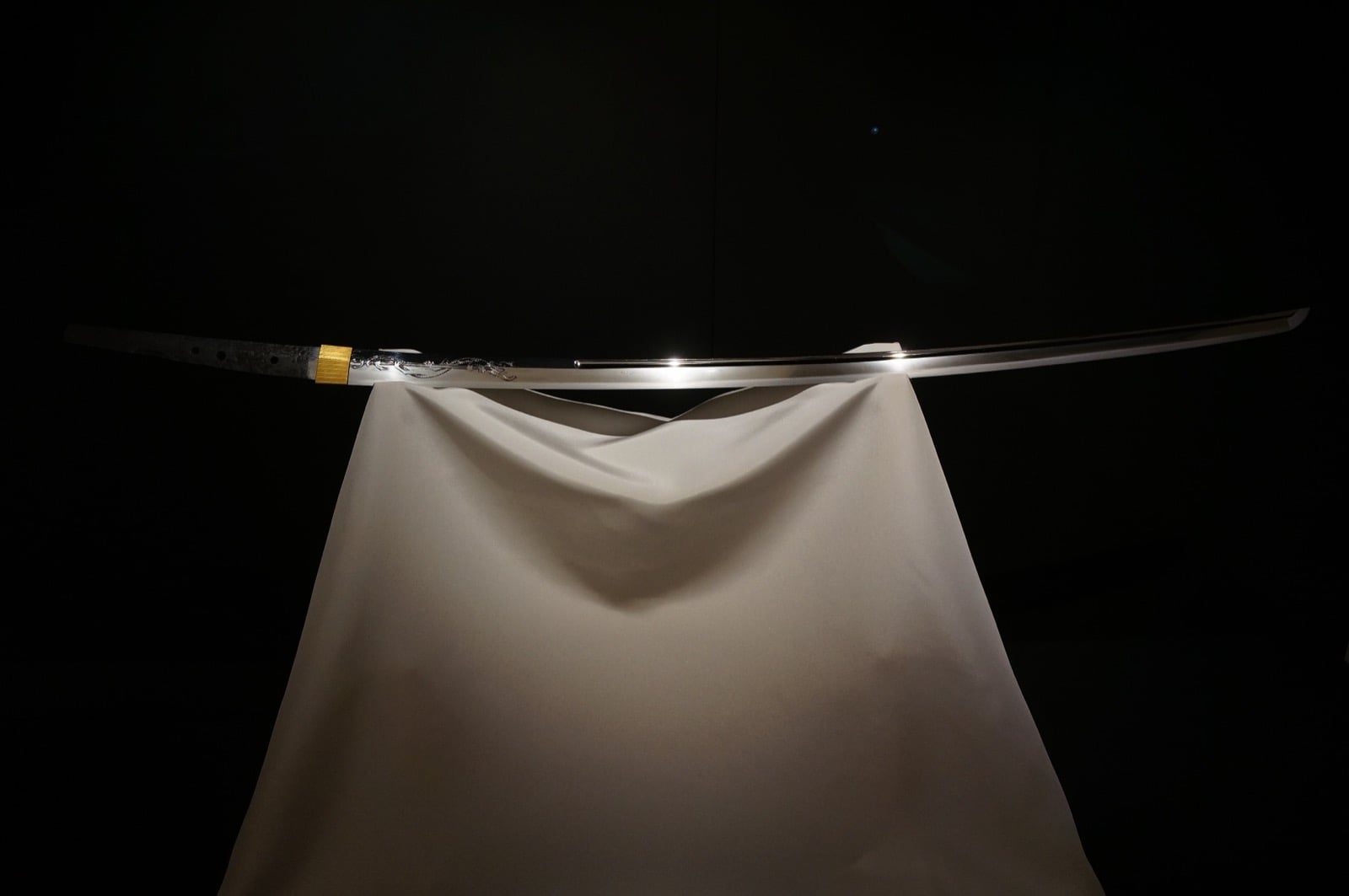

Kagemitsu and Kagemasa
In 1329 he signed a tachi jointly with 景政 (Kagemasa), who in the signature adds 進士三郎 (Shinji Saburō); the official database of cultural properties says that Kagemasa “seems to be of his lineage”. No document establishes what they were to each other: Japanese Wikipedia presents him as a pupil or relative in the article on Kagemitsu, and as a brother in the one on the Kenshin Kagemitsu.
Swords for warriors from other provinces
The inscription on the tachi of 1329 says that it was commissioned and offered by Ōkawara Tanji Tokimoto (大河原時基, Ōkawara Tokimoto); the official database of cultural properties regards it as good evidence of the relationship between the warriors of the Kantō and the smiths of Osafune. According to Japanese Wikipedia, Tokimoto, a native of Chichibu, in Musashi, and lord of Sanpō-nishi, in Harima, brought Kagemitsu and Kagemasa from Osafune to forge that tachi and offer it to the Hiromine shrine, in Himeji.
His swords went on serving as offerings: in 1568, before invading Suruga, Takeda Shingen offered a tachi of his to the Fujisan Hongū Sengen Taisha shrine; it is now an Important Cultural Property.