Sugata
According to Toryu-Mon, bold-looking, wide and with a thick kasane; large, not very elegant blades which, with everything else, are not mistaken for an old Yamato-den.
Jihada
Very pronounced masame-hada.
Hamon
Suguha in nie, or suguha with a gentle notare, with long sunagashi and a double temper line (二重刃, nijūba); sometimes loose spots of temper (玉焼, tama-yaki), temper on the back (棟焼, muneyaki) and sunagashi in lines.
Nakago and mei
The tang is very long and the signatures long. Toryu-Mon records 常陸国水戸住徳勝 (Hitachi no Kuni Mito-jū Norikatsu); the usual one, 水府住勝村徳勝作之 (Suifu-jū Katsumura Norikatsu kore o saku); 水府臣徳勝 (Suifu shin Norikatsu); 水府住人源徳勝作之 (Suifu jūnin Minamoto no Norikatsu kore o saku); 於江府水城士勝村彦六徳勝鍛之 (Kōfu ni oite Suijō-shi Katsumura Hikoroku Norikatsu kore o kitau); 於小石川館勝村徳勝以水国砂鉄作之 (Koishikawa-kan ni oite Katsumura Norikatsu Suikoku satetsu o motte kore o saku), with iron sand from Mito, and a blade forged for the fencing master Sakakibara Kenkichi.
Who he is confused with
For Toryu-Mon, faced with a shinshintō Yamato-den there are only three names to consider: Nanki Shigekuni in his last years, Sendai Kunikane in his last years and Norikatsu.
The two generations
The sources consulted give no features that separate the work of the second Norikatsu from that of the first; his blades are rare.
Details
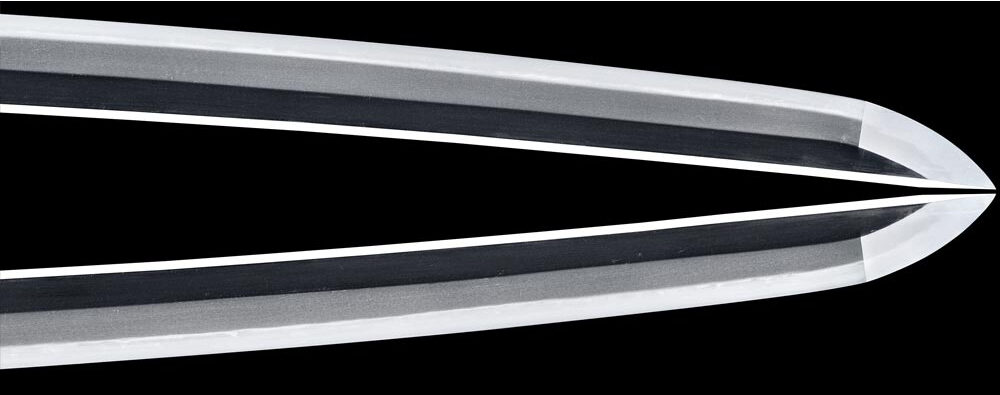
The point of the katana, from both sides: the narrow suguha. Photo: dealer in Japan 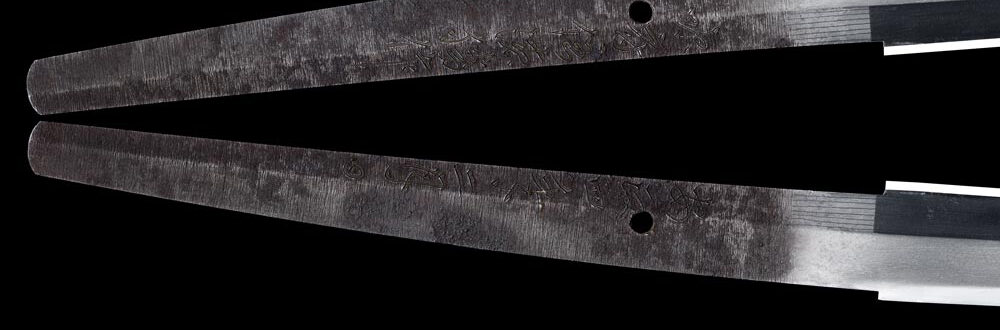
The long tang of the katana, from both sides. Photo: dealer in Japan