Sugata
The 1876 katana studied by the NBTHK is shinogi-zukuri and iori-mune, 2 shaku 7 sun long (about 81.8 cm) with 6 bu of sori (about 1.8 cm): rather broad, with little difference between base and point, a large kissaki, thick and heavy and with scant fukura, the shinshintō shape. Sesko counts him among the late Edo smiths who made shapes inspired by the Nanbokuchō, and among those who revived the broad tantō of the Enbun and Jōji eras (1356-1368); like Kiyomaro, he makes points with little fukura.
Jihada
On that katana, a somewhat visible itame with much ji-nie and chikei; within the temper masame shows.
Hamon
A high temper of gunome-chōji, ō-gunome and gunome in midare, with sections of square gunome. Their heads are split by ko-gunome and small togariba, forming a double figure (複式, fukushiki): for the NBTHK, his most personal feature. It has thick, long ashi that reach almost to the edge, yō, marked shimaba, ko-nie, long kinsuji and fine sunagashi, with a somewhat dense, bright nioiguchi: a pronounced Sōshū-den. This is how the NBTHK separates him from Taikei Naotane, whose kataochi-gunome has utsuri, and from Hosokawa Masayoshi, with his fan-shaped jūka-chōji and crossing ashi: neither has those long, continuous kinsuji.
Bōshi
On the 1876 katana, midare-komi: almost square on the omote and pointed on the ura, with a long turn-back on both sides.
Nakago and mei
He signed 信秀 (Nobuhide) with the place, as in 於浦賀信秀 (Uraga ni oite Nobuhide) in 1853; with his civil name, 栗原謙司信秀 (Kurihara Kenji Nobuhide); and with the title, 筑前守信秀 (Chikuzen no Kami Nobuhide) or 栗原筑前守平朝臣信秀 (Kurihara Chikuzen no Kami Taira no Ason Nobuhide). The sources consulted do not describe his tangs or his file marks.
Horimono
According to Sesko, dragons are typical of his blades, and the one chasing a jewel (玉追龍, tamaoi-ryū) is seen on them relatively often, as in the Gassan school. The 1855 katana in the photos has a dragon on one side and a sword on the other.
Kantei keys
- Broad, thick and heavy shape, with a large kissaki and scant fukura.
- Square gunome with heads split by ko-gunome and togariba, and long ashi almost to the edge.
- Long, continuous kinsuji and masame within the temper.
- Engraved dragons, often chasing a jewel.
Details
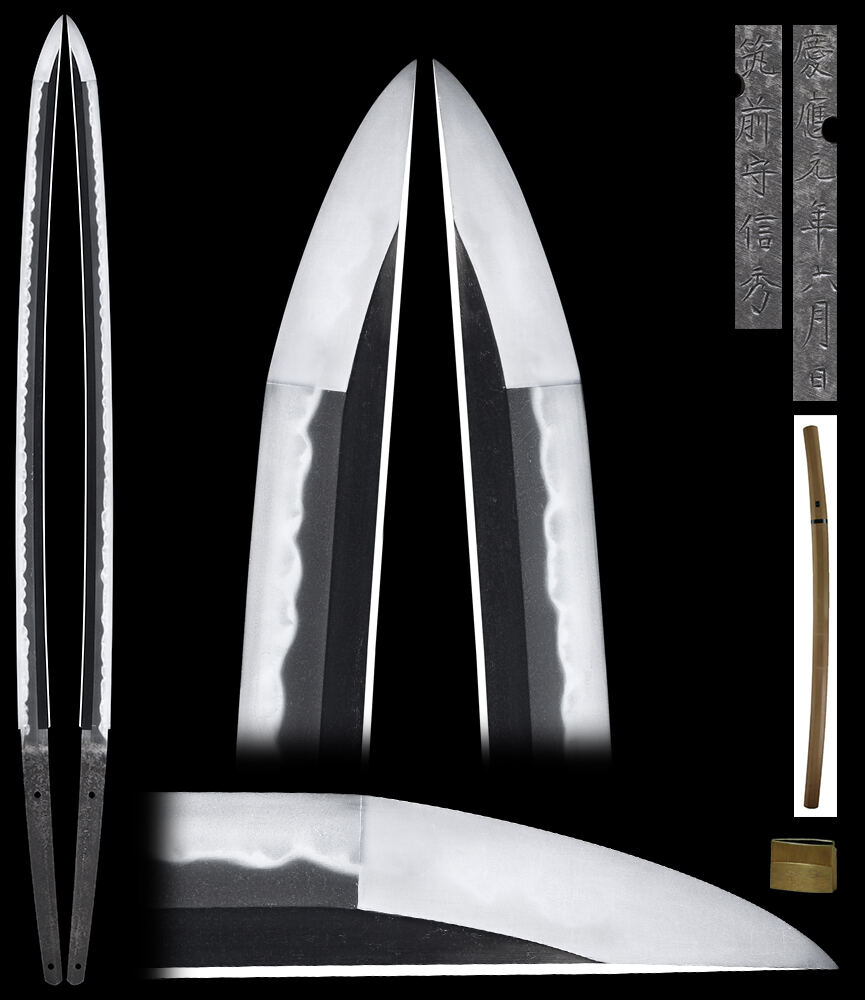
Katana signed 筑前守信秀 (Chikuzen no Kami Nobuhide), of the sixth month of 1865 (Keiō 1). Photo: dealer in Japan 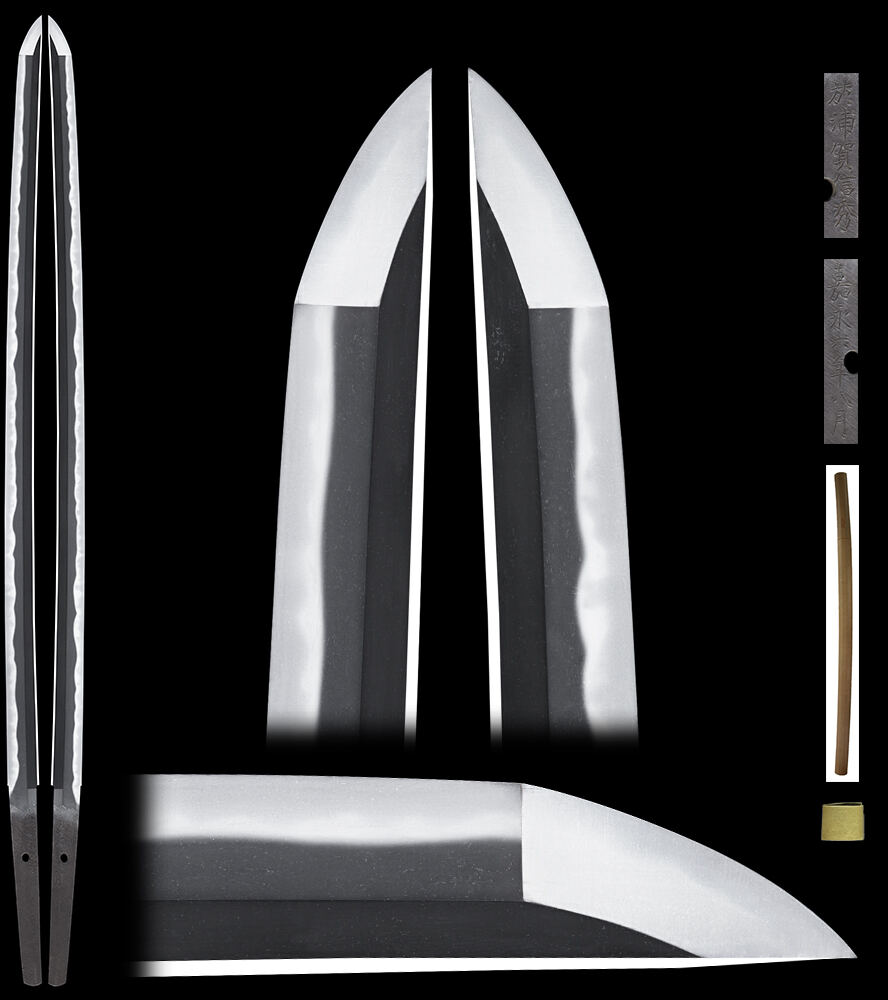
Katana signed 於浦賀信秀 (Uraga ni oite Nobuhide, “Nobuhide, at Uraga”), of the eighth month of 1853 (Kaei 6). Photo: dealer in Japan