On this page
From master to pupil
Kobayashi Yasuhiro (小林康宏), the man of the “斬鉄剣” (zantetsuken)
- Who he was. According to an independent study, he was born in 1914 in Yamanashi; he was a businessman before he was a swordsmith; he researched steel on his own; he set up a forge in Takanawa (Tokyo) around 1968 and obtained his licence in 1970, without a recognised master. In 1977 he went back to Yamanashi and in 1980 founded a forge in the woods, with a 6 m furnace of his own to smelt his steel.
- His fame. Among budō practitioners his blades were called “斬鉄剣” (zantetsuken, “the sword that cuts iron”). He sought a steel of his own, “like that of the kotō”, with a forging method different from the usual one. The headline of the November 2016 issue of Hiden magazine presents Matsuba as a pupil of the swordsmith of the “斬鉄剣” (zantetsuken).
- His death. Another summary places it in the winter of 1987, at his forge; it has not been checked.
- Where Matsuba learned. In 1983 Kobayashi was already in Yamanashi, not in Tokyo: the apprenticeship was there.
- Obata Toshishirō. A user of a collectors’ forum says that Kobayashi made swords for the founder of Shinkendō.
Andō Hirokiyo (安藤広清)
Andō Hirokiyo was born on 4 February 1947 in Tsuyama (Okayama), learned under Kobayashi in Takanawa from 1972, for eight years, and has been the holder of an important intangible cultural property of Okayama Prefecture since 1997. Matsuba calls him his “兄弟子” (anideshi, senior pupil of the same school) and obtained his licence with him.
The Matsuba school (松葉一門, Matsuba ichimon)
He names five pupils: 照人 (probable reading: Teruhito); 内田義基 (probable reading: Uchida Yoshimoto); 文俊基 (Mun Jun-gi), Korean; 鏡夜叉麿 (Kagami Yashamaro), Swedish; and 慶正 (Yoshimasa).
The school is still alive and competing: in 2026 his pupil Yoshimasa finished ahead of Kanemitsu at the NBTHK (努力賞一席, Doryokushō isseki, against 努力賞四席, Doryokushō yonseki). It can also be recognised in its very long tachi: Yoshimasa has exhibited one of 102.6 cm.
His pupils
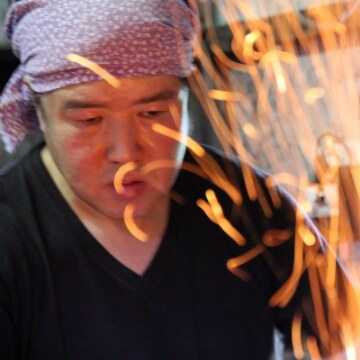
His pupil 照人 (probable reading: Teruhito). Photo: the smith himself 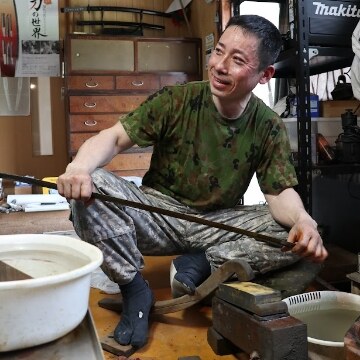
His pupil 内田義基 (probable reading: Uchida Yoshimoto). Photo: the smith himself 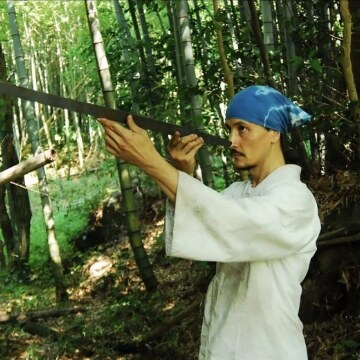
His Swedish pupil 鏡夜叉麿 (Kagami Yashamaro). Photo: the smith himself 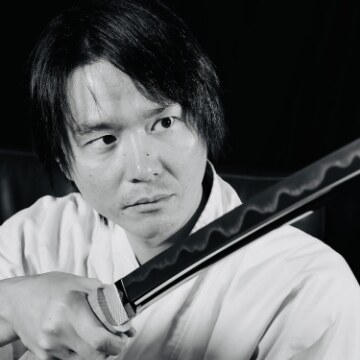
His pupil 慶正 (Yoshimasa). Photo: the smith himself