On this page
Training
- He was born in 1948 in Hokkaidō. He graduated in 1972 from the art section of Hokkaidō University of Education; before that he had spent a year preparing for the entrance exam of the Tokyo University of the Arts, without getting in.
- After university he studied for seven years with 高橋次平 (Takahashi Tsuguhira), holder of an intangible cultural property of Nagano Prefecture. Takahashi was the first pupil of 宮入昭平 (Miyairi Akihira), also called Yukihira. Matsuda joined him in 1973 or in 1974, depending on the source, at the age of twenty-four.
- He spent the first four years cutting charcoal and forged his first sword in the sixth year of his apprenticeship. At night he studied life-size slides of famous swords to learn the hamon and the jihada.
- He received his swordsmith’s licence in 1980.
His forge
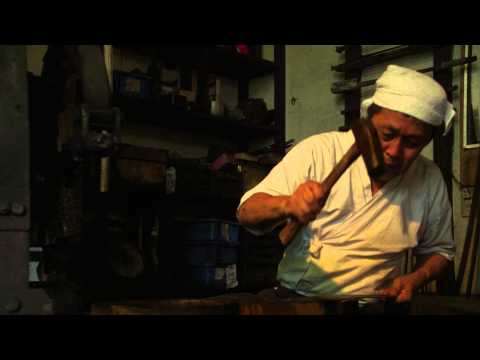
- In 1981 he set up on his own and opened his forge in Funabashi; from 1983 to 1988 he studied forging and hardening with 吉原国家 (Yoshihara Kuniie), holder of an intangible cultural property of Tokyo; in 2006 he moved the forge to the city of Chiba.
- In 1996 he succeeded in recreating a sword of the early Kamakura period, in the style of the Kobizen, which won him the NBTHK president’s prize; an expert said it was probably the first time in eight hundred years that the technique had been seen. It took him ten more years to refine it: from 2003 the edge of the temper line came out clearer.
- In 1999 he held a solo exhibition in London, invited by the British society for the Japanese sword. He has worked with a steelworks to measure and study forging chemically, and he made the tachi for the dohyō-entering ceremony of the yokozuna Hakuhō.
- Chiba Prefecture recognised him as holder of the intangible cultural property “日本刀の鍛錬” (Nihontō no tanren, the forging of the Japanese sword).
- His son 周平 (Shūhei) works with him.
What he thinks
He says one must start from what today’s technique can do and rebuild the method from there, not copy recipes. He applies to the sword what he learned drawing plaster casts: the range of ten tones between white and black. He told it in a book, 『名刀に挑む』 (Meitō ni idomu, “challenging the famous swords”), published in PHP’s 新書 (Shinsho) series in 2017.