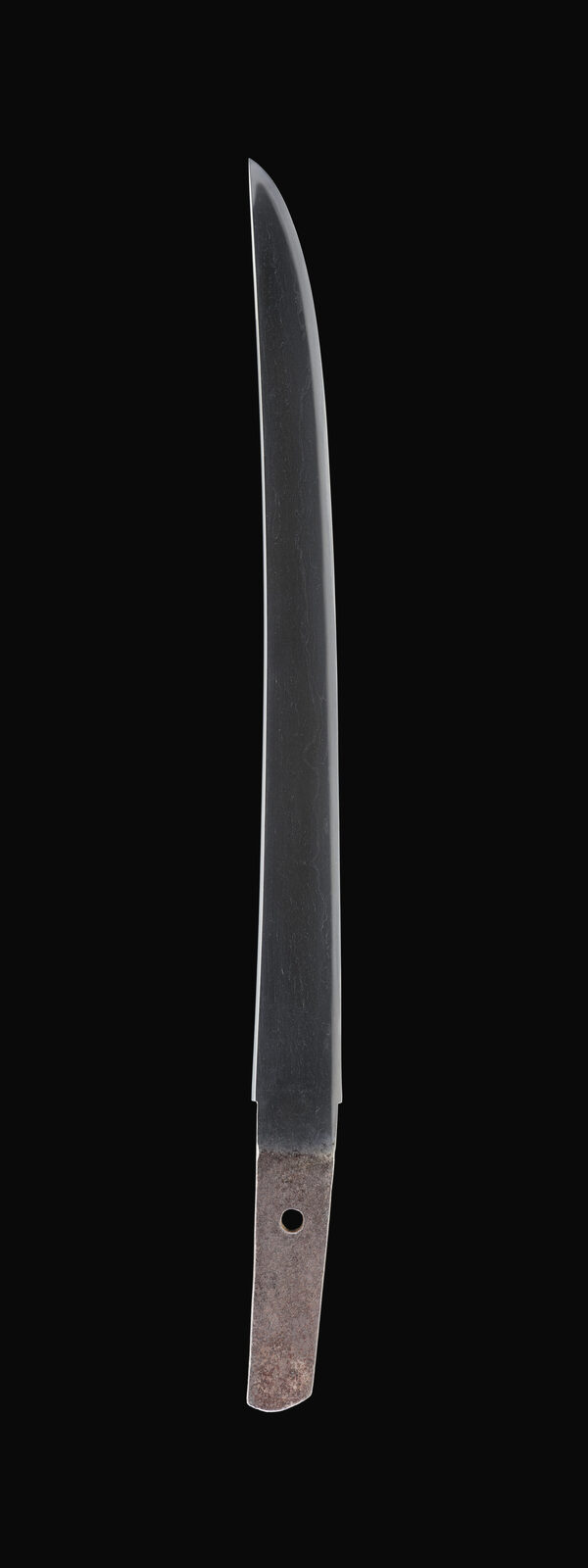
His works, one by one
| Work | Designation | Where it is | Note |
|---|---|---|---|
| Tachi 銘光世作 (mei Mitsuyo saku), the Ōdenta (大典太, Ōdenta) | Important Cultural Property (28 June 1956) and National Treasure (19 February 1957); meibutsu; one of the Tenka Goken | Maeda Ikutokukai (前田育徳会, Maeda Ikutokukai), Tokyo; 65.1 cm | The only signed work of the first Mitsuyo |
| Sōhaya no Tsurugi (妙純傳持ソハヤノツルキウツスナリ, Myōjun denji Sohaya no Tsurugi utsusu nari) | Important Cultural Property; National Treasure under the old law since 17 April 1911 | Kunōzan Tōshōgū (久能山東照宮, Kunōzan Tōshōgū), Shizuoka; 67.9 cm | Unsigned, attributed to Mitsuyo |
| Tantō 銘光世 (mei Mitsuyo) | Important Cultural Property, according to the Japanese Wikipedia | Honmyō-ji (本妙寺, Honmyō-ji), Kumamoto; donated by Hosokawa Yūsai | Not checked in the official database |
| Tachi 光世 (Mitsuyo) | National Treasure in 1924 | Sashita-hiko shrine, Wakayama; donated by Tokugawa Yoshimune | Destroyed in the bombing of Wakayama in 1945 |
| Wakizashi 銘典太作 (mei Tenta saku) | Not designated; 15th century, from a later generation | Kyūshū National Museum; 31.8 cm | Donated by Inada Hidenari |
The Ōdenta
According to Satō Kanzan and the Maeda records, it passed from Ashikaga Takauji to Ashikaga Yoshiaki, to Toyotomi Hideyoshi and to Maeda Toshiie. The 享保名物帳 (Kyōhō meibutsuchō) says that Toshiie received it from Hideyoshi for his daughter Gōhime; another version, recorded by the Japanese Wikipedia, has it pass from Tokugawa Ieyasu to Hidetada and to Toshitsune, for Tamahime.
Legend credits it with the power to heal: the sick recovered when it was kept near them and the illness returned when it was given back.
On 19 August 1792 it was tested at Kozukappara, in Edo, by Yamada Asaemon Yoshimutsu, the official tester, on the bodies of executed criminals: in the test cuts it went right through to the base, and in the three-body cut it severed the top two and stopped at the spine of the third.
It became an Important Cultural Property on 28 June 1956 and a National Treasure on 19 February 1957, with its kawa-tsutsumi tachi-koshirae mounting. The Japanese Wikipedia relates that the Maeda brought the sword to the museum only for the first session, and that the National Treasure session judged it from photographs.
The Sōhaya no Tsurugi
It is the favourite sword of Tokugawa Ieyasu, who received it from Oda Nobukatsu around 1584. Its name is that of the legendary sword of Sakanoue no Tamuramaro, and on the nakago it bears the inscriptions “妙純傳持ソハヤノツルキ” (Myōjun denji Sohaya no Tsurugi) and “ウツスナリ” (utsusu nari).
It measures 67.9 cm, with a sori of 2.5 cm, a motohaba of 3.9 cm, a sakihaba of 2.8 cm and an ikubi-kissaki. Satō Kanzan considered it by the same hand as the Ōdenta because of its sugata, its shape and its jigane and hamon. Legend says that Ieyasu had it tested shortly before his death and asked for it to be placed with its point towards the west.
In the lists
- Tenka Goken. The Ōdenta is one of the five. The five appear together for the first time in the Shokemei kenshū, a copy of the Kyōhō meibutsuchō, which says of it that “it is one of the five illustrious swords under heaven”; it is not known since when they have been called the Tenka Goken.
- The criterion of the list, under discussion. Some (the Shokemei kenshū, the Meikenden, Fukunaga Suiken) say that the excellence of the blade is what counts, and Satō Kanzan that its history counts too; Hirai Yūichi points out that there is not a single Bizen blade, and Satō himself gives, on two pages of the same book, two different lists.
- Kyōhō meibutsuchō. The Ōdenta is recorded as a meibutsu.
- Wazamono. Mitsuyo does not appear in Yamada Asaemon’s ranking of sharpness (業物, wazamono), according to the list in the Japanese Wikipedia.