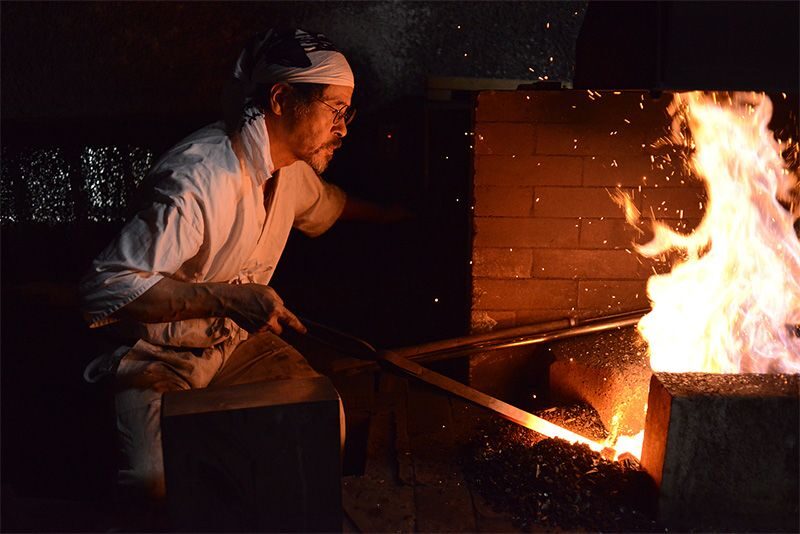
The Miyairi house
- He is the son of 宮入清平 (Miyairi Kiyohira, 1924–2003), who later signed 清宗 (Kiyomune), and the nephew of 宮入昭平 (Miyairi Akihira) (1913–1977), who later signed 行平 (Yukihira) and was a Living National Treasure from 1963. The Japanese Wikipedia lists him among the swordsmiths of the family.
- According to him, the family has forged since the end of Edo, and the house school was the Sōshū-den. His cousin is 宮入小左衛門行平 (Miyairi Kozaemon Yukihira).
Two masters
- In 1978 he graduated in History from Kokugakuin University and became a pupil of 隅谷正峯 (Sumitani Masamine), a Living National Treasure of Bizen, known for his “Sumitani chōji”. He met him on a university trip to Hokuriku. In a house of the Sōshū tradition he was seen as a “heretic”. He stayed with him for five years.
- In 1983 he went on to learn under his father, to return to the Sōshū tradition. Nine years according to him; twelve according to Tōmi city council. He then became independent and set up his forge in Tōmi.
- Nippon.com points out that the licence requires at least five years of apprenticeship under a master.
Museums, shrines and the imperial household
- In 2002 the Metropolitan Museum of Art in New York invited him to care for its sword collection.
- In 2003 he made the sword for the dohyō-iri (土俵入り, dohyō-iri, the ring-entering ceremony) of the yokozuna Asashōryū; from 2002 to 2014, the protective swords (守り刀, mamori-gatana) of the princesses of the Takamado household; in 2008 and 2012, votive swords for the Futarasan shrine in Nikkō.
- In 2004, when the city of Tōmi was founded, his first solo exhibition. In 2011 Nagano Prefecture recognised him as the holder of an intangible cultural asset, the technique of forging the Japanese sword.
- In 2020 he forged three swords, 天 (Ten), 地 (Chi) and 人 (Jin), on “the sword of the beginning”, for the video game company Nitroplus; the 人 (Jin) sword was dedicated at the 石上神宮 (Isonokami Jingū) shrine. In 2021 he dedicated a tōsu at the Ise shrine.
- In 2024 and 2025, the exhibition “東御の刀鍛冶” (Tōmi no katanakaji, the swordsmiths of Tōmi) featured him as its protagonist; the city council published its film about him in 2026 (in “Videos”).