On this page
Akashi Kuniyuki (明石国行)
Tachi signed 国行 (Kuniyuki), in the NBTHK’s Japanese Sword Museum (刀剣博物館, Tōken Hakubutsukan), in Tokyo. It was designated an Important Cultural Property on 25 May 1937 and a National Treasure on 31 March 1953.
Its name comes from the Matsudaira of Akashi, in Harima, who owned it. After the war it passed into the collection of the publisher Fujisawa Otoyasu, who donated it to the NBTHK, according to the Japanese Wikipedia. It measures 76.5 cm of blade, with 3.1 cm of curvature and 3.03 cm wide at the base. It bears a bōhi on both sides and inside it, in relief, a three-pronged sword (三鈷剣, sanko-ken), a rare thing. The museum label visible in the photo of the display case gives 76.6 cm.
A legend makes it the “Omokage” of Nagasaki Tamemoto, shortened; it does not hold up, because the blade shows no sign of suriage. The Japanese Wikipedia describes the nakago as kijimomo (雉股, kijimomo, “pheasant’s thigh”), with a hole for the cord at the end, something uncommon. The official record gives the tip as kurijiri; the two descriptions do not fully match.
The “Akashi Kuniyuki”
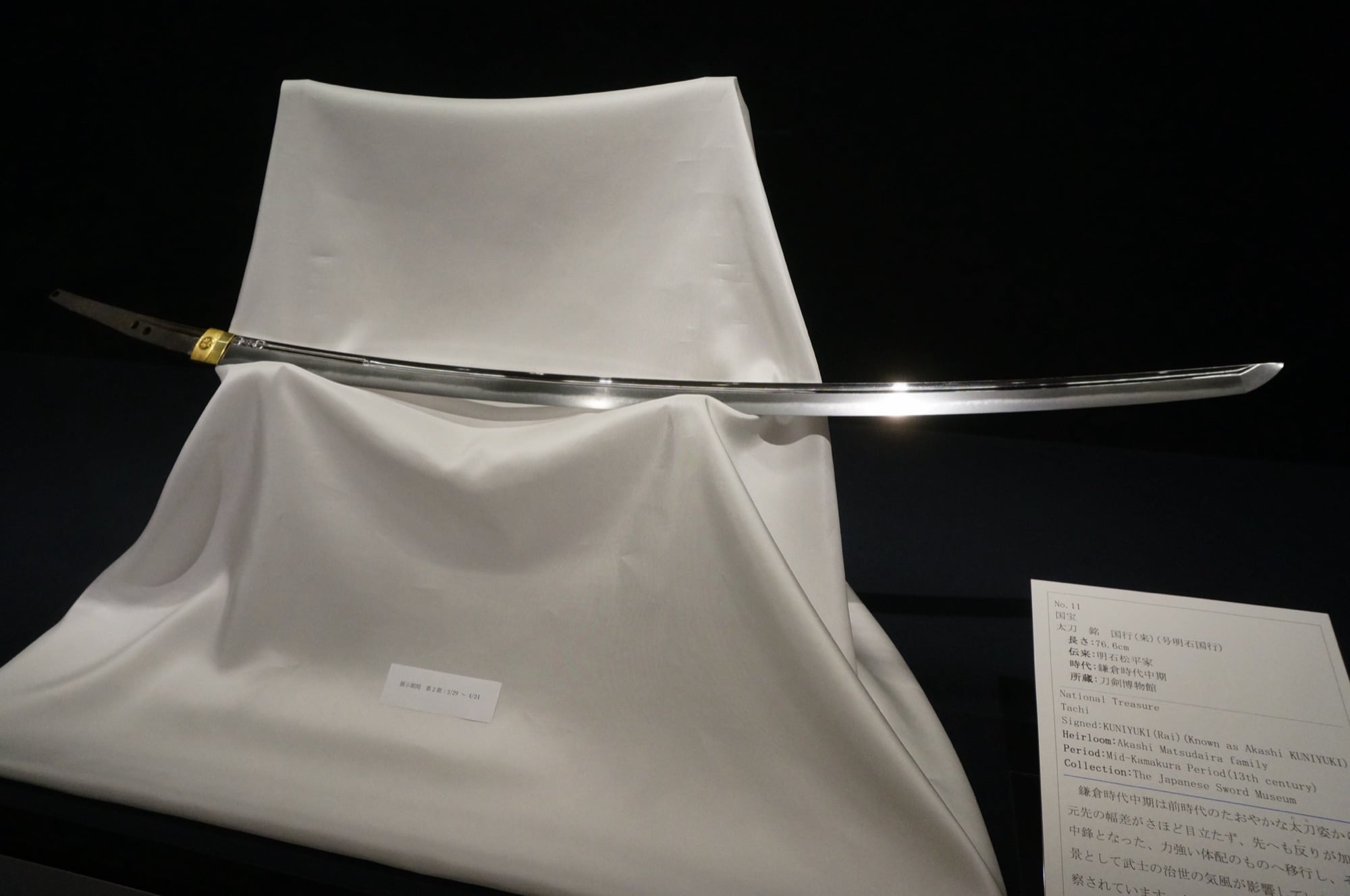
The “Akashi Kuniyuki” on display at the Japanese Sword Museum, with its label. SLIMHANNYA, CC BY-SA 4.0, via Wikimedia Commons · CC BY-SA 4.0 · source 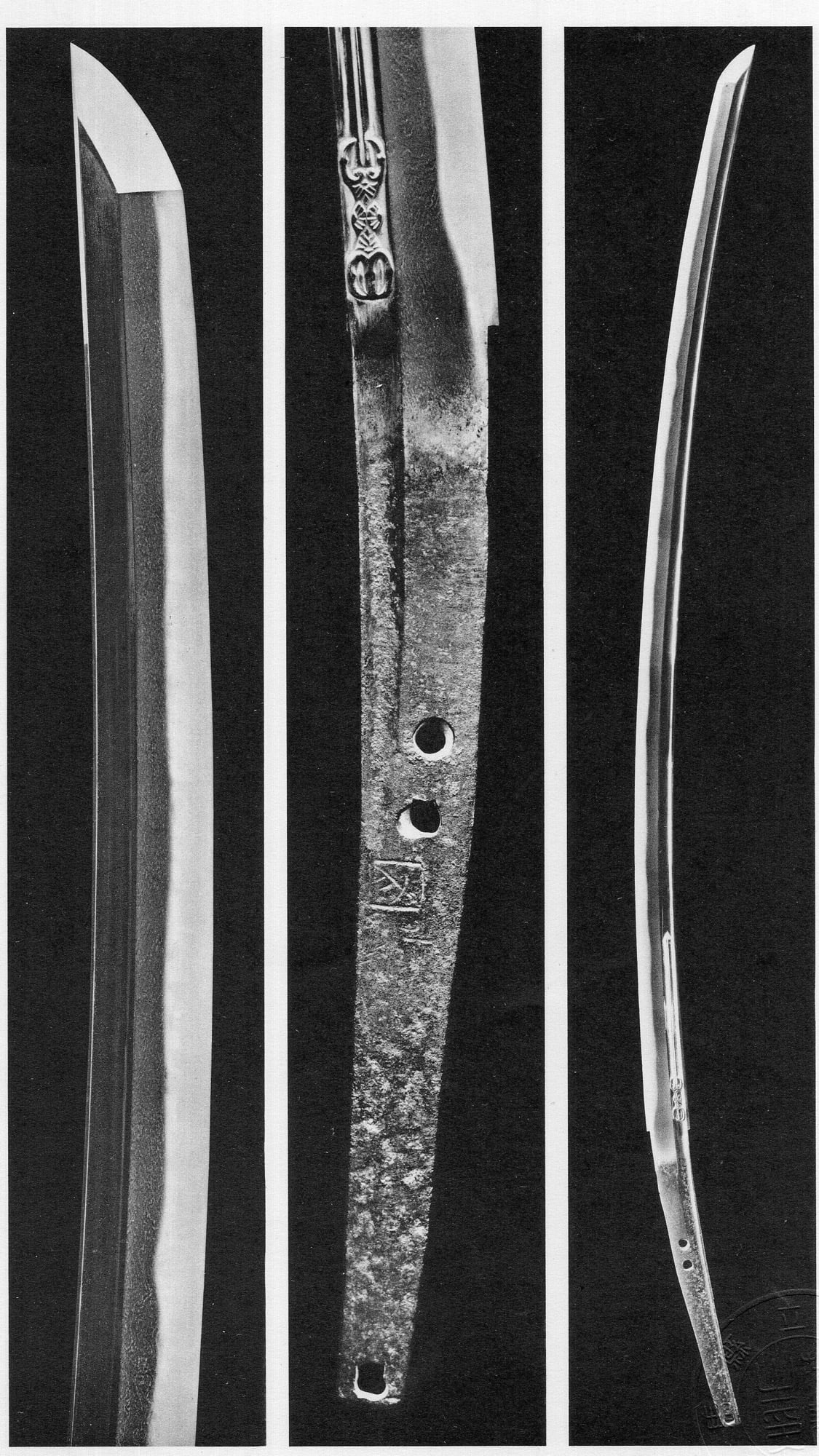
The “Akashi Kuniyuki”: point, nakago with the signature 国行 (Kuniyuki) and the whole blade, in an old photo by the Committee for the Protection of Cultural Properties. 文化財保護委員会 (Bunkazai Hogo Iinkai, Committee for the Protection of Cultural Properties), Public domain, via Wikimedia Commons · Public domain · source


Another National Treasure, to be verified
The Japanese Wikipedia gives as a National Treasure another tachi 国行 (Kuniyuki) within the wedding trousseau (婚礼調度類, konrei chōdo-rui) of the Tokugawa Art Museum in Nagoya; we have not been able to verify it in the official database.
Important Cultural Properties
The Japanese Wikipedia lists thirteen tachi and katana that are Important Cultural Properties, some only attributed (伝国行, den Kuniyuki). They are, among other places, in the Tokugawa Museum, in the Kunōzan Tōshōgū shrine (久能山東照宮, Kunōzan Tōshōgū) in Shizuoka, which has two, in the Sakura Jinja in Okayama, in the Isaniwa Jinja in Ehime and in private collections. One, designated in 1937, has been of unknown whereabouts since it was confiscated by the Allied forces.
In museums
The Kyūshū National Museum, in Dazaifu, holds a tachi signed 国行 (Kuniyuki), F77, donated by Kitazaki Tetsurō: an 87.6 cm blade and 2.2 cm of curvature, shinogi-zukuri and iori-mune, with the signature on the side worn facing out at the waist. In 2018 the Kyoto National Museum showed, in 「京のかたな」 (Kyō no katana, “The swords of Kyoto”), a tantō 国行 (Kuniyuki) of his, donated by Nagafuji Hajime (no. 62), and an Important Cultural Property tachi from the Tokugawa Museum (no. 61).
NBTHK Tokubetsu Jūyō
Sesko describes a Tokubetsu Jūyō sunnobi-tantō of 30.7 cm, now mounted as a wakizashi, with a jiba of almost Nanbokuchō air that anticipates the style of Kunimitsu and Kunitsugu. It came to the Shimazu in 1729, on the occasion of the wedding of Takehime (竹姫, Takehime).
In the old lists
In what was consulted, no work of his is recorded in the 『享保名物帳』 (Kyōhō meibutsuchō) or in the wazamono lists. The list of famous swords in the Japanese Wikipedia gives names such as “Kunohe Rai Kuniyuki” and “Mōri Rai Kuniyuki”; we have not verified whether they are in the Kyōhō meibutsuchō.