On this page
Kantei keys
They are given by the NBTHK, in its journal of September 2016:
- Jihada. It is not the nagare-hada typical of Yamato: it is usually a very refined and tight itame, strong and clear, the hallmark of Kanenaga.
- Hamon. The common Yamato one, with kuichigai-ba, nijūba, uchinoke and hotsure. His is low in the lower half and widens in the upper, sometimes different on each side; the nie is thick and sparse, and gives strength to a calm temper.
- Bōshi. Yakizume or with a short turn-back with ō-maru, with a strong hakikake at the point, a Yamato feature.
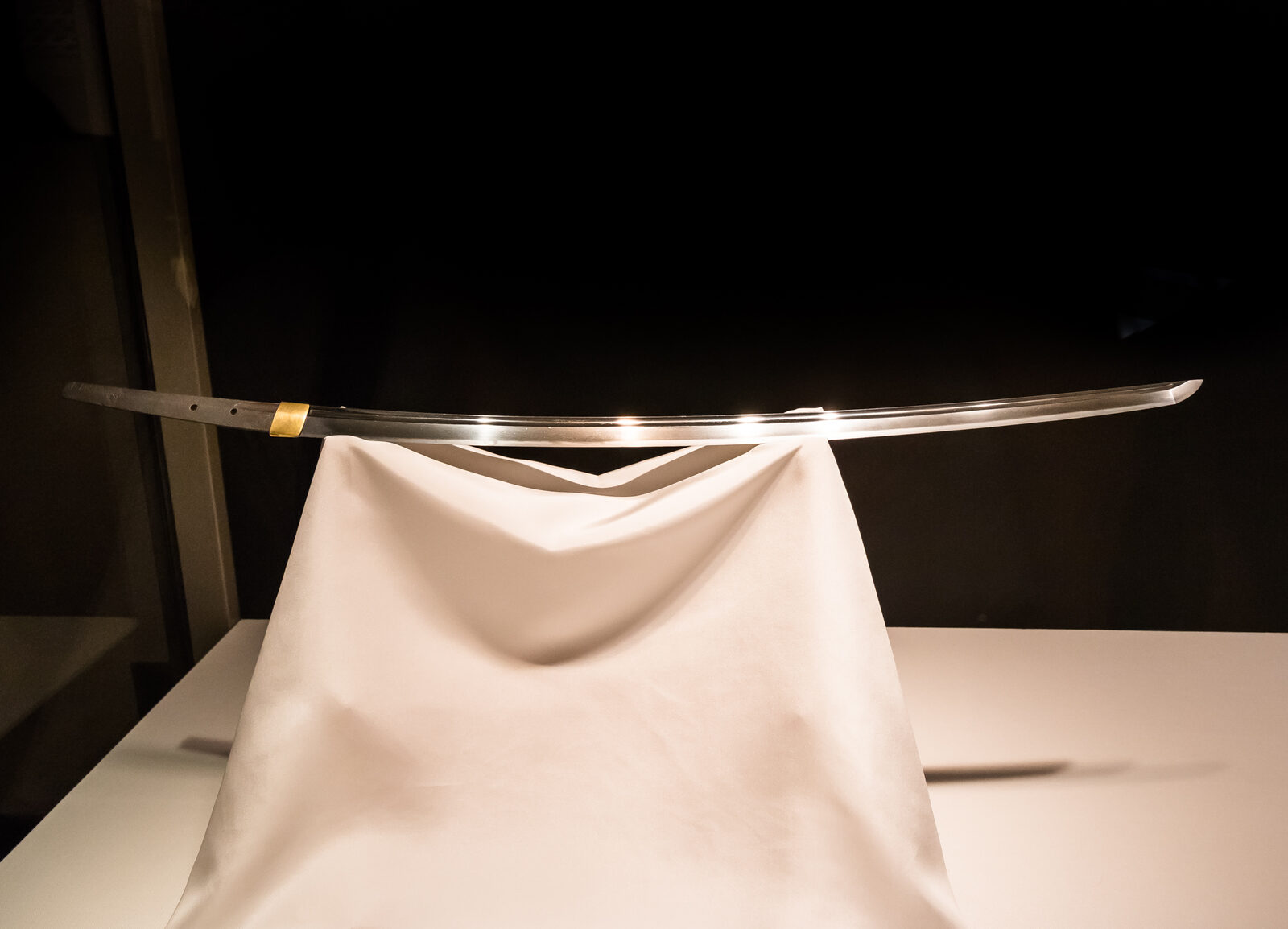
- Sugata. On the tachi of the Shijōnawate shrine: shinogi-zukuri and iori-mune, wide shinogi-ji, thick blade, strong sori and a short chū-kissaki; 73.7 cm. The Agency for Cultural Affairs highlights, on the one in the Tokyo National Museum, the elegant Yamato shape.
- Nakago and mei. Hardly any of his blades keep the original tang: almost all are shortened, according to the record of the National Treasure. On the Shijōnawate tachi, the shortened tang has two holes and the two-character signature, 包永 (Kanenaga), has the 包 (kane) small and the 永 (naga) large, next to the back.
In his blades
- The Shijōnawate tachi, according to the NBTHK: tight itame with dense ji-nie and fine chikei; chū-suguha with ko-gunome, many ashi and yō, more than in his usual work, and kinsuji.
- The National Treasure of the Seikadō, according to the official record: almost certainly by the first Kanenaga and the best of his work; the Tegai style is clearly visible, and the nie of the temper shines strongly.
- The one in the Tokyo National Museum, according to the official record: a representative work, with his characteristic style; 71.3 cm long, 2.3 cm of sori and 19.8 cm of tang.