The samurai and their sword
Samurai is a word used for everything and explains little. This is the warrior class as the sources document it: where it came from, how it was ranked inside, why the sword became its badge and how much the sword really counted in combat, until the Meiji state dissolved it. The history of the blade, period by period, is in “Periods: from jōkotō to shinsakutō”.
The word: bushi and samurai
The word samurai (侍) comes from an old verb, saburau (侍ふ), “to be in service, to attend a lord”. Its form changed over the centuries: saburahi in Heian, saburai in Kamakura and Muromachi, and samurai from the sixteenth century. bushi (武士), on the other hand, simply means “warrior”. The first names a relationship, that of the one who serves; the second, a trade.
For centuries they were not synonyms. In Heian, samurai meant the attendants of the court and of noble houses; in Kamakura it came to mean a direct vassal of the shōgun; and in Edo, strictly speaking, it was the high-ranking warrior, above the kachi (徒士), the low-ranking foot warrior. Today the two words are used interchangeably, and so they are in this guide, except where the difference matters.
The picture of the samurai as an armoured warrior fighting every day does not fit the age when the class was most numerous either: in the two and a half centuries of peace of Edo, most were officials, administrators and guards in their lord’s service, paid a stipend in rice and wearing the sword as the sign of their status.
Where they came from (tenth to twelfth centuries)
There is no birth date and no single explanation. Japanese historians have worked with three, which today’s textbooks combine: rural lords who cleared new land and defended it with their own arms (kaihatsu ryōshu, 開発領主); families of the lesser court nobility who made war a hereditary trade, the so-called functional theory (shokunō-ron, 職能論); and the contingents raised by the provincial governments (kokuga gunsei, 国衙軍制).
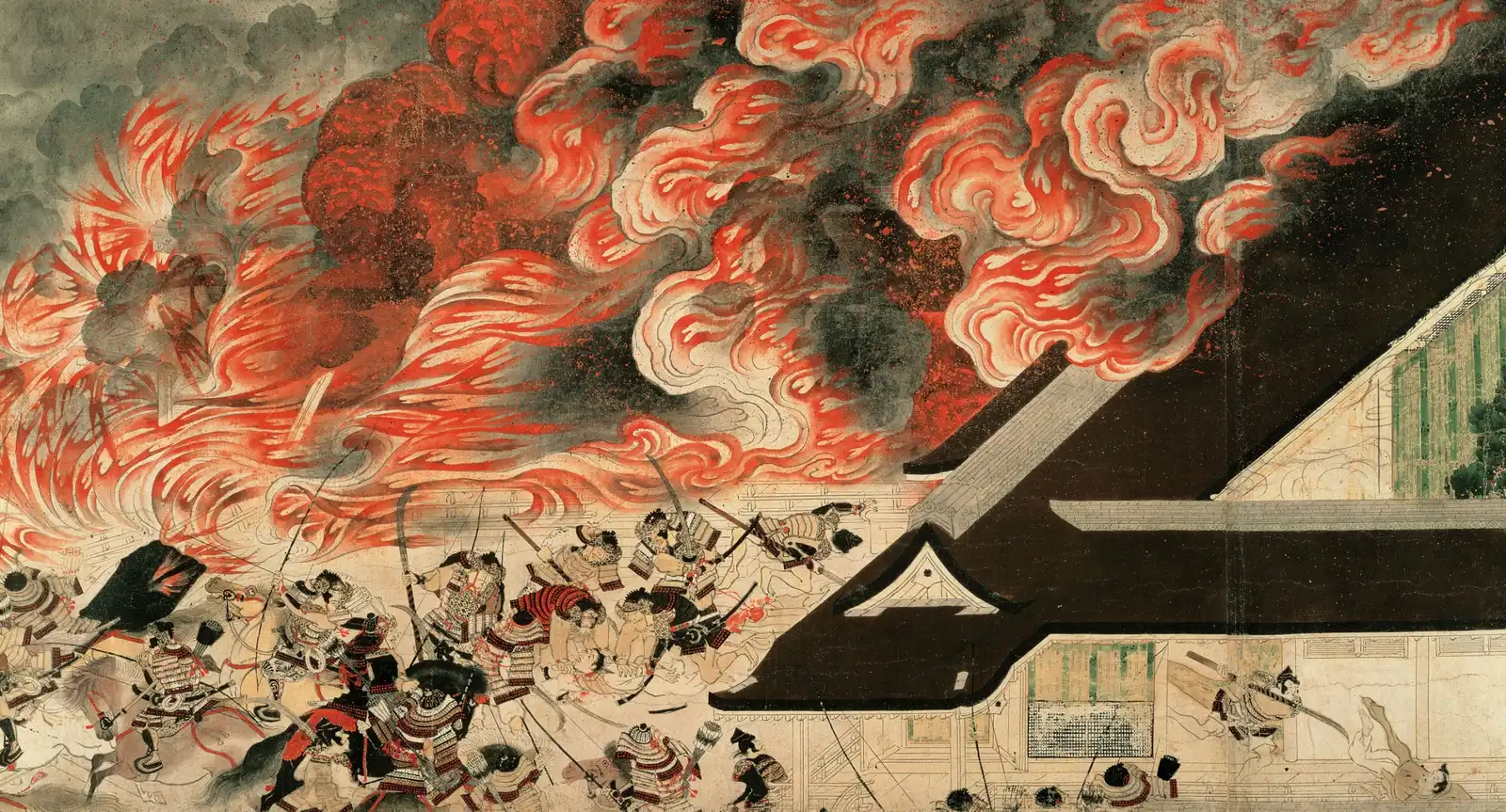
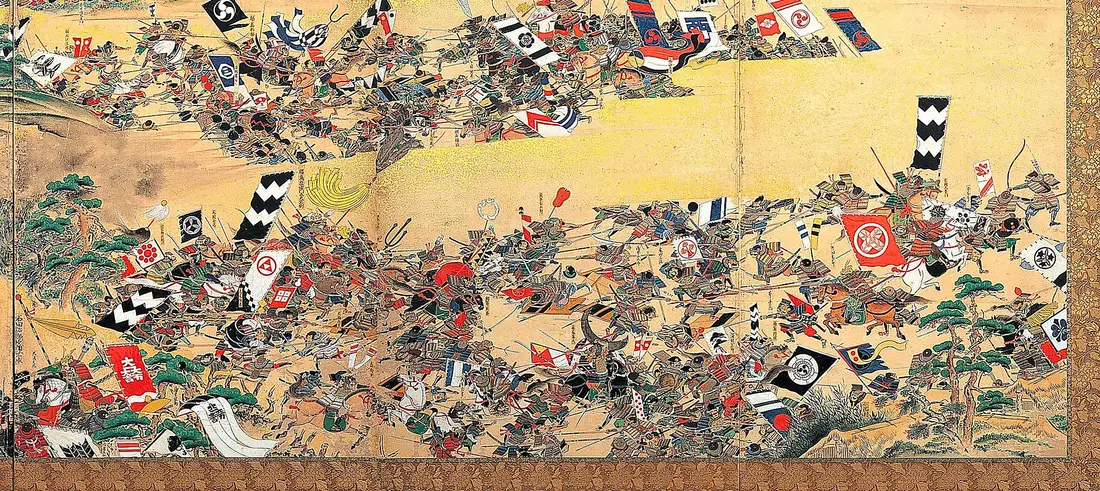
What can be recognised is the type: a mounted archer carrying a curved sword. Its strength showed early. In 939 Taira no Masakado (平将門) rose in the Kantō and went as far as proclaiming himself “new emperor” before dying in battle the following year; in the eleventh century the northern wars, the Former Nine Years’ War (1051–1062) and the Later Three Years’ War (1083–1087), built up the following of the Minamoto. By the mid-twelfth century warriors were already settling the disputes of the court (Hōgen, 1156; Heiji, 1159–1160), and the Genpei War (1180–1185) destroyed the Taira.
The title that crowned the class was older: sei-i taishōgun (征夷大将軍), “great general who subdues the barbarians”, the command given in 797 to Sakanoue no Tamuramaro (坂上田村麻呂) for the campaigns against the Emishi of the north. In 1192 Minamoto no Yoritomo (源頼朝) obtained it and made it the permanent head of a warrior government, the bakufu (幕府), which ruled alongside the court rather than in its place.
The ranks of the class
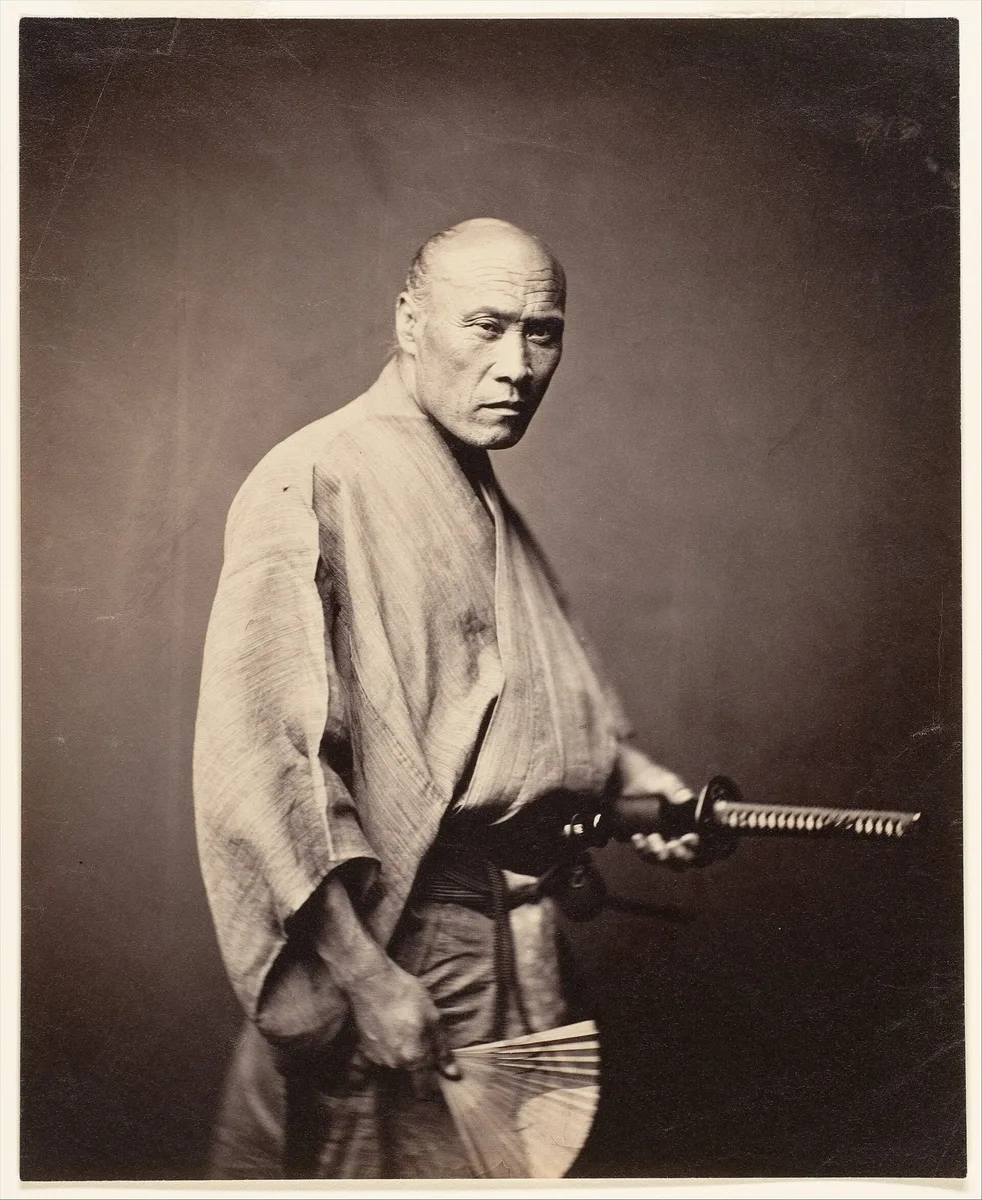
Within the warrior class the distances were as great as between the class and everyone else. In Edo, from top to bottom:
| Rank | What it was |
|---|---|
| daimyō (大名) | Lord of a domain yielding 10,000 koku of rice or more; in the eighteenth century there were about 260. |
| hatamoto (旗本) | Direct vassal of the shōgun with less than 10,000 koku; from the late seventeenth century, with the right of audience. |
| gokenin (御家人) | Direct vassal of the shōgun, without the right of audience. |
| samurai (侍) | Strictly speaking, the high-ranking warrior of a domain: he could appear before his lord, rode a horse and was usually paid from land. |
| kachi (徒士) | Low-ranking foot warrior: he did not see the lord and drew a rice stipend from the storehouse. |
| ashigaru (足軽) | Foot soldier, the lowest rung; in some domains almost on a par with the servants (chūgen, 中間) and without a surname. |
| gōshi (郷士) | Warrior who lived in the countryside and farmed it, with recognised surname and sword. |
| rōnin (浪人) | Samurai without a lord. |
Rising from ashigaru to kachi was easier than from kachi to samurai, and in some domains an ashigaru post could be bought and sold. As for numbers, the 1872 register counted the shizoku (士族), the former warriors, as 3.9 % of the population, and the sotsuzoku (卒族), the former common soldiers, as another 2 %: altogether, roughly one Japanese in twenty. Above them all still stood the court and its nobility (kuge, 公家).

The sword as a privilege
Until the late sixteenth century wearing a sword set no one apart: peasants, monks and merchants went armed. Toyotomi Hideyoshi (豊臣秀吉) changed that. His katanagari (刀狩), the “sword hunt” of 1588, forbade peasants to own long and short swords, bows, spears and firearms, promising that the metal would go into the nails of a great Buddha being raised in Kyoto. It did not disarm the countryside —many villages handed over a few pieces and kept the rest— but it took away the right to bear a sword from anyone who was not a warrior. In 1591 another edict fixed the separation of warriors and peasants (heinō bunri, 兵農分離): a man of arms could not become a peasant or a merchant, nor a peasant leave his land for trade.
Edo tightened the rules further. In 1668 commoners in Edo were forbidden to wear a sword every day, except merchants in government service, and in 1683 the ban reached them all; the short sword was still worn by custom for much of the eighteenth century, and on journeys, at weddings and at funerals until Meiji. The pair of long and short sword, the daishō (大小), remained the mark of the class, and for attendance at the castle the shogunate prescribed even its look: black scabbard, white ray skin and black wrap. The right to a surname and a sword (myōji taitō, 苗字帯刀) could be granted to a commoner for merit, sometimes for life only: that is how the cartographer Inō Tadataka (伊能忠敬) received it.
The privilege gave rise to a myth: kirisute gomen (切捨御免), the samurai’s supposed right to cut down any commoner who offended him. The phrase is late —Edo documents speak of teuchi (手討)— and the right was tightly conditioned: the offence had to be proved with witnesses and reported to the authorities, otherwise the case was tried as a homicide. At the same time, failing to answer a public insult could be punished as cowardice. It was, above all, a duty of honour with paperwork.
From chokutō to katana
The Japanese sword as we recognise it —curved, single-edged, ridged (shinogi-zukuri, 鎬造), with a tang fitted into a wooden hilt held by a peg (mekugi, 目釘)— did not arrive all at once. The early blades were straight (chokutō, 直刀) and of continental tradition; the curve came from the north.
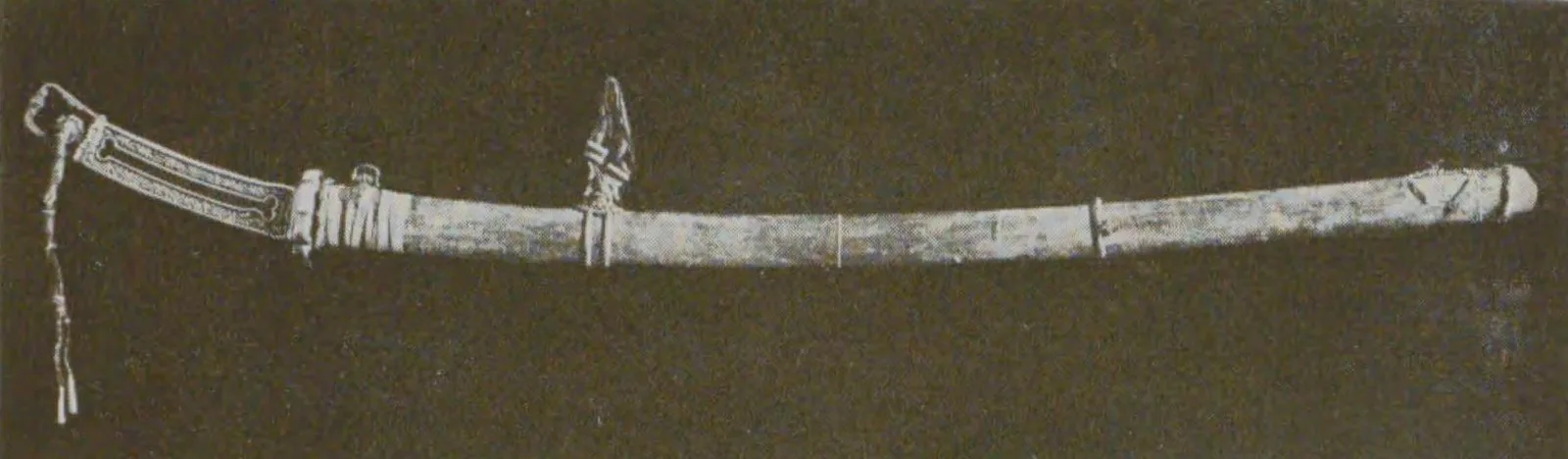
The Emishi (蝦夷), the peoples of northern Honshū, used the warabitetō (蕨手刀), a short sword forged with the hilt in the same piece of iron and the pommel curled like a young fern shoot (warabi). Some 280 are known, nearly all from Tōhoku and Hokkaidō, from the seventh to the ninth century, and the later ones are longer and curved: a sword for slashing from horseback. From it comes the kenukigata tachi (毛抜形太刀) of the first half of the tenth century, still in one piece and with a hilt opening shaped like tweezers (kenuki), but already ridged and curved. When the iron hilt gave way to a wooden one fixed with a peg, the Japanese sword was complete.
The tachi (太刀) dominated from the twelfth to the fifteenth century. It hung from the belt on two hangers with the edge down, and in origin it was a reserve weapon: until the Genpei War the mounted warrior’s main weapon was the bow, and the tachi was used after dismounting or falling. Beside it the uchigatana (打刀) appears early, mentioned already in the early twelfth century as a sword of foot soldiers. Its origin is debated: it may have grown out of the infantryman’s dagger (sasuga, 刺刀) or out of the guardless dagger that the ranking warrior wore next to his tachi (koshigatana, 腰刀), and probably out of both.
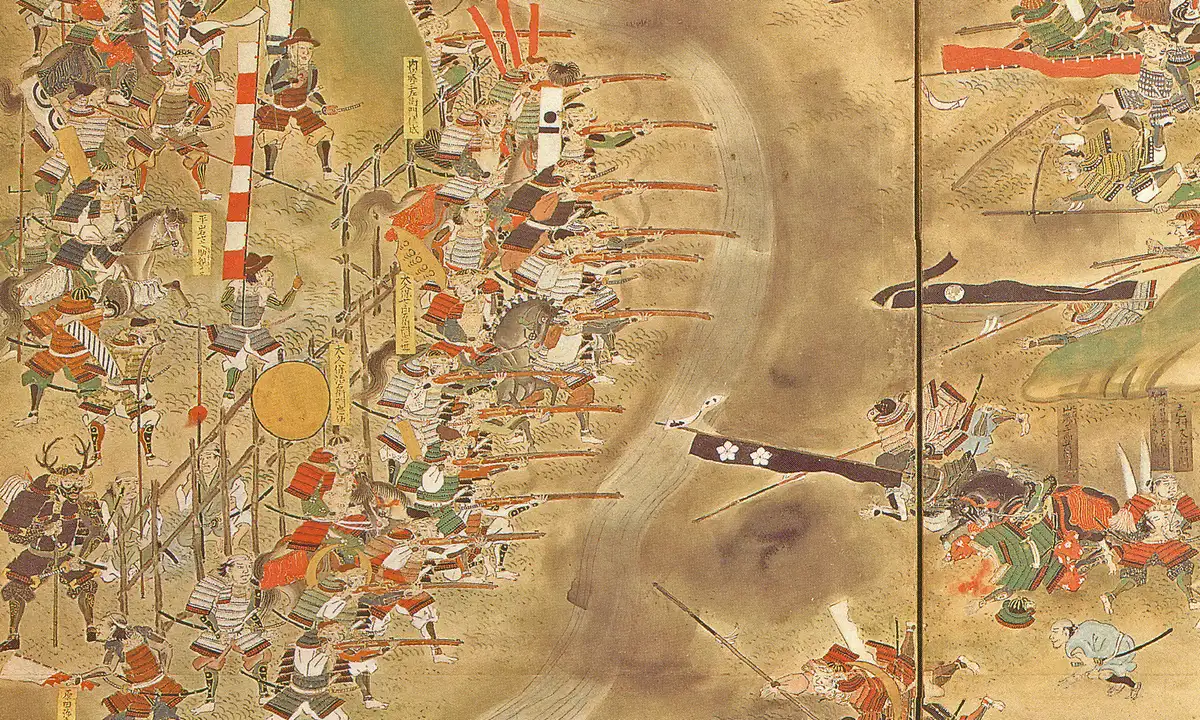
With the Ōnin War (1467–1477) combat moved from duels between riders to masses of infantry, the ashigaru, with spears and, from 1543, firearms. On foot the hanging tachi got in the way; the uchigatana, thrust through the obi edge up, could be drawn and used to cut in a single movement. By the end of Muromachi it was general, and many old tachi were shortened at the tang to be mounted as katana (suriage, 磨上げ): that is why much of what survives from the great Kamakura smiths is shortened katana, many of them unsigned. In the Bakumatsu the activists against the shogunate (shishi, 志士) went back to long, almost straight blades with a large point, the so-called kinnōtō (勤王刀).
How the sword is worn even decides where the signature goes: it is cut on the face of the tang that faces outwards when the sword is carried as intended, the haki-omote (佩表) on a tachi and the sashi-omote (指表) on a katana. That is why Japanese museums show the tachi edge down and the katana edge up. The measurements and shapes of each type are in “Blade types”.



The sword in real combat
Medieval warriors asked for reward in writing. In their reports of merit (gunchūjō, 軍忠状) and in the lists of wounded (teoi chūmon, 手負注文) they recorded who had been wounded and, often, by what weapon. Those papers are the best window we have on how battles were fought, and they tell something the legend leaves out: the sword wounded few.
The historian Thomas Conlan counted the wounds by known weapon in the fourteenth-century reports (721 cases) and in those from 1467 to 1600 (1,208 wounds). In both periods about three wounds in four were caused by missiles: arrows above all and, later, also bullets and stones. In the fourteenth century almost every close-combat wound was a sword wound, which makes roughly one in four of the total; from 1467 the spear takes four in five close-combat wounds and the sword falls to one in twenty. The Japanese historian Suzuki Masaya (鈴木眞哉), working with 201 documents from 1467 to 1637, arrives at a similar distribution: arrows, about four wounds in ten; firearms and spears, about two each; stones, one; and the sword, less than one in twenty.
The figures have a catch, and Conlan himself warns of their false precision. They are the wounds of survivors on the side claiming reward, nearly always warriors of rank: they do not say what the dead died of, nor do they count the rank and file. They show trends; they do not measure.
In Japan the question is an open debate. Suzuki and other authors argue that the sword was a secondary weapon, useful above all for taking the enemy’s head (kubitori, 首取り) that proved the deed; other historians answer that it was indispensable where spear and bow are useless: in the mêlée, inside castles and houses, in night attacks and in the mountains. The numbers do not settle the matter: they say how often the sword wounded, not when it was irreplaceable.
With the peace of Edo the blade stopped being tested in battle and began to be tested another way: the cutting test and the inscriptions it left on tangs are covered in “Ranks, cutting tests and titles”.
Even so, swords still left the scabbard in earnest, and the blade keeps the record. Several famous swords owe their fame to the combat marks they still bear. The Ishida Masamune (石田正宗) is also called Kirikomi, “the one with the cuts”, for the cuts it took on the back, on the ridge line (shinogi, 鎬) and on the back of the tang. And the Honjō Masamune (本庄正宗) reached the general who gave it its name with battle notches.
Workshops tell of a case from late Edo, with no fame at all, that shows better what a fight leaves behind: a katana by Fujiwara Tadahiro (藤原忠広) with which a low-ranking samurai of the small Okabe domain (Okabe-han, 岡部藩) defended himself one night against three thieves trying to rob him of the funds in his keeping. As the story is told, all three were badly wounded; he survived, wounded too, and his lord praised him for saving the money without anyone being killed. The family is said to have kept the sword for more than a century just as it was: five nicks in the edge, four cuts in the habaki and another in the guard and its washers, the start of the edge (hamachi, 刃区) broken, the back wavy and the hilt blackened with blood. It also holds a lesson for collectors: two later polishes removed the rust and the smaller nicks, and part of the evidence with them.

The end of the class (1868–1948)
The Meiji Restoration of 1868 did not abolish the samurai at a stroke: it took them apart piece by piece in less than ten years.
| Year | What happened |
|---|---|
| 1869 | The lords return their domains to the emperor (hanseki hōkan, 版籍奉還). Former warriors become shizoku (士族), a civil status with a stipend. |
| 1871 | The domains are abolished and prefectures created (haihan chiken, 廃藩置県). A decree makes wearing the sword and the traditional topknot optional (sanpatsu dattōrei, 散髪脱刀令). |
| 1873 | Conscription (chōheirei, 徴兵令): war stops being the trade of one class. |
| 1876, March | Haitōrei (廃刀令): wearing a sword in public is banned except in full-dress uniform, for the military, the police and officials on duty. Owning one is not banned. |
| 1876, August | Hereditary stipends are commuted into government bonds (chitsuroku shobun, 秩禄処分). |
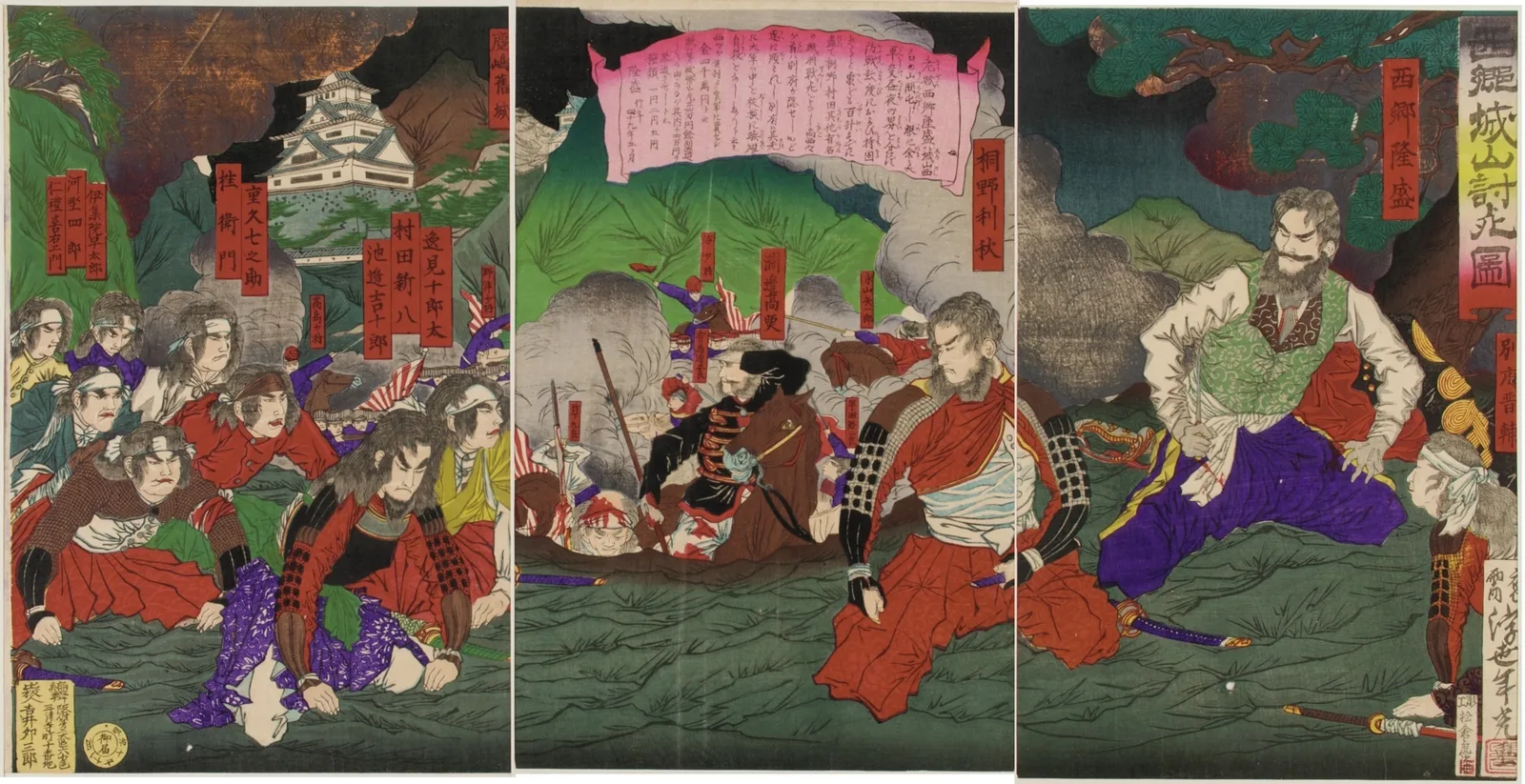
| 1877 | Satsuma Rebellion (Seinan sensō, 西南戦争). Saigō Takamori (西郷隆盛) dies at Shiroyama on 24 September, facing an army of conscripts with artillery. |
| 1947 | The new Constitution abolishes hereditary ranks; shizoku is removed from the family register on 1 January 1948. |
The sword did not vanish with the class: it stayed in homes, in the army and in museums. What happened to sword forging between 1876 and 1953 is told in “Periods: from jōkotō to shinsakutō”.

Bushidō, without idealising it
bushidō (武士道), “the way of the warrior”, sounds like an ancient, closed code, and it was not one. The word appears in writing in the early seventeenth century —one of its first appearances is in the Kōyō gunkan (甲陽軍鑑), the chronicle of the Takeda, around 1616— and there it refers mainly to courage and renown in battle. Before that, the warrior ideal was put differently: “the way of bow and horse” (kyūba no michi, 弓馬の道).
In the peace of Edo, thinkers such as Yamaga Sokō (山鹿素行) gave it a Confucian content, meant for a class that no longer fought; the Hagakure (葉隠), dictated around 1716, circulated as a reserved teaching of the Nabeshima clan until the end of the shogunate.
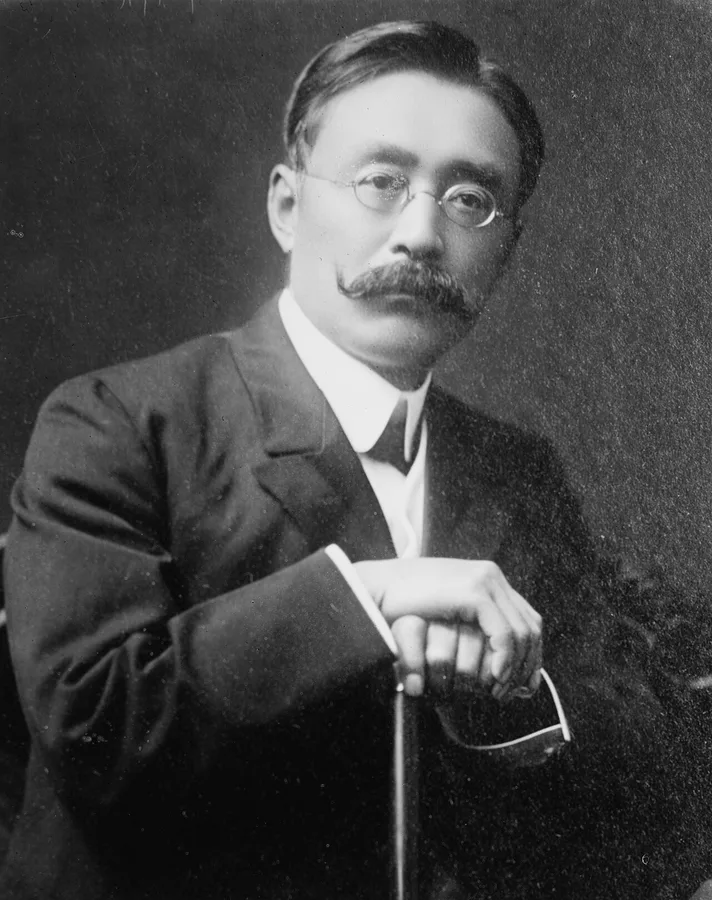
The idea that circulates around the world today —a code of honour shared by all samurai— dates from 1899: Nitobe Inazō (新渡戸稲造) set it out in a book written in English for Western readers, Bushido: The Soul of Japan, and Japanese military nationalism later took it over. None of this invalidates it as an ideal, but it rules out reading it as the norm of eight centuries of warriors: every age and every house had its own.
Further reading
- Wikipedia · Japanese sword The history of the sword, from chokutō to the Bakumatsu, and its use in combat.
- Japanese Wikipedia · the sword hunt The katanagari of 1588, its articles and how current research reads it. In Japanese.
- Wikipedia · the Haitōrei of 1876 The decree that banned wearing swords in public, and whom it exempted.
- Wikipedia · Bushido From the first appearances of the word to Nitobe’s book and its later use.
- Thomas Conlan · State of War The study of fourteenth-century war reports that counted wounds by weapon. University of Michigan Press.
- Wikipedia · Kiri-sute gomen What the supposed right to kill over an insult really was, and the procedure it required.