Shape (sugata)
The silhouette of a blade is the first thing you look at and the first thing that dates it: where the curve falls, how much it narrows towards the tip, how large the kissaki is and how the blade sits in the hand. This topic teaches you to read those features one by one, follows their evolution period by period and explains why the shape we see today in an old blade is not always the one that left the forge: almost all the great kotō blades have been shortened, and centuries of polishing change the point, the thickness and even the curve.
How to look at a blade
The sugata (姿), also called taihai (体配), is the silhouette of the blade and its overall proportions. Together with the grain of the steel (jihada) and the temper line (hamon), it is one of the three features examined first, and the one that says most about the period: even a faithful copy of the grain or the hamon nearly always leaves some clue in the shape. It serves first to date a blade; then, sometimes, to narrow it down to a school or a smith.
The position
The blade is held upright, at arm’s length, with the tang or the hilt at the bottom. The tang has to be exactly vertical: if it leans, the point of greatest curvature always seems to sit near the middle, and a koshizori is mistaken for a toriizori. The same goes for photographs in books, which are best rotated until the nakago is vertical before judging the curve. To see whether the curve grows towards the tip (sakizori), it helps to hold the blade horizontally, with the end of the tang next to your face, and follow the back with your eye.
An order so nothing is missed
There is no official order. This is the one Markus Sesko proposes as his working list in kantei exercises, from the bottom up:
- the length (nagasa);
- the curve: how much and where (sori);
- the width and how it narrows towards the tip, with the funbari;
- the point (kissaki) and the curve of its edge (fukura);
- the ridge line (shinogi) and the band between the ridge and the back (shinogi-ji);
- the back (mune), the thickness (kasane) and the swelling of the faces (niku);
- grooves and carvings (hi and horimono);
- the tang, last.
The weight in the hand
Some experts say kotō, shintō or shinshintō just by lifting the blade. The rule that goes around —“light, kotō; heavy and point-heavy, shinshintō”— is a useful simplification and nothing more: there are very healthy Kamakura tachi that are heavy, and light shintō or shinshintō blades. Weight is a hint; it does not date.


The elements of the shape
Each feature on its own dates little; what dates is the combination. This is the list of what gets examined, with what each usually indicates.
Length
The nagasa (長さ) is measured in a straight line from the machi to the tip. A notably long blade points to an unshortened Kamakura or Nanbokuchō tachi, or to a shinshintō work; a daitō barely longer than a large wakizashi points to the Muromachi.
The curve: how much and where
The sori (反り) is the greatest depth between the back and the chord running from the machi to the tip. Where it falls matters as much as its size: over the centuries the point of greatest curvature moves up from the base towards the tip.
| Type | Where the curve falls | When |
|---|---|---|
| koshizori (腰反り) | below the middle, often at the height of the habaki; in old tachi it continues into the tang | Heian and early Kamakura; revivals |
| koshizori that “bows forward”, utsumuku (俯く) | the curve does not grow again towards the tip: the upper section stays almost straight | late Heian and early Kamakura |
| toriizori (鳥居反り), also nakazori (中反り) or kyōzori (京反り) | around the middle, like the crossbar of a torii | from mid-Kamakura; dominant in late Kamakura and Nanbokuchō; returns in shintō |
| sakizori (先反り) | grows from the monouchi to the tip | Muromachi katana, more marked the later they are; a slight hint points to the end of the Nanbokuchō or the early Muromachi |
| uchizori (内反り) | towards the edge | Kamakura tantō; can also be the result of wear |
| takenokozori (筍反り) | uchizori with scant fukura, “like a bamboo shoot” | late Kamakura, Norishige in particular |
| muzori (無反り) | no curve | tantō of several periods |
The curve is born of the hardening itself: as the edge hardens it expands and bows the blade towards the back. But in a fully developed blade the smith adds curvature on purpose, beyond what the hardening gives, and it is that deliberate curve that separates the styles.
Width, taper and funbari
The width at the machi (mihaba, 身幅) is always judged together with the width at the yokote (sakihaba, 先幅): what dates is how much the blade tapers.
- Long, strongly tapering and deeply curved: a tachi from before the Nanbokuchō, or a copy of one.
- Long, wide, shallow and with little taper: mid-Nanbokuchō, Keichō-shintō or shinshintō.
- Strong taper with a very shallow sori and a compact point: Kanbun-shintō.
Funbari (踏ん張り), “standing with legs apart”, is the flaring of the blade in the first few centimetres above the machi —Sesko speaks of 4 or 5 cm—, on the edge side and on the back. It is not width: a wide blade that tapers evenly has no funbari; what counts is the rhythm of the taper at the base. It only exists on unshortened (ubu) tangs and is lost with machi-okuri, with suriage and with repeated polishing, above all on the back. That is why a blade that keeps it can be taken as unshortened and in its original shape. It is partly explained by the yaki-otoshi (焼き落とし): the hardening began some distance above the machi, and the smith widened the base to compensate for that unhardened section.
The point and the fukura
| Kissaki | What it looks like | What it usually indicates |
|---|---|---|
| ko-kissaki (小切先) | small | the smaller, the older; Heian and early Kamakura |
| chū-kissaki (中切先) | medium | the most common in every period |
| ō-kissaki (大切先) | long | Nanbokuchō, Keichō-shintō, shinshintō |
| ikubi-kissaki (猪首切先) | short and wide, “boar’s neck” | mid-Kamakura, in the line of wide, robust tachi |
| kamasu-kissaki (魳切先) | almost no fukura, “barracuda head” | jōkotō and very early kotō, or reproductions of them |
Beware of the label “ō-kissaki”: many Nanbokuchō blades described that way have points barely bigger than an elongated chū-kissaki, partly because of polishing. Workshops say there is no official rule for measuring the kissaki: the type is judged by eye, relative to the width of the blade. The same workshops use a rule of thumb that compares the length of the point with the width of the blade at the yokote: under 1.5 times that width, the point is short, of the ikubi type; between 1.5 and 2 times, it is a chū-kissaki; over 2 times, an ō-kissaki. It helps you get your bearings; it does not settle an argument.
The fukura (ふくら) is the curve of the edge within the point. Full is fukura tsuku (ふくら付く); scant, fukura kareru (ふくら枯れる). It is scant on Samonji and Sue-Sōshū tantō, on late Muromachi katana, on Ōei-Bizen and in the Kiyomaro school, and it helps avoid mistaking an Ōei-Bizen for a Kamakura Bizen. But the fukura is easily reshaped in polishing: a scant fukura can be original or a repair. The point where the yokote, the shinogi and the ko-shinogi meet is the mitsukado (三つ角).
Shinogi and shinogi-ji
A high shinogi, with a marked diamond section, belongs to Yamato and related schools (Uda, Mihara, Niō, Naminohira), to Sue-Bizen and Sue-Seki, and to all naginata and nagamaki and their conversions. A low shinogi belongs to Bizen and Sōshū (Ichimonji, mid-Kamakura Osafune, Kozori) and to Tsuda Sukehiro. A wide shinogi-ji is Yamato; a narrow one, Sōshū and Yamashiro.
Back, thickness and niku
- The flat back, kaku-mune (角棟), appears almost only on old blades; the rounded maru-mune on old blades and in some schools (Ko-Bizen, Aoe); the two-sided iori-mune is high in Yamato and low in Bizen; the three-sided mitsu-mune appears in Sōshū and on Yamashiro tantō.
- The kasane (重ね) is, strictly, the thickness measured at the back. With a high shinogi a blade looks thick even if its kasane is thin. It is a dating key: mid-Nanbokuchō blades have a very thin kasane for their size, and their Keichō-shintō and shinshintō copies reproduce the silhouette well but with a somewhat thicker kasane. A sudden drop in thickness towards the tip, instead of an even thinning, betrays heavy polishing in the monouchi.
- The niku (肉) is the swelling of the faces: hira-niku (平肉) over the whole face, ha-niku (刃肉) near the edge. Full niku is typical of Kamakura, and its variant full almost to the edge is the hamaguri-ba (蛤刃), the “clam-shell edge”. Niku decreases with the mid-Nanbokuchō and its imitations. Full niku holds up better against hard targets; a flat face cuts well in soft material but with a more delicate edge. Removing niku from a Kamakura blade without need is a polisher’s mistake. Even so, some polishers flatten the faces of healthy blades simply because they shine more in a display case: the blade looks better, but loses the strength the niku gave it.
- The ubu-ha (生ぶ刃) is an unsharpened section next to the machi. It indicates an unshortened blade with little polishing; on a too-perfect “Kamakura” blade, it should raise the suspicion of a copy.
A point of its own: kissaki-moroha-zukuri
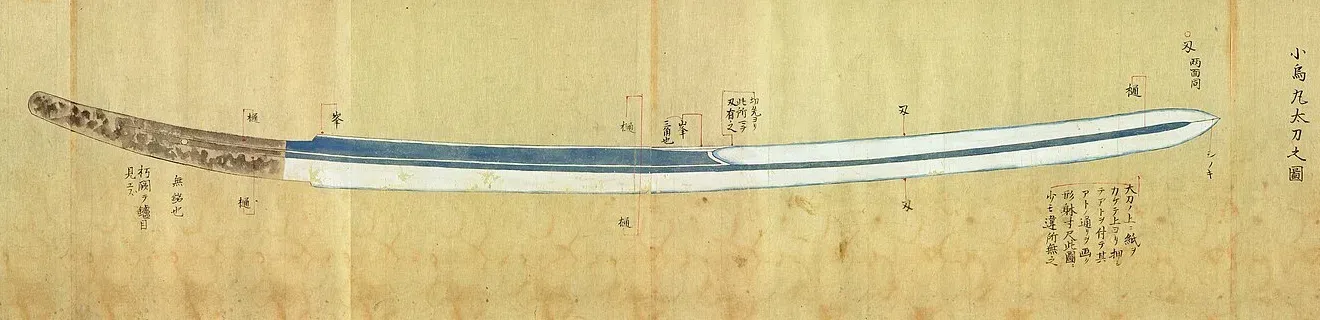
In kissaki-moroha-zukuri (鋒両刃造) the point section is double-edged: the back of the point is sharpened and hardened, unlike kanmuri-otoshi, which only thins the back. It is also called kogarasu-zukuri (小烏造) after the Kogarasumaru (小烏丸), the blade that best represents the passage from the straight thrusting sword to the curved cutting one: 62.8 cm of nagasa and 1.2 cm of sori, strong curvature at the base and almost none above, an ubu tang and no signature. Tradition attributes it to Amakuni and makes it a treasure of the Taira; it resurfaced in 1785, passed to the Sō of Tsushima, who gave it to Emperor Meiji in 1882, and today it is imperial property (gyobutsu, 御物). Its date ranges, depending on the source, from the late Nara to the mid-Heian. The straight swords of the Shōsōin (正倉院) already include examples of this point, and in the Bakumatsu and early Meiji it was copied out of nostalgia. According to workshop tradition, on those Shōsōin swords the double edge runs for about 10 cm at the point, on a kiriha-zukuri blade; from the 12th century the form was rare in warriors’ hands, survived as a ceremonial court sword and evolved into kanmuri-otoshi. Workshops also explain why a long blade with two symmetrical edges hardly exists in Japan: hardening curves the blade towards the back, and with two hardened edges that tension has nowhere to go.


Shape period by period
The tables follow the stylistic stages of Markus Sesko’s kantei series, checked against Japanese Wikipedia and the Hyōgo Prefectural Museum of History. Their dates are those of the shape, not of politics, and do not fully match those of the topic “Periods: from jōkotō to shinsakutō”. The trend is firm; the smiths in each row are just two or three examples, and the measurements are indicative.
Tachi and katana
| Stage and label | The shape | Examples |
|---|---|---|
| Late Heian (11th–12th c.) · yūbi (優美), “graceful” | slender, strongly tapering, deep koshizori bowing forward towards the tip and continuing into the tang, funbari, ko-kissaki; about 80 cm | Sanjō Munechika, Ko-Bizen Tomonari, Hōki Yasutsuna |
| Early Kamakura (1185–1232) · yūsō (優壮), “elegant and strong” | a little wider, with a larger point, less taper; koshizori still marked | Awataguchi Kunitomo, Ko-Ichimonji Norimune, Ko-Aoe Sadatsugu |
| Mid-Kamakura (1232–1288) · gōsō (豪壮), “magnificent” | longer and wider, little taper, from koshizori to toriizori, abundant niku, full chū-kissaki; alongside, a sturdier line with ikubi-kissaki | Awataguchi Kuniyoshi, Fukuoka-Ichimonji Yoshifusa, Osafune Mitsutada |
| Late Kamakura – early Nanbokuchō (1288–1336) | longer still, larger point, toriizori, thinner kasane and less niku | Rai Kunimitsu, Osafune Kagemitsu, Enju Kunisuke |
| Mid-Nanbokuchō (1336–1375) · Enbun-Jōji-sugata (延文・貞治姿) | tachi up to 90 cm and ōdachi over 120; little taper, scant niku, thin kasane, shallow toriizori, ō-kissaki with scant fukura; nearly all shortened today | Hasebe Kunishige, Kanemitsu, Ōmiya Morikage |
| Late Nanbokuchō – early Muromachi (1375–1428) · Ōei-Bizen (応永備前) | a step back: shallow toriizori, thicker kasane, taper and chū-kissaki; at the end, “Kamakura-style” tachi with a slight sakizori | Sanjō Yoshinori, Osafune Morimitsu, Kozori Tsuguyuki |
| Mid-Muromachi (1428–1467) | shorter, more taper, thicker kasane, growing sakizori: the passage from tachi to katana | Osafune Norimitsu, Sukemitsu, Toshimitsu |
| Late Muromachi (1467–1555) · katate-uchi (片手打ち), for one hand | short katana of 60 to 65 cm, slightly elongated chū-kissaki, wide with little taper, thick kasane, deep sakizori | Osafune Sukesada, Muramasa |
| End of the Muromachi (1555–1572) | lengthens again (73–75 cm); wide, thick kasane, sakizori still clear | Osafune Sukesada, Kanetsune |
| Momoyama – early Edo (1572–1624) · Keichō-shintō (慶長新刀) | a revival of the already shortened Nanbokuchō: 70–75 cm, wide, little taper and little niku, shallow sori, ō-kissaki or elongated chū-kissaki, kasane somewhat thicker than the originals | Horikawa Kunihiro, Echizen Yasutsugu, Hizen Tadayoshi |
| Early Edo (1624–1652) · Kan'ei-shintō (寛永新刀) | about 70 cm, moderate sori, taper, chū-kissaki | Kunisada, Kunisuke |
| Later Edo (1652–1688) · Kanbun-shintō (寛文新刀) | about 70 cm, strong taper, shallow sori, compact chū-kissaki tending towards ko-kissaki; one of the easiest shapes to recognise | Inoue Shinkai, Nagasone Kotetsu, Nagasone Okimasa |
| Mid-Edo (1688–1781) · Genroku-shintō (元禄新刀) | the Kanbun shape is left behind: more sori, harmonious taper, chū-kissaki; the “typical” katana | Ikkanshi Tadatsuna, Yasukuni |
| Late Edo (1781–1844) · fukkotō (復古刀) | 70–75 cm, somewhat wider, gentle taper, deep sori, chū-kissaki: a return to Kamakura | Suishinshi Masahide, Taikei Naotane, Hosokawa Masayoshi |
| Bakumatsu – early Meiji (1844–1876) | a new revival of the mid-Nanbokuchō: wide, little taper and little niku, shallow sori, ō-kissaki or elongated chū-kissaki, kasane thicker than the originals | Minamoto Kiyomaro, Masao, Sa Yukihide |
| Bakumatsu, variant · kinnōtō (勤王刀) | long blade of about 85 cm, almost no sori, chū-kissaki | Sa Yukihide, Saitō Kiyondo |
The Kanbun-shintō has two explanations, and neither is proven: Sesko attributes it to a swordsmanship that preferred the thrust to the cut, and Japanese Wikipedia to training that was by then done mostly with bamboo swords (shinai, 竹刀), which are almost straight.
Tantō and ko-wakizashi
| Stage | The shape | Examples |
|---|---|---|
| Early Kamakura | hira-zukuri, slight uchizori, full fukura; nearly always under 24 cm | Awataguchi Kunitomo, Awataguchi Hisakuni |
| Mid-Kamakura | the standard length, jōsun (常寸), of 25 to 26 cm, without sori or with uchizori; the most balanced proportions | Awataguchi Norikuni, Rai Kunitoshi, Shintōgo Kunimitsu |
| Late Kamakura | the jōsun coexists with tantō of 27 to 32 cm, wider and almost without sori; the hōchō-tantō (包丁), very wide for its length | Rai Kunimitsu, Masamune, Sadamune |
| Mid-Nanbokuchō | the Enbun-Jōji shape in short: 30 to 40 cm, wide, full fukura, thin kasane, clear sakizori (sunnobi-tantō, 寸延短刀) | Hiromitsu, Kanemitsu, Aoe Tsugunao |
| Late Nanbokuchō – early Muromachi | the classic tantō becomes scarce; long hira-zukuri ko-wakizashi with sakizori | Osafune Morimitsu, Nobukuni |
| Mid and late Muromachi | wide ko-wakizashi with deep sakizori; a revival of the Kamakura tantō (23–26 cm, uchizori) and moroha-zukuri of 20 to 23 cm | Kanefusa, Muramasa, Shimada Yoshisuke |
| Momoyama | an Enbun-Jōji revival with sakizori, fuller fukura and thicker kasane; wide katakiriha-zukuri | Umetada Myōju, Horikawa Kunihiro |
| Edo | tantō production falls; mostly copies of kotō pieces, longer | Nagasone Kotetsu, Mino no Kami Masatsune |
| Shinshintō | an Enbun-Jōji revival of 39 to 43 cm and of the Kamakura tantō, nearly always with a thicker kasane | Minamoto Kiyomaro, Saitō Kiyondo |
The wakizashi
The shinogi-zukuri wakizashi, “like a small katana”, does not appear until the Muromachi and is rare until the middle of the period. Many blades just under two shaku from before the Edo were forged as uchigatana or katate-uchi and are classed as wakizashi today only by their length: the label on a listing does not say what the blade was made for.



Shortened blades: machi-okuri, suriage and ō-suriage
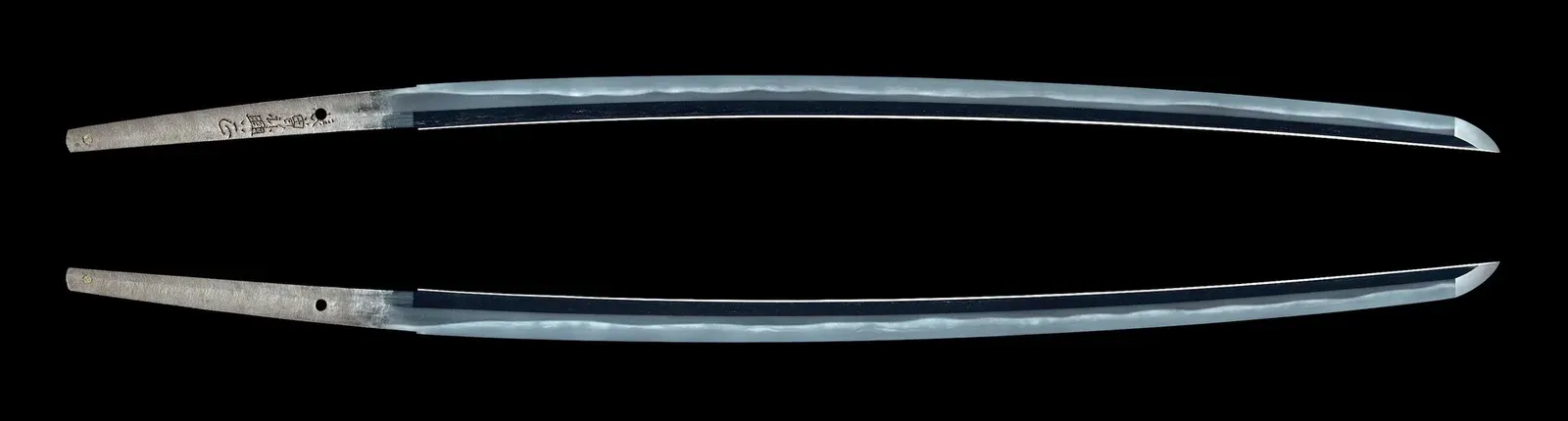
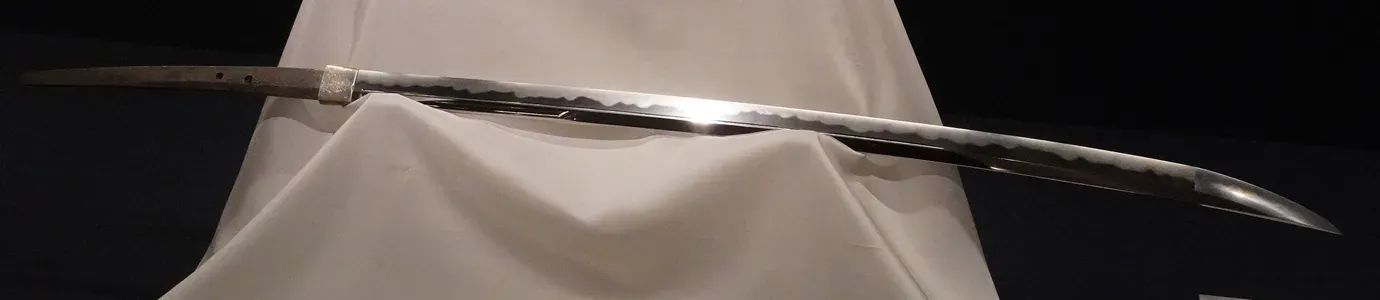
Steel was expensive, and shortening a serviceable blade cost less than forging a new one: shortening is almost as old as the forge. Blades were shortened to suit the person who would carry them, to fit changes in combat —from horseman to foot soldier— and to meet Edo regulations. The consequence for today’s viewer is clear: most surviving Kamakura and Nanbokuchō tachi have been shortened, and one at its original length is rare.
Three degrees of shortening
- Machi-okuri (区送り): the notches of the machi are moved up without cutting the tang. The blade becomes a little shorter, the tang longer and still ubu (生ぶ), but the funbari is lost.
- Suriage (磨上げ): the end of the tang is cut off and a new one is made from the lower part of the blade, keeping part of the original tang and often the signature.
- Ō-suriage (大磨上げ): the shortening is so great that nothing of the original tang or signature remains.
In the workshop, to remake the tang, the edge and the back are ground down and only one face, the back one, is thinned to give it its taper; that is why a groove (hi) running into the tang ends shorter on that face. Sometimes the part of the hamon that becomes tang has to be softened with heat, and the hamon fades out next to the new machi. In workshop practice the new filing is done straight across (kiri) and the end is cut straight, whatever the original was, which helps tell what was remade from what left the forge; before the 16th century this is not a fixed rule. In workshop parlance, moreover, “ō-suriage” is sometimes said of any remade tang without a signature, even when the cut was short.
Saving the signature
On an ō-suriage the signature can be saved in two ways: the orikaeshi-mei (折返銘), in which the signature is folded over to the other face and ends up upside down, and the gaku-mei (額銘), also tanzaku-mei (短冊銘), in which it is cut out as a plaque and inlaid into the new tang. Shortened tangs also often carry an attribution inlaid in gold (kinzōgan-mei, 金象嵌銘).
Tenshō-suriage and Keichō-suriage
These are modern labels for the ō-suriage of those two eras when, according to Sesko, the elite —from Oda Nobunaga to Hideyoshi— sought Sōshū and Sōden-Bizen works of the Nanbokuchō to wear shortened as uchigatana. The sources disagree on the detail; what they share is this: in Tenshō-suriage the end of the tang was finished carefully so that it looked original, and in Keichō-suriage the tang, with little taper, was cut straight.
How to recognise an ō-suriage
- The shape. In workshop practice a true ō-suriage has at least some 10 cm cut off, and a shortening like that takes the funbari with it: the base loses its flare, and the blade looks wider in the middle than next to the machi. An “ō-suriage” that keeps a strong funbari was probably cut little, or not at all.
- The hamon at the machi. According to workshops, on an ō-suriage the original hardening runs into the new tang or fades out from the heat of the cut. But a hamon that fades out at the machi proves nothing on its own: smiths also reheated the tang after hardening.
- The utsuri. For workshops, if it starts close to the machi, the blade was shortened little.
- The filed-off signature. Workshops tell of full-length blades whose signature was filed off to pass them off as the ō-suriage of a more famous smith: works by Sekido have been seen presented as Ichimonji, by Echizen Yasutsugu as Masamune and by Mihara as Rai. There are documented cases of signatures and attributions later withdrawn.
Other ways of remaking a blade
A blade with a broken point can be remade by grinding the back down heavily: the result is a dry, sharp point, sometimes with an acquired shōbu-zukuri shape and with the bōshi turned into yakizume, and since the machi hardly moves many keep their signature. Specialists call it satsuma-age (さつまあげ), a recent term. Conversions of pole arms, naginata-naoshi (薙刀直し) and nagamaki-naoshi (長巻直し), have a look of their own: sakizori or nakazori and unokubi, kanmuri-otoshi or shōbu shapes; nagamaki-naoshi usually have a remade yokote and bōshi, and naginata-naoshi often neither. See “Blade types”.



When the shape changes by itself: polishing, wear and repairs
The shape we see on an old blade includes centuries of use and polishing. Each polish removes steel, and removes it unevenly: the point, thin and exposed, loses more than the base. Some consequences are well documented; others are workshop hypotheses best treated as such.
- The uchizori of tantō. Repeated polishing wears the thin point of a tantō first and can produce or accentuate uchizori: a tantō without uchizori is usually healthier.
- The point. With use and polishing the edge of the point rounds off and the yokote moves down towards the tang. Workshops hold that many small Heian and early Kamakura points were originally drier, of the kamasu type, and that the shape we see is partly wear. But the relationship also works the other way round: a very dry point can be the result of a restoration that removed a lot of material. Both things can be true. According to the same workshops, original kamasu points are seen above all on blades that were barely used, those offered to temples and shrines before they were ever carried, such as an Ichimonji tachi that belonged to the Uesugi.
- The curve. Repairing a broken point by grinding down the back reduces the curve near the tip. Workshops have also observed that wear does the opposite of hardening: the curve comes from the tension of the hardened edge, and as the hardened zone shrinks with polishing, the sori drops, above all towards the top, where the blade wears most. The result, those workshops say, is a more pronounced koshizori: the curve we see today on a Heian tachi is real, but it includes some wear.
- Thickness and width. Workshops explain it like this: on a new blade the thickest point is the machi. Polishing thins and narrows the blade but not the tang, so the thickest point moves down towards the tang, the machi loses depth and the habaki area seems to sink; if the machi disappears altogether, it has to be recut with a file. A sudden drop in thickness in the monouchi also changes the balance of the blade.
- The faces. Each polish lowers the niku. A good polisher tries to preserve the original geometry; a poor one flattens the faces. A workshop has shown it with two sister blades by the same smith, forged the same way and polished by the same person: the one polished with restraint lost 138 g and barely 0.2 mm of thickness at the yokote; the over-polished one lost 270 g, and its thickness at the yokote fell from 6.0 to 3.8 mm.
Polishers know that a thorough repolish can erase the history of the shape —a back rippled by use that is left straight, a broken point that is remade— and polishing changes the appearance of the hamon and the grain, though not the real hardening.

What the shape dates and what it does not
Shape is the best tool for dating, but it has limits worth knowing before relying on it.
A biased corpus
From the Kamakura, almost only blades by famous smiths made for high-ranking clients survive unshortened. One also has to distinguish between war tachi (hyōjō no tachi, 兵仗太刀) and ceremonial ones (gijō no tachi, 儀仗太刀), and between those of courtiers, warriors, temple treasures and common soldiers: what we see is the tip of the iceberg. The Ō-Kanehira, an unusually wide Heian tachi, is a reminder that not even one period had a single shape.
Smiths with two shapes
Until the mid-Nanbokuchō some smiths —Rai Kunitoshi, Osafune Nagamitsu, Kagemitsu, Kanemitsu, the Enju school— made both the shape of their time and a classic one, in the manner of the Heian or the early Kamakura. An “old” shape does not guarantee an old blade.
Copies and revivals
Keichō-shintō and shinshintō imitate the Nanbokuchō silhouette well, but with a thicker kasane: that is the first place to look. The shinshintō smiths of the Masahide and Naotane school also copied Yamashiro, with funbari, and Bizen, with koshizori.
Early dates the shape contradicts
Many smiths were dated in pre-Edo documents to eras that are too early: Munechika around Eien (987–989), Yasutsuna around Daidō (806–810). The surviving blades do not support this. The fully developed blade —shinogi-zukuri with a deliberate curve— belongs to the turn of the 10th and 11th centuries, and those smiths are better placed in the late Heian.
Explanations of the age: hypotheses, not causes
It is tempting to read each shape as a portrait of its time: the ikubi-kissaki as warrior spirit, the ō-kissaki as Nanbokuchō ostentation, Heian slenderness as courtly elegance. These are interpretations. The date of the ikubi-kissaki —mid-Kamakura, in a line of robust tachi that coexisted with a more slender one— is well established; its cause is not: some link it to the Jōkyū war of 1221; others read it as a reflection of the sober, sturdy taste of the Kamakura warrior class. Likewise, Sesko sees the mark of the Mongol invasions in less niku, a thinner kasane and a longer point, but as an indirect relationship that only shows three or four decades later.

Further reading
- Markus Sesko · Kantei 1, sugata The starting point of the kantei series: how to look at the shape and what each feature dates.
- Markus Sesko · the tachi shape, Heian to Muromachi The stages of the shape with their reference blades and measurements.
- Markus Sesko · Tenshō-suriage and Keichō-suriage What sets the two tang finishes apart and why Nanbokuchō blades were shortened that way.
- Wikipedia · Nihontō (日本刀) The history of the shape period by period and the types of sori, with Japanese bibliography. In Japanese.
- Hyōgo Prefectural Museum of History · the shape of the sword A museum introduction to the silhouette and its evolution. In Japanese.
- Wikipedia · Glossary of Japanese swords Short definitions of the terms of shape: sori, funbari, kissaki, fukura.