Kantei: how to look at a blade
Kantei means looking at a blade until you can say who made it, where and when, before reading the signature. This is the method: the order in which a blade is examined, the question each step answers, what the tang records besides a name, what an oshigata is, and how the game works with which Japanese enthusiasts have trained their eye for centuries. The outcome of all that work, the certificate, has a topic of its own: NBTHK papers.
What kantei is (and what it is not)
Kantei (鑑定) today means attributing a blade to a smith, a school, a province and a period from what can be seen in it: the shape, the steel, the temper and the tang. The same word names the certificate that records the attribution, the kanteisho (鑑定書), and the game of guessing the maker with the signature covered, described further down.
The older word is mekiki (目利), "having an eye". According to the researcher Markus Sesko, mekiki judged above all the quality of a blade by its appearance, and in the Muromachi period it gave way to a kantei whose main purpose was attribution. That there were already experts in the fourteenth century who told "the good from the bad" in swords is recorded by a chronicle of the time, the Masukagami (増鏡).
Workshops also speak of a warriors' judgement, buke-mekiki (武家目利), the «samurai's eye», said to have always stood alongside that of the professional experts. According to that tradition, it looked at what mattered to the person carrying the blade, its quality and its cutting ability, more than at the pattern of the temper line, and in the Momoyama period, when the Hon'ami already enjoyed Toyotomi Hideyoshi's favour, there were still warriors known as connoisseurs, such as the daimyō and poet Hosokawa Yūsai, or the Hasegawa house of Mino, to which genealogies of smiths and albums of rubbings are attributed. Today the word kantei covers the judgement, the paper and the game, but the warrior's question still lies underneath it all: not only whose blade it is, but whether it is good.
Two things kantei is not. It is not reading the signature: ideally the signature comes last and only confirms what the blade has already said, because a signature is easier to fake than a smith's way of working. And it is not the paper: a paper records the judgement of a panel of experts at a given moment; it changes what people think of the blade, but the blade is the same as it was before the examination (see NBTHK papers).
The order of looking: shape first, nakago last
The usual practice, among authors and schools alike, is to start and end in the same place: first the shape (sugata, 姿), last the tang (nakago, 茎). In between come the steel (jigane, 地鉄), the temper (hamon, 刃文) and the tempered point (bōshi, 帽子), and the order of those steps varies from author to author: some put the steel before the temper, others, such as the European branch of the NBTHK, the temper before the steel. What recurs is the order at both ends.
Each step answers a different question:
| Step | What you look at | What it tells you |
|---|---|---|
| 1. Shape | length, curvature and where its deepest point falls, width, thickness, size of the point | the period |
| 2. Steel | density and pattern of the hada, colour and clarity of the metal | the region or the school |
| 3. Temper | pattern of the hamon, nie and nioi, activity within the temper | the school or the smith |
| 4. Point | how the temper turns in the bōshi | narrows down the school and the smith |
| 5. Tang | patina, file marks, holes, signature | confirms and sometimes dates |
The shape is looked at from a distance: the blade held upright at arm's length, to take in its proportions, curve and balance at once. It rarely deceives; even faithful copies of old blades usually give themselves away in some detail of the shape (see Shape (sugata)). The weight in the hand is a hint, but the rule "light means old, heavy means recent" has so many exceptions that it is useless on its own.
The steel needs care, because its appearance depends heavily on the polish: its age, the polisher's hand and the finish. It pays to look at what the polish does not change, the density and pattern of the hada: an even hada along the whole blade speaks of a good smith. The temper, finally, is examined by moving the blade against the light, because its activity only shows at certain angles (see The temper line up close).

How a blade is held and looked at
Japanese custom asks for a gesture before drawing: a slight bow to the sword. The blade is then drawn slowly with the edge upwards, letting the back slide along the inside of the scabbard so that the edge does not touch the wood. For a proper study the bamboo peg (mekugi, 目釘) is removed, the hilt and the collar (habaki, 鎺) are taken off, and the blade is held by the tang, with a cloth or a sheet of thin paper between hand and steel.
Light is the tool. The shape and the colour of the steel show well in diffuse light, but the activity of the temper (the nie, the nioi and their patterns) only appears when the blade is tilted towards a concentrated light and moved slowly, from the base to the point and on both sides. Each stretch of the blade needs its own angle, and a beginner who takes in the whole blade at a glance misses almost everything.
Two common-sense rules: the steel is not touched with the fingers, because the grease of the skin stains and rusts it, and nothing is rubbed over its surface without knowing what one is doing (see Polishing and care). The polisher and expert Nagayama Kōkan added a third, recalled by the European branch of the NBTHK: before examining a blade, give thanks to all the owners who have kept it until today.
Omote and ura: the two faces
Every blade has a front, the omote (表), and a back, the ura (裏). The omote is the face turned outwards when the sword is worn, and since the two main ways of wearing it are opposite, so is the "outer" face.
The tachi hung from the belt with the edge down: its outer face is the haki-omote (佩表) and the inner one the haki-ura (佩裏). The katana is thrust through the obi with the edge up: its outer face is the sashi-omote (差表) and the inner one the sashi-ura (差裏). The smith signs on the outer face, so with both blades laid with the point to the same side, the signature falls on opposite faces of the tang: that is the difference between tachi-mei (太刀銘) and katana-mei (刀銘). This is why Japanese museums display a tachi edge down and a katana edge up: the visitor always sees the signed face.
The rule has exceptions, since some smiths signed tachi on the other face. The side of the signature is a clue, but it does not decide on its own whether a blade was made as a tachi or as a katana: the shape has the last word. The date, when there is one, usually goes on the ura.
The most often cited exceptions are Yukihira of Bungo, who habitually signed his tachi on the haki-ura, and many tachi of the Aoe school of Bitchū, signed on the inner face. A shortened blade, moreover, keeps its type as long as it keeps its signature: a tachi cut down at the tang (suriage, 磨上) that still has it remains a tachi; if the cut took it away, it is treated as a katana; and a naginata heavily shortened and turned into a sword becomes a katana or a wakizashi.
Nor do the two faces always have the same temper line, and that is not necessarily a flaw. In the practice of the workshops there are four causes: an uneven quench, frequent in old blades and rare in shintō; one face ground down more than the other by polishing; a steel construction that is not symmetrical; and, rarely, the smith's intention. The famous case of the last is the Konotegashiwa (児手柏), a kodachi by Kanenaga of the Tegai school of Yamato, from the late Kamakura period, with an undulating temper line on the omote and a straight one on the ura. Hosokawa Yūsai named it after a plant that a poem in the Man'yōshū (万葉集) uses as an image of two-faced people. That is why the temper line is always judged by looking at both faces.

The nakago as a document
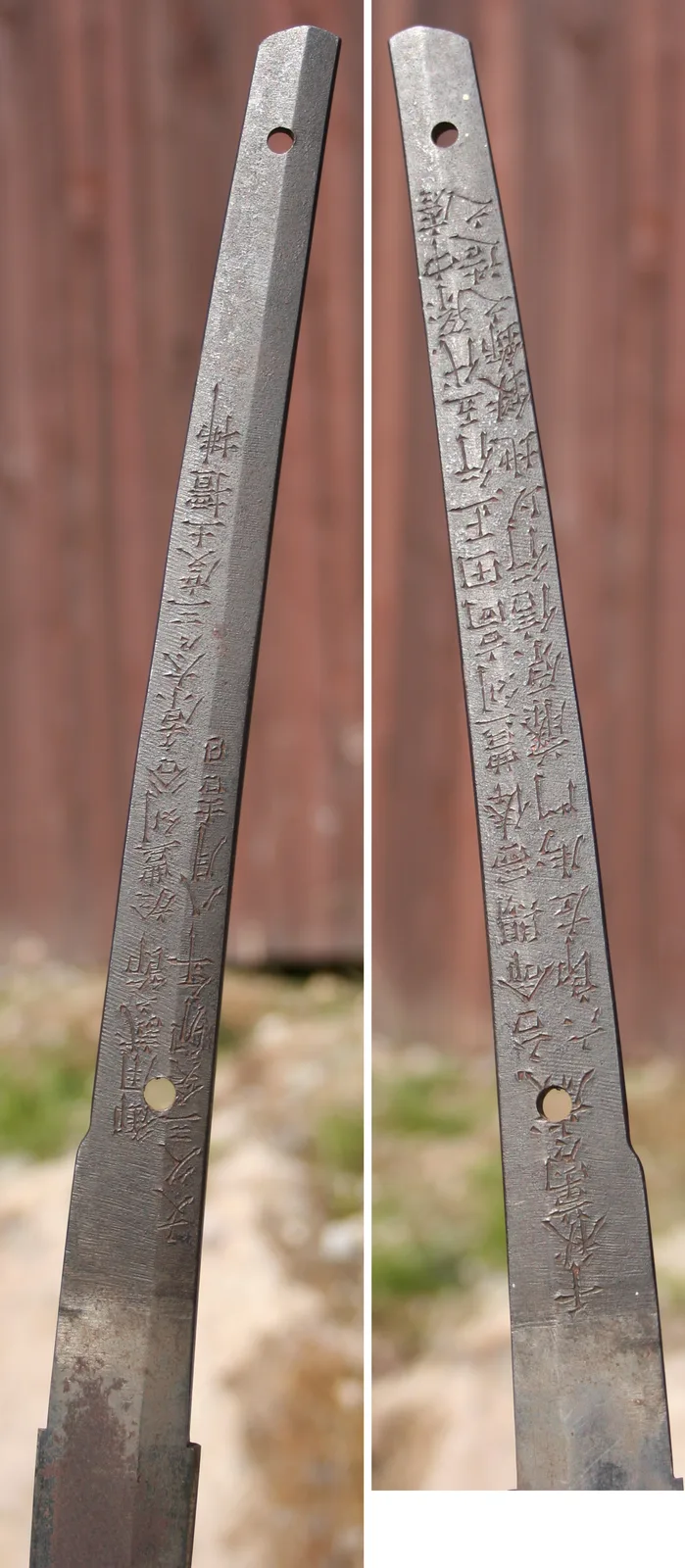
The tang is never polished (see Anatomy of the katana), and so it keeps what the rest of the blade has lost to successive polishes: the surface the smith left, his file marks and centuries of rust. A nakago is examined with the hand and the eye: its feel, its patina, the state of the holes, the file marks, the shape of the end, the finish of the back and, if there is a signature, besides what it says, the direction in which the chisel entered each stroke.
The patina
The sabi (錆), the rust patina of the tang, helps to date and to authenticate. There is no "correct" colour valid for every blade; what can be recognised is fabricated patina. Grounds for suspicion are rust that has not settled and looks young for the age attributed to the blade; a rough or finely granular texture, like the one chemicals leave; a colour in uneven patches; a straight-line border between the rusted and the clean area, without the natural transition; and sometimes a smell unlike that of ordinary rust. A doubtful patina casts doubt on a good signature. And genuine patina is never cleaned: information goes with it that does not come back.
On colour, connoisseurs do not agree: some workshops take a black, dense patina as the sign of good steel, while for others the right one is reddish brown, chocolate-coloured, never black. That is why it pays to look for the signs of a manufactured patina rather than for a colour.
The file marks
The yasurime (鑢目) roughens the tang so that it does not slip inside the hilt. Each smith did it his own way, with files he made himself, and that is why it helps to tell schools and smiths apart. File marks slanting the opposite way to the usual, katte-agari (勝手上り), are typical of left-handed smiths and weigh heavily in an attribution. The decorative filing, keshō-yasuri (化粧鑢), combined with the others, appears in the second half of the shintō period and helps with dating (the types of file marks are in Anatomy of the katana).
The holes
The peg hole (mekugi-ana, 目釘穴) tells the story of the blade. A single one usually points to an original tang; several, to remountings or a shortening, although some Bakumatsu blades, some spears and blades made for iai may have two from the start. Besides how many there are, their shape matters: a hole stretched into an oval (urizane), two merged into a gourd shape (hyōtan, 瓢箪), one overlapping another in a heart shape (inome, 猪の目) or one plugged with soft metal (semegane) are almost always traces of successive mountings, not a design; the square one (masugata, 枡形) is an archaic form. Sesko has studied a classification of these shapes written in 1806, but the idea is enough: the shape of the hole is history.
What is inscribed besides the name
- The date (nenki, 年紀), with the name of the era (nengō, 年号), usually on the ura.
- The owner: an ownership inscription (shoji-mei, 所持銘) of the kind "in the possession of such-and-such lord".
- The commission (chūmon-mei, 注文銘): who the blade was made for.
- The smith's age (gyōnen-mei, 行年銘), often on a notable birthday and counted the traditional way (kazoedoshi, 数え年): one is born aged one and adds a year each New Year.
- The result of a cutting test (tameshi-mei, 試銘), sometimes inlaid in gold. What that test was and who performed it is told in Ranks, cutting tests and titles.
Attributions written by others
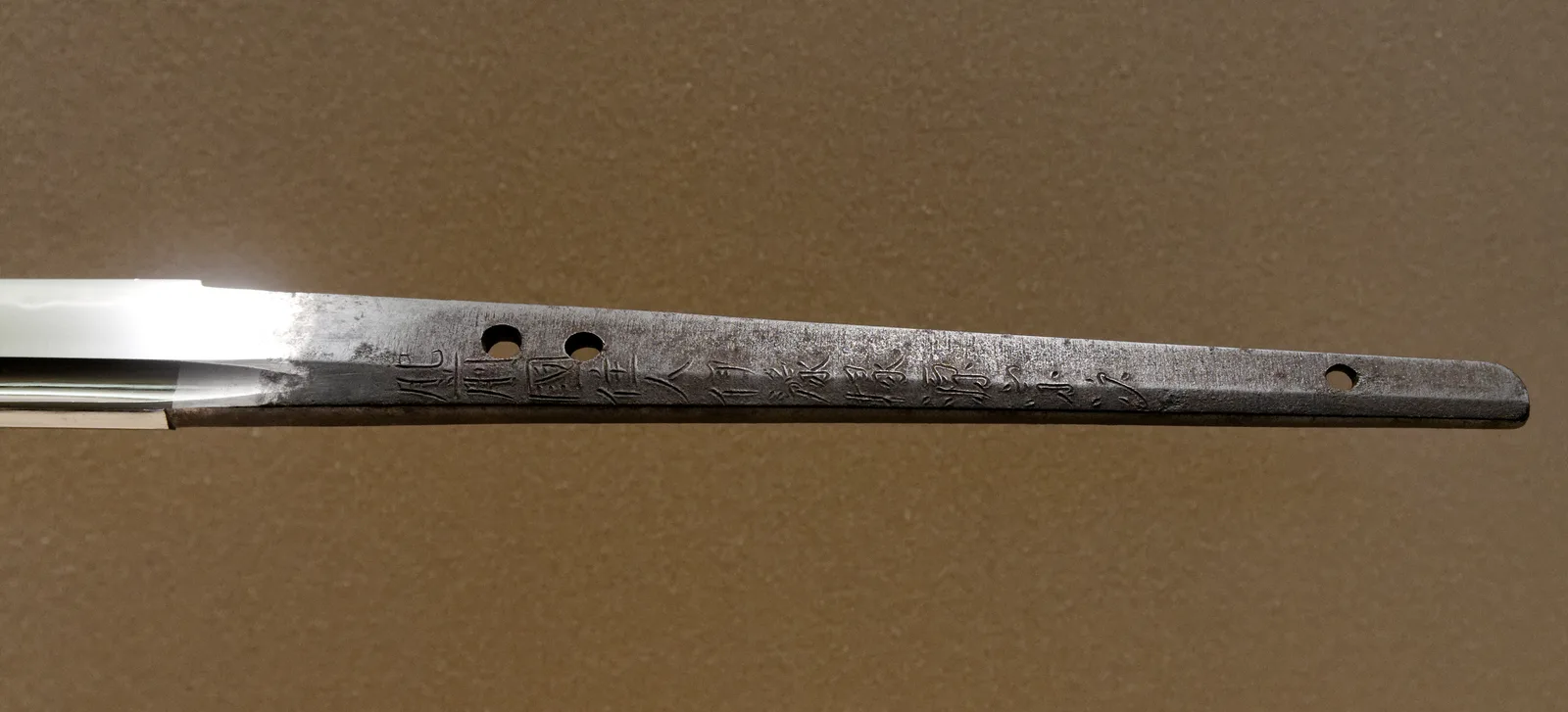
Not everything written on a tang was written by the smith. On unsigned or shortened blades, experts left their verdict on the tang itself: inlaid in gold (kinzōgan-mei, 金象嵌銘), almost always the work of the Hon'ami; in red lacquer (shu-mei, 朱銘); or in lacquer with gold powder (kinpun-mei, 金粉銘). They are attributions, not signatures, and are judged as such: a gold inlay can even be removed if the attribution stops convincing. For the same reason, before "cleaning up" a signature that looks doubtful several opinions are needed: an odd signature may be a local custom nobody recognised in time, and scraping it off destroys the document.


Why there are good unsigned blades
An unsigned blade (mumei, 無銘) is not a lesser blade for that reason. There are two very different kinds. The ubu-mumei (生ぶ無銘) never had a signature: the smith did not put one. The other lost it: when a blade is heavily shortened from the tang (ō-suriage, 大磨上), the signed part disappears. In this second case the signature was sometimes saved by cutting it out and setting it into the new tang (see Anatomy of the katana), or an expert left his attribution in gold or lacquer.
The most famous case is Masamune. Only a few blades signed by him are accepted, among them the Fudō Masamune, the Kyōgoku Masamune and the Daikoku Masamune, and almost all the work attributed to him is mumei. Why he signed so little is not known. The scarcity of signatures even fed, in the Meiji era, the theory that Masamune had never existed, which the signed blades refute (see Famous swords and legends).
For blades that were never signed, several explanations are put forward, all of them hypotheses: that a smith, out of respect, did not sign an offering to a temple or shrine, or a blade made for a great lord; or that in some workshops the custom was to sign little. None holds for every case. What is certain is that without a signature the attribution depends entirely on the blade, and that is where kantei does its work: NBTHK papers attribute mumei blades to a smith or a school, and say so, as an attribution.
Some cases illustrate those explanations. The swords that the Ise shrine renews every twenty years along with the rest of its treasures, in the ceremony of the transfer (shikinen sengū, 式年遷宮), were made unsigned for centuries; smiths tell that a modern swordsmith, recognised as a Living National Treasure, was the first to sign his, as one who answers for his work. The Kasuga Taisha shrine in Nara keeps tachi offered to it by the nobility since the Heian period; there is a story of an unsigned one in the old Bizen style that spent centuries there before being polished again, and in 2017 a long late-Heian tachi, attributed to the earliest smiths of Hōki, was identified at the same shrine. Many Yamato blades, made for the great temples, were not signed either, and some schools signed only with the group's name, such as the Ichimonji of Bizen, sometimes with a single stroke (一, ichi), or the Gassan school.
At other times the signature was removed on purpose. When the Tokugawa began to frown on Muramasa's blades, some owners erased or altered his signature. There are also stories of daimyō who scraped off the signature of a family heirloom so that the shōgun would not claim it, and of signatures of lesser smiths erased to pass the blade off as an ō-suriage by a great name. Faced with an unsigned tang, the question is always threefold: whether it never had a signature, whether it was lost when the blade was shortened, or whether someone took it off.
The oshigata: a reading, not a photograph
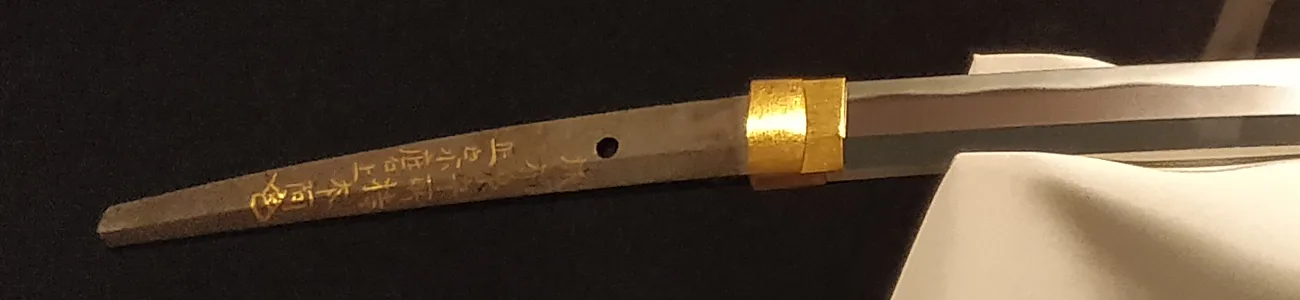
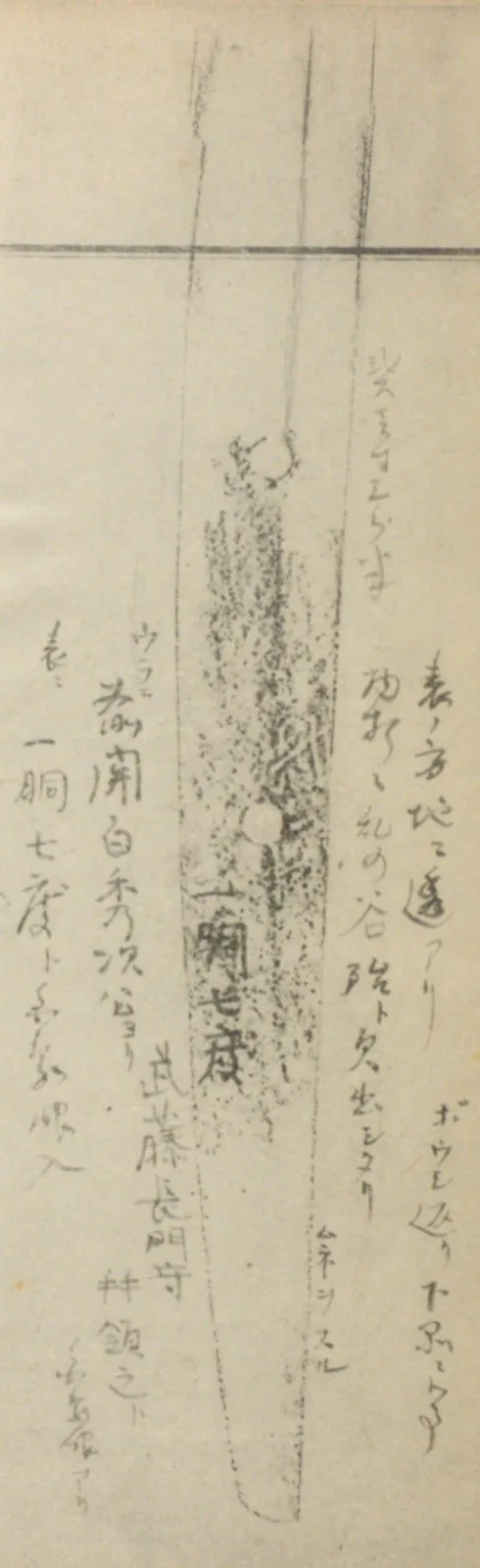
An oshigata (押形) is a tracing of the blade: the outline and the tang with its signature are taken by rubbing solid ink over thin paper laid on the steel, and the hamon is then drawn by hand, looking at the blade. It is a practice peculiar to Japan.
It began in the Muromachi period with drawings of signatures and tangs, probably to teach how to recognise forged signatures. In Momoyama it came to record the shape and the temper; the most famous of that time is Hon'ami Kōtoku's, with the blades of Toyotomi Hideyoshi. The present method, with a solid ink called sekkaboku (石華墨), at first imported from China, was settled at the end of the Edo period, and in the Meiji era the hamon began to be drawn in pencil, with greater precision. The paper is held down with weights, never with magnets, which would magnetise the blade.
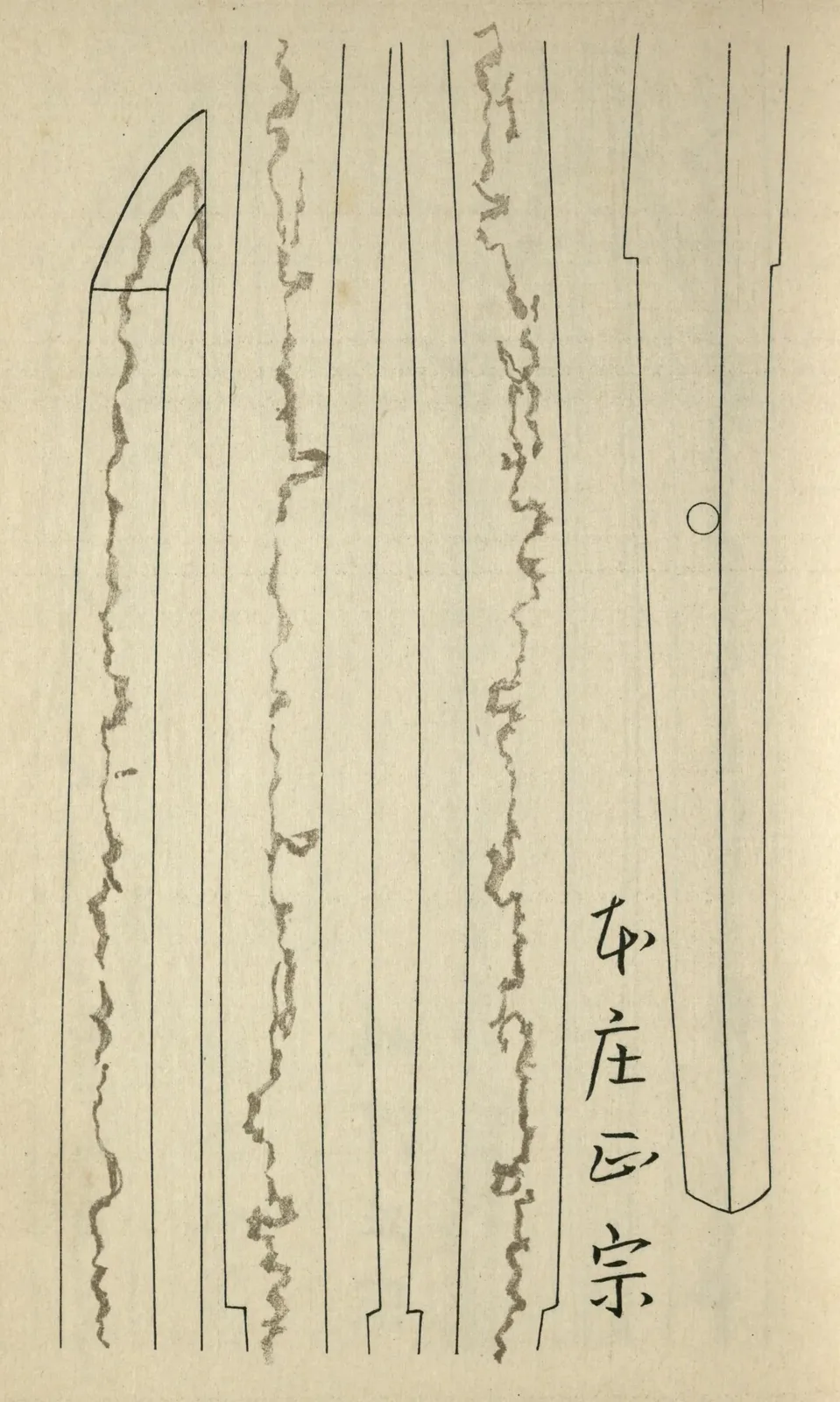
Photography has taken over much of its role, but the oshigata lives on in study, in reference books and in the examinations. Drawing a hamon well is difficult and few do it, mostly polishers. And there lies its limit: an oshigata is someone's reading. Sesko has published several oshigata of one and the same blade, made by experts, that agree neither on the course of the hamon, nor on its activity, nor on the point. What counts is how familiar the draughtsman is with the smith, the polish (in a fresh polish some details stand out more, and the blade "calms down" over the years) and the draughtsman himself. An oshigata helps study, but it does not replace the blade or a good photograph.

The words of kantei: images and elegance
The vocabulary of kantei sounds like poetry and confuses the beginner. There is a reason: it was not created by metallurgists but by literate enthusiasts who described what they saw in images. There is science behind it, since the activity of the temper (hataraki, 働き) consists of martensite formations, with large crystals in nie and tiny ones in nioi, but the names are those of a landscape:
| Term | The image | What it is |
|---|---|---|
| sunagashi (砂流し) | flowing sand | sweeps of nie along the hamon, like the pattern left by sand carried by water |
| kinsuji (金筋) | golden threads | short, bright lines of nie within the temper, following the layers of the steel; there is no gold in them |
| inazuma (稲妻) | lightning | a fine line zigzagging through the nie or nioi |
| yubashiri (湯走り) | running hot water | patches of nie or nioi that detach from the hamon towards the body of the blade |
| imozuru (芋蔓) | sweet-potato vine | a thick, long and dull kinsuji, associated with Satsuma blades |
| mizukage (水影) | shadow in the water | an utsuri rising diagonally from the base of the blade; it is associated with re-tempering (saiha) but does not prove it on its own, since the school of Horikawa Kunihiro shows it on original blades |
The images breed legends too. Sunagashi is not achieved by throwing sand into the tempering clay, as one sometimes hears, and mizukage does not mark the water level in the tank. Even the names have their reading: some hear a hint of mockery of Satsuma, the land of sweet potatoes, in imozuru, while others take it as praise for the skill of its smiths.
How these phenomena form and how they look is told in The temper line up close; here they matter as words of kantei.
The other family is that of elegance, useful for reading NBTHK descriptions. They are ordinary Japanese words that the language of the sword uses with nuances of its own, and Sesko has studied them one by one:
- kōga (高雅): noble and refined; said of the tachi of the mid and late Heian and of Kamakura.
- koga (古雅): the elegance that age brings.
- fūga (風雅): that of a personal, sought-after taste.
- tenga (典雅): classical and correct.
- yūga (優雅): the kind the artist achieves.
- kanga (閑雅): calm and restrained; said, for instance, of a sober straight temper by a smith who was usually flamboyant.

The kantei game
Nyūsatsu kantei (入札鑑定), "kantei by bidding", is the traditional way of training the eye. Several blades are presented with the tang covered; each participant writes down a "bid", the name of the smith he thinks made it, and the judge replies with a set formula that tells him how close he has come. With that clue he bids again; the usual thing is up to three bids per blade.
| Reply | What it means |
|---|---|
| atari (当り) | a hit: it is that smith |
| dōzen (同然) | "as good as": the master, a pupil or a member of the maker's family; it counts as correct |
| kuni-iri (国入り) | the province is right, the smith is not |
| tōri (通り) | another province, but in the same large historical region, one of the roads of the old circuit system (goki-shichidō, 五畿七道) |
| jidai-chigai (時代違い) | the period is wrong |
| iya (イヤ) | not even close |
The core is shared, but the exact names and the scoring vary from club to club. As a rule, a hit at the first attempt scores more than at the second, and a dōzen somewhat less than an atari.
The game is old. The Hon'ami recommended it as practice in the Edo period, and there are reliable records at least from the Bakumatsu: Sesko has studied the lists of two sessions of 1860 and 1861 kept by a Satsuma samurai, with the owners presenting their blades, judges taking turns, the points noted in red ink and a winner. The mechanics are almost the same as today.
The NBTHK keeps it alive in two ways. At its monthly study meeting (teirei kanshōkai, 定例鑑賞会), on the second Saturday of each month at the Japanese Sword Museum in Tokyo, blades are presented for kantei and each answer is later published with its reasoning. And in its journal, the shijō kantei (誌上鑑定), "kantei on paper", gives each month the data and the oshigata of a blade without its signature; members send in one vote and the solution appears in a later issue.
The usual warning: getting many right is not the same as understanding the blade. What is being trained is the eye, and it is learned by joining what one has read with what one has seen, and by asking those who know.

The edge and cutting: why a blade is not judged by what it cuts
"How well does it cut?" is the question heard most often and the one that says least. Cutting depends on the angle of the edge, on how sharp it is, on the hardness of the temper, which has to be balanced against toughness because a very hard edge is brittle, and on the shape and curve of the blade. And almost all of that changes with every polish.
The Japanese blade does not seek the keenest possible edge. Its faces swell towards the edge, with "flesh" (niku, 肉), in what is called hamaguri-ba (蛤刃), the "clam-shell" edge. Such an edge is more obtuse and in itself cuts less than a flat-ground one; in exchange it is stronger, and the curve of the section reduces friction and lets the blade go in deep without sticking. Taking the flesh off an old blade to make it cut better uses it up for good.
This is no theoretical warning. Some practitioners of mat cutting (tameshigiri, 試し斬り) grind down old blades to take the flesh off them so that they bite better into the target, and in doing so they destroy them: what is removed does not come back, and a centuries-old blade ends up as a worn tool. For cutting mats, a new blade is made; an old one is preserved.
That is why kantei does not test the blade: it studies it. The shape, the steel and the temper say more about a blade than any trial, and they do not wear it out. Historical cutting tests, their inscriptions and the lists of smiths that came out of them are told in Ranks, cutting tests and titles.

A short history of the appraisers
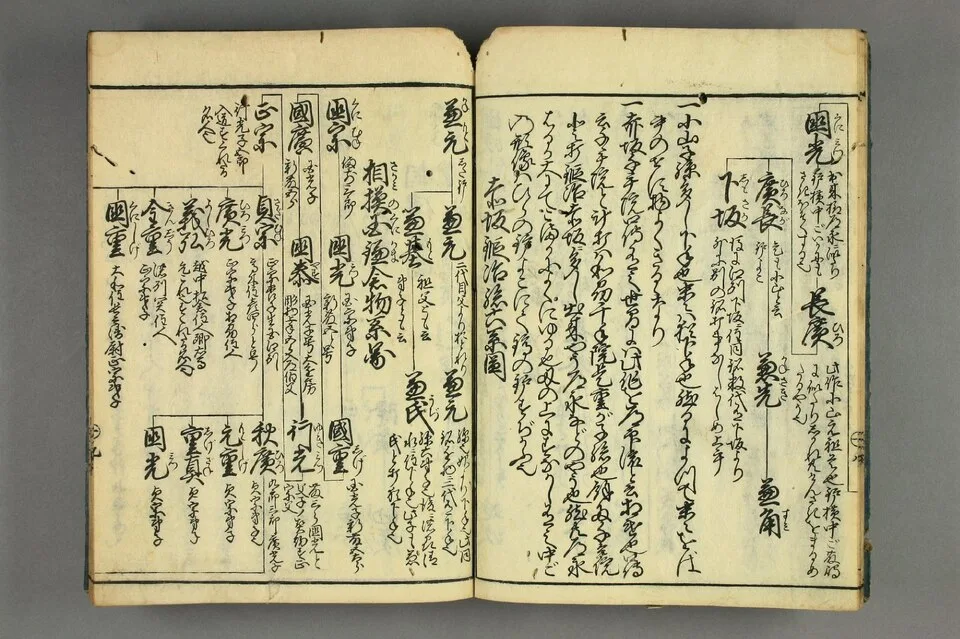
The oldest surviving books on swords are repertories of smiths and signatures, the mei-zukushi (銘尽). Until 2017 the first was held to be the Kanchiin-bon (観智院本), named after the Kanchiin, a sub-temple of the Tō-ji in Kyoto, where it comes from: it is a 1423 copy of material gathered around 1316, with lists of smiths, school genealogies and drawings of tangs. That year a mei-zukushi copied in 1351 on the back of some drafts turned up in the archive of the Ryūzōji family, in the Saga Prefectural Library; it is now the oldest known.
The Hon'ami (本阿弥) were the great family of appraisers. Tradition traces them back to Myōhon (d. 1353), in the service of the shōgun Ashikaga Takauji. Hon'ami Kōtoku (d. 1619), the ninth head of the family, obtained from Toyotomi Hideyoshi, early in the Keichō era, the authority to judge swords and issue certificates, the origami (折紙), and from then on the family was the authority on kantei throughout the Edo period. In 1611 the Kokon mei-zukushi (古今銘尽) was produced, and through its many editions it spread knowledge of swords among the samurai. And the thirteenth head, Hon'ami Kōchū, compiled with his family, on the orders of the shōgun Tokugawa Yoshimune, the Kyōhō meibutsuchō (享保名物帳), the list of famous swords (see Famous swords and legends; an origami by Kōchū is shown in NBTHK papers).
In modern times, Hon'ami Kōson (1879–1955), polisher and researcher, founded a society for the study of the sword in 1914, brought that study to the wider public and gave its final form to the classification of the five traditions (see The gokaden and the schools). After the war, Honma Junji (1904–1991), a specialist in old blades, and Satō Kan'ichi (1907–1978), a specialist in shintō, known by their pen names Kunzan and Kanzan as "the two san" (ryōzan, 両山), were among those who convinced the occupation authorities that the Japanese sword was art and not merely a weapon. In 1948 the NBTHK was born, and both were central figures in it.
The appraisers themselves warned of the limits of their documents. In 1956 Satō Kanzan cautioned in the NBTHK journal that forged sayagaki (鞘書), verdicts written on the wooden scabbard, were circulating under his name, and asked that nobody buy on the strength of a sayagaki, but by looking at the blade. Around 1800 a merchant had the Hon'ami examine a tantō signed "Masamune": it turned out to be by another smith of the same name, from Mino, and it had a crack in the edge as well. Neither the signature nor the document replaces the blade.

Further reading
- Markus Sesko · the KANTEI series Recommended reading: articles that follow the classic order, from shape to steel, temper and point, and then the schools. It stops at Yamashiro.
- Study of Japanese Sword · how to handle a blade Step by step, with photos: how a blade is drawn, held and looked at.
- Tōken Kenkyū Rengōkai · nyūsatsu kantei A Japanese study association explains the game and the judge's replies. In Japanese.
- Japanese Wikipedia · oshigata History of sword tracing, from the Muromachi drawings to the Meiji pencil. In Japanese.
- Japanese Wikipedia · the Japanese sword The reference article; its section on appreciation sums up what is looked at and in what order. In Japanese.
- NBTHK The society that issues the papers, with its Sword Museum and its study meetings. In Japanese.