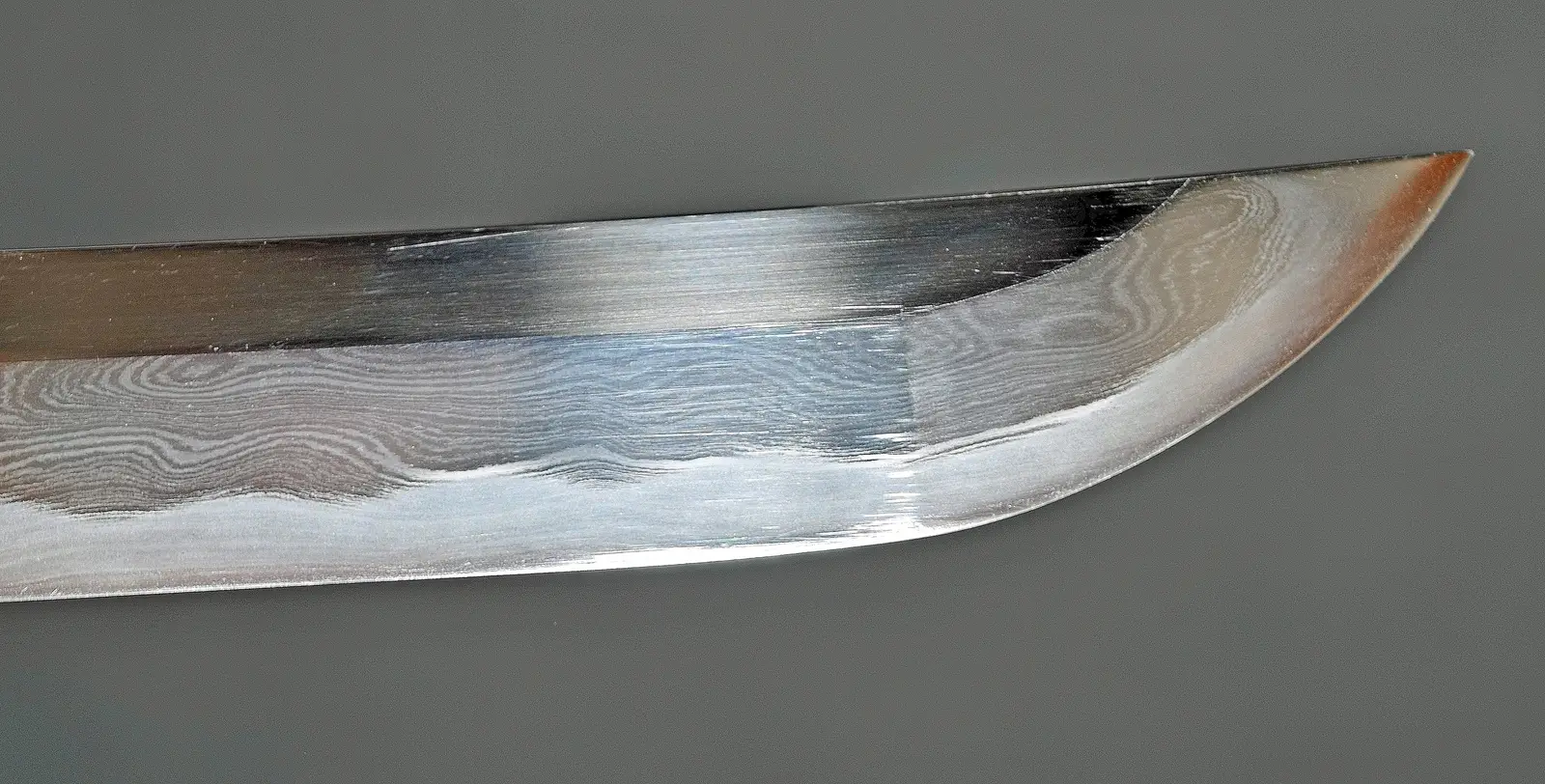
The temper line up close
The hamon is the part of the blade people look at most and misread most often. Its pattern helps place a school and a period, but what speaks of quality is the texture of the hardened edge: the grain, the brightness, the evenness. This topic goes through the patterns and their schools, the activity inside the temper, where it starts, the shadow called utsuri, the point, and what polishing changes and what it does not.
What the hamon is, and why its pattern does not measure quality
The hamon (刃文) is the visible boundary of the hardened zone that carries the edge, the yakiba (焼刃). It is born in the quench: the smith coats the blade with a clay (yakiba-tsuchi, 焼刃土) that is thin towards the edge and thick towards the back, heats it and plunges it into water; the edge cools fast and hardens, the rest cools slowly and stays tougher. How the clay is laid on is covered in «Anatomy of the katana» and «Forging and construction»; here the point is to read the result.
The pattern does not depend on the clay alone. The steel, the fire and the water all shape it. That is why two questions are worth keeping apart. What pattern it has helps place a school and a period. How it is made —a bright, clear, consistent edge, with fine, well spread particles— is what speaks of craftsmanship. A spectacular pattern with a murky edge is a worse blade than a plain, clean suguha.
Workshops like to say that the great old midare and chōji were drawn by the steel more than by the smith's hand: with a very sensitive steel, the clay only channels what the hardening does on its own. That is why those patterns cannot be fully copied, and why their later imitations look somewhat drawn.
The history can be told in three stages. Up to the thirteenth century straight or finely irregular tempers dominate (suguha, ko-midare, ko-chōji). From the late thirteenth century the pattern becomes deliberate: gunome in Osafune, notare in Sōshū and in Kanemitsu. In shintō the pictorial patterns reach their peak, like the tōran-ba of Ōsaka. Dates and specific schools are in «The gokaden and the schools».
Nie and nioi: the grain of the temper
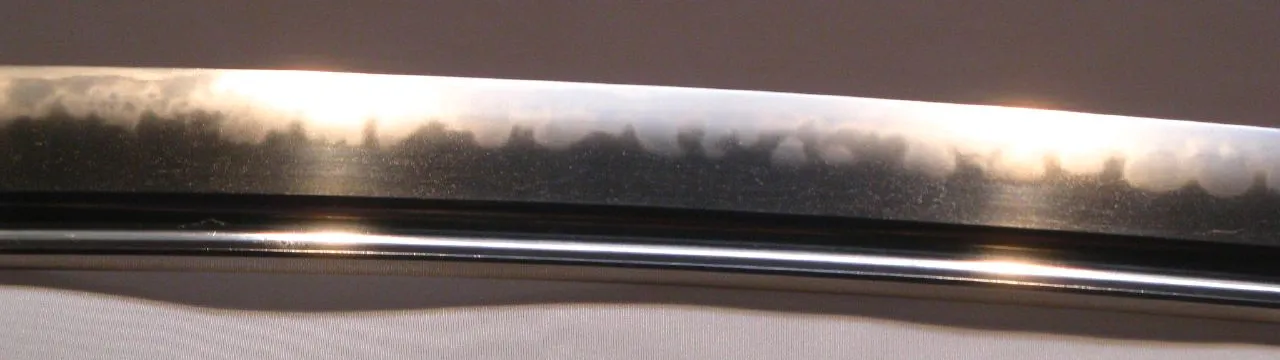
Nie (沸) and nioi (匂) are the same hardened structure seen at different scales. Nie can be told apart grain by grain, like frost; nioi is so fine that the eye blends it into a luminous mist. Ko-nie (小沸) is a small nie; ara-nie (荒沸), a coarse one; kazunoko-nie (数の子沸), patches of coarse nie associated with the shintō of Satsuma. A blade is nie-deki (沸出来) or nioi-deki (匂出来) depending on which one dominates.
The boundary between the yakiba and the ji is the habuchi (刃縁); seen through its nioi, which is always present even when nie dominates, it is called nioiguchi (匂口). It is described by its width —wide and deep (nioi-fukashi, 匂深し) or tight (nioi-shimaru, 匂締まる)— and by its light: bright, crisp or dull.
Some school rules, with the caution every rule deserves: a very bright nioiguchi in classic Osafune (Nagamitsu, Kagemitsu) and in Kotetsu; dull in many provincial schools of early Kyūshū and Hokkoku; wide in shintō, above all in Ōsaka and Hizen. And a word on method: the nioiguchi is not the hadori, the whitening the polisher gives the hardened zone. To see the real boundary you need a point light and must tilt the blade until the reflection runs across it.

Suguha: the straight temper
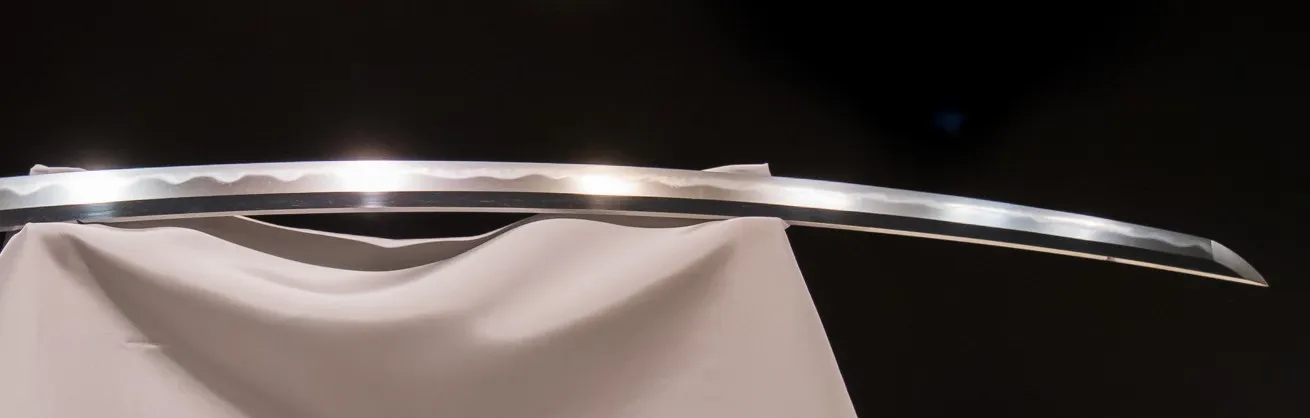
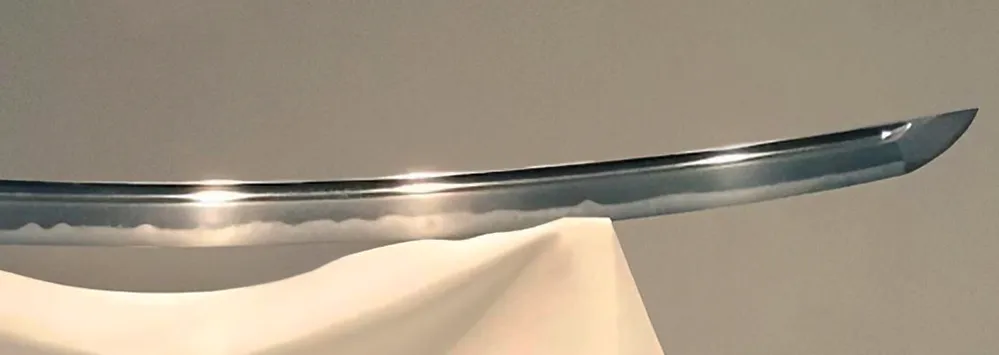
Suguha (直刃) is the straight temper, parallel to the edge. It is classified by width:
- ito-suguha (糸直刃), «thread-like», very narrow;
- hoso-suguha (細直刃), narrow;
- chū-suguha (中直刃), medium;
- hiro-suguha (広直刃), wide, a third of the blade's width or more.
It is one of the oldest patterns. Since the pattern barely varies, the school is read in the texture. In nie: Yamashiro (Awataguchi, Rai) and Yamato (Tegai, Hoshō, Senjuin, Taima); in shintō, Horikawa Kunihiro, Inoue Shinkai, the second Sukehiro and Tadayoshi of Hizen; in shinshintō, Masahide and Naotane. In nioi: Osafune (Nagamitsu, Kagemitsu, Sanenaga), Ōei-Bizen, Sue-Bizen, middle Aoe and Sue-Seki. With a dull nioiguchi: Bungo Yukihira, Gassan, Hōju, Naminohira and other provincial schools.
Yamato is also recognised by the «vertical» activity over the suguha —hakikake, nijūba, kuichigaiba— which follows the straight grain of its steel. A suguha frayed by nie is called suguha-hotsure (直刃ほつれ).

Ko-midare and the gunome family
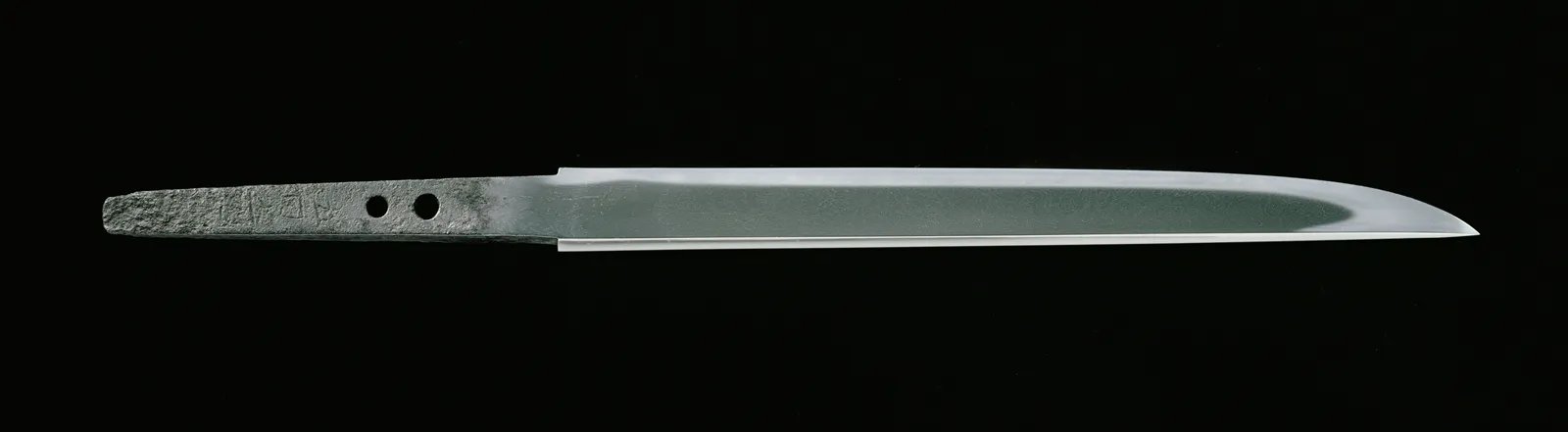
Midareba (乱刃) is any temper that is not straight. The oldest is ko-midare (小乱れ), a small, low irregularity seen in Ko-Bizen and in the tachi of late Heian: the Dōjigiri Yasutsuna, one of the five swords under heaven (tenka goken, 天下五剣), has ko-midare with ashi and kinsuji.
Gunome (互の目) is a sequence of rounded heads of similar size. It was born in Osafune at the end of Kamakura: Kagemitsu already uses it as ko-gunome and kataochi, and Muromachi Osafune turns it into a complex gunome-midare. From there it passes to Mino and to the whole country.
| Pattern | What it looks like | Where it is seen |
|---|---|---|
| ko-midare (小乱れ) | small, low irregularity | Ko-Bizen, late Heian tachi |
| gunome (互の目) | rounded heads of similar size | Osafune from the end of Kamakura; later, the whole country |
| ko-gunome (小互の目) / ō-gunome (大互の目) | the same pattern, small or large | Kagemitsu (ko-gunome); Sue-Bizen |
| kataochi-gunome (片落ち互の目) | flat heads with one side sloping towards the valley, like saw teeth; also nokogiri-ba (鋸刃) | associated with Kagemitsu, with forerunners in Nagamitsu; inherited by Kanemitsu |
| togari-gunome (尖り互の目) | pointed heads | Sue-Seki |
| sanbonsugi (三本杉) | sharp peaks in groups of three, «three cedars», at regular intervals | the Kanemoto line of Seki |
| uma-no-ha midare (馬の歯乱れ) | large, regular gunome, «horse's teeth» | Sōshū: Masamune, Gō Yoshihiro, Norishige |
| koshi-no-hiraita midare (腰の開いた乱れ) | elements that open out at the base | Sue-Bizen and Muromachi Bizen |
Sanbonsugi offers a useful reading for kantei. In the first two Kanemoto —the second is the famous Magoroku— it is irregular and low, with a soft nioiguchi; in later generations it becomes regular, almost drawn, with a tight nioiguchi. A very regular sanbonsugi therefore points to a late Kanemoto, not to Magoroku.
The Gassan school of Dewa hardens mostly in suguha, but here and there its temper turns into ko-gunome or notare. Workshops explain it by the regular waves of its steel, the ayasugi-hada (綾杉肌), which the temper follows with no intention of drawing anything.

Chōji, notare and hitatsura
Chōji
Chōji (丁子) imitates the clove bud: a round head on a narrow neck. It is among the oldest patterns and its emblematic school is Bizen's Ichimonji; a temper made entirely of chōji is called chōjiba.
| Variant | What it looks like | Where it is seen |
|---|---|---|
| ko-chōji (小丁子) | small, tight chōji | Ko-Bizen, Heian tachi |
| ō-chōji (大丁子) | large chōji, sometimes with a very broad head (ōbusa-chōji, 大房丁子) | Ichimonji |
| jūka-chōji (重花丁子) | overlapping heads, like clustered flowers | Fukuoka Ichimonji at its height; Mitsutada and Nagamitsu; imitated by the Ishidō in shintō |
| saka-chōji (逆丁子) | chōji slanting towards the point | Katayama Ichimonji, middle Aoe; in shintō, the Ishidō; in shinshintō, Naotane |
| kawazu-no-ko chōji (蛙子丁子) | round head and long neck, «tadpole» | Mitsutada, Kamakura Ichimonji |
| fukuro-chōji (袋丁子) | a «bag» of loose temper in the ji with chōji inside | Fukuoka and Katayama Ichimonji, Mitsutada |
Shintō chōji that imitate Ichimonji can often be told apart by the point (see the section on the bōshi).
Notare
Notare (湾れ) are broad, gentle waves: large (ō-notare), small (ko-notare) or shallow (asai-notare). It appears after Kamakura, above all in Sōshū (Sadamune, Nobukuni), and is used by Kanemitsu and Sōshū-influenced Bizen in Nanbokuchō; in shintō, by Yasutsugu, Kotetsu, Tadayoshi and Inoue Shinkai, among others.
Hitatsura
Hitatsura (皆焼, «hardened all over») is a temper of abundant nie that spills across the whole blade: to the main pattern are added loose islands in the ji, tobiyaki (飛焼), and temper on the back, muneyaki (棟焼). It was born in Nanbokuchō Sōshū (Hiromitsu, Akihiro) and later spread across the country; Muramasa made a famous one, the «Murachidori» (群千鳥). It is a very hard temper to control.
Two nuances often heard in workshops. The shinshintō chōji is a drawn pattern, made on purpose, and should not be confused with that of the old Ichimonji. And notare was born at the same time as the ō-kissaki of the Nanbokuchō: the two arrive together.
Workshops point out that hitatsura did not stay in the Sōshū either: according to that workshop observation, it would be found in Seki in the fifteenth century and in Owari in the sixteenth, with Yoshiharu. Some hold that the old hitatsura was not designed but simply appeared when a very sensitive steel received a strong hardening.



The painted patterns of shintō
In the Edo period some workshops turned the hamon into a picture. The ji becomes a canvas framed between the machi and the yokote, and the temper draws waves, beads or mountains. These patterns demand great control, but it bears repeating: the pattern does not measure quality. A showy tōran-ba with a murky edge is still a mediocre blade.
| Pattern | What it looks like | Who |
|---|---|---|
| tōran-ba (濤瀾刃) | large chained waves, sometimes with balls of temper in the ji (tama, 玉) like spray | created by Tsuda Echizen no Kami Sukehiro in Ōsaka; imitated across the country and revived in shinshintō |
| juzuba (数珠刃) | round, even gunome, «rosary beads» | Kotetsu and his circle |
| hyōtanba (瓢箪刃) | «gourd» elements, narrow in the middle | Kotetsu |
| sudareba (簾刃) | lines inside the temper that recall a bamboo blind | Tanba no Kami Yoshimichi, of the Mishina school |
| kikusui-ba (菊水刃) | a variant of sudareba: a chrysanthemum on the water | Yoshimichi's circle |
| Fujimi-Saigyō (富士見西行) | an isolated peak like Mount Fuji and a smaller, double one: the poet Saigyō gazing at the mountain | Mishina, Yoshimichi, Kunisuke of Kawachi |
Some polishers and smiths see these patterns as the start of a decline: once the hamon is conceived as a picture, the hardening stops serving the blade and serves the effect. It is an opinion, not a rule, but it explains why kantei looks at the edge of the temper before its design.

Hataraki: the activity of the temper
Hataraki (働き, «activity») are the effects of the temper inside the hamon and along its boundary, what Japanese calls hachū no hataraki (刃中の働き). They are not ornaments: they tell how the steel behaved, and they are often what is most prized in a blade. Most of them live inside the hamon, not in the ji:
| Term | What it is | Note |
|---|---|---|
| ashi (足) | a line of nioi that crosses the temper towards the edge | ko-ashi, naga-ashi, chōji-ashi; saka-ashi (逆足) if it slants towards the point |
| yō (葉) | «leaf»: a detached ashi that does not touch the boundary, inside the hamon | not an island in the ji: that is a tobiyaki |
| kinsuji (金筋) | a short, straight, bright line of nie near the boundary | Sōshū, Yamashiro |
| ginsuji (銀筋) | like kinsuji, but dull | the line between the two is subjective |
| inazuma (稲妻) | «lightning»: a broken kinsuji | Sōshū |
| imozuru (芋蔓) | a thick, murky inazuma | Satsuma, in shintō and shinshintō |
| sunagashi (砂流し) | «swept sand»: lines of nie parallel to the boundary | Yamato, Sōshū, Yamashiro |
| hakikake (掃掛け) | like sunagashi, but short and fine, towards the ji | on the boundary and in the point |
| hotsure (解れ) | a boundary frayed by nie | Yamato |
| nijūba (二重刃) | a second parallel boundary; with three, sanjūba (三重刃) | Yamato |
| uchinoke (打ちのけ) | a short, crescent-shaped nijūba over the boundary | Yamato; it gives its name to the Mikazuki Munechika, «crescent moon» |
| kuichigaiba (喰違刃) | the boundary breaks and continues in parallel, offset | Yamato |
| nie-kuzure (沸崩れ) | a «collapsed» temper in nie, with no clear outline | Sōshū and its orbit |
Outside the hamon, in the ji, are tobiyaki (飛焼, loose islands of temper), muneyaki (棟焼, temper on the back), yubashiri (湯走り, drop-like patches of nie, more transparent and with a softer outline than tobiyaki) and chikei (地景, dark, shining lines of nie that follow the grain of the steel).
Some names carry a judgement: workshops recall that imozuru, «sweet-potato vine», was a slightly mocking name.

Where the temper starts: yakidashi, yaki-otoshi, koshiba and mizukage
The start of the temper next to the ha-machi, the step that separates the blade from the tang, is called yakidashi (焼出し). On an unshortened blade the temper usually runs a little into the tang. Some ways of starting are almost a signature:
- sugu-yakidashi (直焼出し): starts straight and soon moves into the main pattern;
- Kyō-yakidashi (京焼出し): starts in suguha and changes abruptly;
- Ōsaka-yakidashi (大坂焼出し): straight or in gentle notare, it widens little by little into the main pattern;
- Mino-yakidashi (美濃焼出し): starts with a koshiba;
- Satsuma-yakidashi (薩摩焼出し): irregular from the very beginning.
Koshiba (腰刃) is one or a few very tall elements of temper at the base, at the start of the hamon. In common usage it is the same as the Mino start, but it also appears on Kamakura blades: Fukuoka Ichimonji often has it, and the Onimaru Kunitsuna has it on both faces.
Workshops also tell a second story about koshiba. On the finest blades of the twelfth and thirteenth centuries (Ko-Bizen, Ichimonji, Awataguchi Kunitsuna) it would be an effect of the steel itself: the temper starts wide, following the utsuri, with fine particles, and then drops with denser nie. The Seki smiths of the fifteenth century, such as Muramasa and Kanesada, imitated it with clay, and from then on koshiba also names a design.
Yaki-otoshi (焼き落とし) is the opposite: the temper does not start at the machi but somewhat higher, because the base did not harden. It is common on very old blades and survives as a school trait in Kyūshū (Bungo Yukihira). It also appears on re-tempered blades, so on its own it proves nothing. Its relation to the shape of the base is covered in «Shape (sugata)».
The workshop explanation is simple: the base never reached hardening temperature because the tang was not heated. It is not a flaw: that unhardened stretch does not cut, but it is not the part that is used either. Besides Bungo Yukihira, it is noted in the Naminohira school of Satsuma.
Mizukage (水影, «shadow in the water») is a light, utsuri-like shadow that rises diagonally from the start of the temper next to the machi. The traditional reading takes it as a sign of re-tempering, but it is also documented on original work, so it does not prove it on its own; the diagnosis is in «Blade condition: flaws and deceptions». The popular explanation —the mark of the water level in the trough— does not hold up.
It has been seen in original work by Horikawa Kunihiro, the first Tadayoshi and the first Kunikage, and workshops consider it natural on blades from before the seventeenth century, when the tang was not hardened. Some smiths add a nuance: on a blade of original length it is normal; on a shortened one, it suggests the blade was overheated. The Onimaru Kunitsuna shows why koshiba and mizukage are read together: an oshigata (押形, a rubbing of the blade) made in 1588 left out the mizukage beside the koshiba, and a re-hardening was suspected; later oshigata draw it, and today it is taken as a trait of Kunitsuna's style.

Utsuri: the shadow of the temper
Utsuri (映り) is a whitish, misty reflection in the ji, between the hamon and the shinogi, separated from the temper by a darker band, the antai (暗帯). It is not a surface effect: it survives many polishes. To see it you need a good polish and good light; you look from the start of the temper upwards, slowly changing the angle. The utsuri is said to «stand» (utsuri ga tatsu, 映りが立つ), and is described as crisp or faint.
What it is metallurgically is not settled. It is an effect of the quench in the zone that does not fully harden, and its exact structure is still being studied. There are several hypotheses: a zone heated just around the temperature at which the steel changes structure, without the martensite of the edge; three bands of different hardness (very hard edge, hard antai, softer utsuri); coarse or spheroidised pearlite according to some smiths; or small differences in the thickness of the clay and the composition of the steel. What is certain is that it depends on the steel and the way of quenching, not on the polish, and that its shape need not follow the hamon: there is midare-utsuri over a suguha.
| Type | What it is | School and period |
|---|---|---|
| midare-utsuri (乱れ映り) | undulating, irregular utsuri | Kamakura Bizen (Ichimonji, Osafune); rare after mid-Muromachi |
| chōji-utsuri (丁子映り) | a midare-utsuri that traces the chōji | Ichimonji |
| bō-utsuri (棒映り) | a straight band parallel to the edge; also sugu-utsuri (直映り) | late Kamakura Osafune (Kagemitsu, Kanemitsu), Ōei-Bizen |
| jifu-utsuri (地斑映り) | utsuri in patches | Ko-Bizen, Aoe; Heian and early Kamakura |
| dan-utsuri (段映り) | several utsuri stacked on one another | Aoe |
| nie-utsuri (沸映り) | utsuri made of ji-nie, in clouds, only on nie-deki blades | Rai; in shintō, Horikawa Kunihiro; the Dōjigiri has it |
| shirake-utsuri (白け映り) | whitish and diffuse, with an ill-defined shape | Mino (Sue-Seki), Kaga and provincial schools of Muromachi |
| botan-utsuri (牡丹映り) | loose round patches, «like peonies» | Kanemitsu and his workshop |
| tsukare-utsuri (疲れ映り) | not utsuri at all: tired steel or exposed core that looks like a reflection | wear; see «Blade condition: flaws and deceptions» |
Utsuri belongs to kotō, above all to Kamakura Bizen; a saying of the trade, recorded by Markus Sesko, gives a blade with clear utsuri high odds of being kotō Bizen. It is a clue, not a law. After 1600 it becomes rare; this is usually explained by the change of steel and by a quench aimed at a showy hamon rather than at the blade; the Ishidō of shintō and some shinshintō smiths imitated it only halfway. In 2014 the Masamune Prize for tachi and katana, vacant for eighteen years, went to a blade by Kawachi Kunihira that reproduced the midare-utsuri of kotō; he credited it to a quench aimed at toughness rather than at the beauty of the hamon. Reproducing the look does not, on its own, prove that the old technique has been recovered.
Workshops explain utsuri as the fruit of a sensitive steel given the right hardening, and they stress that its shape goes its own way: a chōji can carry a bō-utsuri, and a suguha a wavy utsuri. Chōji-utsuri is also called kage-chōji (影丁子), «shadow chōji». Not every explanation has survived: a text of 1843, the Kentō kikigaki, put utsuri down to a double quench that is now judged impracticable.


The bōshi: the temper in the point
The bōshi (帽子; also 鋩子) is the temper inside the kissaki. Its final part turns back towards the back of the blade, the kaeri (返り), and ends at the tome (止め). Hardening the point well takes great skill, so the bōshi is a good indicator of the quality of the whole blade; if polishing has eaten it away, the damage is serious. A very late turn-back (agari-kaeri) or a slanting one can give away a reshaped point.
| Form | What it is | School |
|---|---|---|
| ko-maru (小丸) | small, round turn-back | the most common; typical of Ōsaka and Inoue Shinkai |
| ō-maru (大丸) | broad turn-back | Mino |
| yakizume (焼詰め) | no turn-back: the temper runs out at the back | Hoshō of Yamato |
| ichimai (一枚) | the whole point hardened | common in Sengoku (Sukesada, Kiyomitsu); close to hitatsura |
| midare-komi (乱れ込み) | the irregular temper runs into the point | Bizen, Sōshū |
| jizō (地蔵) | midare-komi with a pinched turn-back, like the profile of a Jizō | Mino (Sue-Seki), Kanemoto |
| kaen (火焔) | abundant nie with «flaming» hakikake | Sōshū |
| sansaku-bōshi (三作帽子) | straight after the yokote, undulating in the curve, short ko-maru | the «three masters» of Osafune: Nagamitsu, Kagemitsu, Sanenaga |
| rōsoku (蝋燭) | a sharp turn-back, «like a candle wick» | Kanemitsu, Ōei-Bizen |
| tora no o (虎の尾) | a long turn-back parallel to the back that ends abruptly | Ko-Mihara |
| taki no otoshi (滝の落し) | a long, oblique turn-back, «like a waterfall» | Mihara |
| taore (倒れ) | a slanting turn-back | Sue-Seki; also on reshaped points |
In kantei the bōshi is the final adjustment: it confirms what the shape (the period), the steel (the region) and the hamon (the school) have said, or it is so peculiar that everything has to be reconsidered. In kotō the hamon runs naturally into the point; in shintō the bōshi changes character at the yokote. Hence a practical rule: an exuberant «Ichimonji» chōji, utsuri included, but with a straight or notare bōshi, points to a shintō Ishidō rather than to an Ichimonji. The full order of looking is in «Kantei: how to look at a blade».
Two workshop warnings about the point. The polishing of the kissaki, the narume, seeks contrast and often hides the real bōshi. And the kamasu-kissaki (魳切先), with its almost straight line, gets rounded by polishing: if it looks round today, that may be the work of the polishers and not of the smith.


One blade, two faces
The hamon need not be the same on the omote and the ura, which is why both faces must always be examined. According to workshops, there are four causes:
- An uneven quench: clay of different thickness or uneven heat on each face.
- An uneven polish: one face was ground down more because of rust or damage, and part of the pattern went with the steel.
- An asymmetric construction: if the skin of the blade is thicker on one face, that face gives a crisper temper.
- Intention: blades with a deliberately different hamon on each face.
The effect of polishing has been tested in a workshop: when one side of a tantō with a very active chōji was ground down by 1.5 mm, the hamon on that side calmed down. It is what happens, more slowly, to heavily polished blades.
The famous case is the Konotegashiwa Kanenaga (児手柏包永), a tachi by Tegai Kanenaga (Yamato, late Kamakura). One face has a boldly drawn midare; the other, a suguha-hotsure; both, deep nie and nioi. Hosokawa Yūsai named it after a poem of the Man'yōshū about the konotegashiwa plant, with its «two-faced» leaves, and shortened it in Tenshō 2 (1574). It passed to the Tokugawa and became the great sword of the Mito house; it was burnt in the 1923 earthquake and is kept in the Tokugawa Museum. Whether the name refers to an intended difference or to a botanical misunderstanding is still debated.
Of the burnt original, the blade survives without its temper; in 2017 the smith Gassan Sadatoshi forged a copy.
A difference between faces is not, on its own, a flaw or a sign of forgery.

Norishige: a style of his own
Norishige (則重) worked in Gofuku, in Etchū province, at the end of Kamakura; dated works from 1310 to 1314 are known. Edo tradition counts him among the ten disciples of Masamune, but the early sources and the dates suggest he was rather his fellow student under Shintōgo Kunimitsu.
His style is among the most recognisable in Sōshū:
- the steel: a very prominent ō-itame, with thick, abundant chikei that draw swirls, like layers of bark laid one over another. This is the matsukawa-hada (松皮肌, «pine bark»), also read shōhi-hada;
- the ji: coarse nie and rounded yubashiri;
- the hamon: a suguha base with ko-notare, ara-nie on the boundary and dense ko-nie inside; kinsuji, sunagashi and inazuma that start in the steel and continue into the temper, so that the line between ji and hamon is hard to make out;
- the bōshi: midare-komi with yakizume, or with a deep turn-back.
In Norishige the steel and the temper are read together: the same nie that forms the chikei of the ji carries on into the hamon as kinsuji and inazuma. His tantō «Nihon'ichi» (日本一) is a National Treasure and is kept in the Eisei Bunko.
A workshop experiment helps to understand that look. From a single block of mixed steel, built in kōbuse (a hard jacket wrapped around a soft core; see «Forging and construction»), a tachi and a wakizashi were forged. The tachi came out with a large layered pattern and with the nie of the ji visible right inside the hamon: the «Norishige look». The wakizashi, with the same steel, gave a tight ji-nie with no layered pattern. The workshop's conclusion is that the difference lies in the grain, in the size of the particles left by the hardening, and not only in how the steel was folded. It is not a scientific study, but the lesson holds for the whole Sōshū: what we call hada is also the work of the hardening.
What polishing changes and what it does not
Polishers put it like this: the real hamon, the hardened structure, does not change with a new polish: a polish removes very little steel. What changes is its appearance: the colour of the hardened zone, the brightness of the particles and the apparent width of the boundary depend on the polisher and the finish. Hadori (刃取り) is exactly that, an interpretation: the whitening the polisher gives the hardened zone, with a smoother outline than the real boundary.
Workshops add a nuance: repolishing changes the grain you see, because each polisher brings it out in his own way, but not the pattern of the layers in the steel. And science is starting to look inside: neutron imaging of a re-hardened wakizashi signed by Norimitsu of Osafune showed a temper more than 5 mm deep, in waves, with crystals of up to 0.5 µm at the edge against 1–2 µm in the rest of the blade (Oikawa et al., Scientific Reports, 2024).
Over the years and the polishes the steel does wear away. The temper may lose height, the blade «calms down» and the activity fades; if the bōshi is lost, the damage is serious. Polishing in depth, the fake hamon, burns (yakemi) and re-tempering (saiha) are covered in «Blade condition: flaws and deceptions» and «Polishing and care».

Further reading
- Markus Sesko · Kantei 3: hamon and bōshi (1) Nie, nioi, the nioiguchi and the hataraki, with the terminology used on papers.
- Markus Sesko · Kantei 3: hamon and bōshi (2) The patterns one by one, from suguha to tōran-ba, with their schools.
- Markus Sesko · Kantei 3: hamon and bōshi (3) The forms of the bōshi and how they refine or overturn a judgement.
- Markus Sesko · Some thoughts on utsuri The hypotheses about what utsuri is, with the views of metallurgists, polishers and smiths.
- Markus Sesko · Kantei 2: jigane and jihada (3) The types of utsuri and who revived it in shintō and shinshintō times. In English.
- Wikipedia · Konotegashiwa Kanenaga The story of the tachi with a different hamon on each face. In Japanese.