Blade condition: flaws and deceptions
Hardly any old blade is entirely clean: a close look finds pores, openings, battle marks or the trace of centuries of polishing. The useful question is not whether there are flaws, but which ones, where they are and how much they weigh for use and for appreciation. This topic sorts them by origin —hardening, forging, wear, fire and use—, explains the additions that cover them and how to uncover them, and ends with a table of severity.
Why every blade has kizu
In Japanese any physical flaw of the blade is a kizu (疵). Nearly all of them are born in the forge or in the life of the sword: slag the folding did not drive out, a fold that did not weld completely, a small slip in the quench, a blow in battle, rust and, above all, centuries of polishing. That is why almost any blade that looks clean from a distance shows something under good light.
What matters is severity. Some flaws endanger the blade —a crack in the temper can snap it when cutting—, others only spoil the look, and others are not counted as flaws at all or even add. The yardstick has also changed: while the sword was a weapon, functional failure weighed most; today, judged as a work of art, whatever spoils the view weighs too. The same kizu is judged differently by its size, its place —in the hardened edge or in the ji, in the upper half or next to the tang— and by the period and school of the blade.
The map places the most common ones. The following sections group them by origin, and the last one ranks them in a table of severity.

Flaws in the temper
The most feared sit in the hardened band of the edge, because that is the part that works. They are fine cracks, to be looked for under good light with the blade tilted, and not to be confused with a forging opening that happens to fall inside the hamon.
| Flaw | What it is | How much it weighs |
|---|---|---|
| hagire (刃切れ) | A crack in the hardened edge, almost at right angles to it. | The most feared: the blade can snap there when cutting. Fatal for use; for appreciation it weighs less. |
| karasuguchi (烏口) | The same kind of crack inside the point (kissaki). | Serious: the point can break off when thrusting. |
| hagarami (刃搦み) | An oblique crack, or forging opening, that reaches the edge. | Small, it barely counts. In the upper half of the blade, the part that cuts, it threatens a chip; near the tang, much less. |
| tsuki-no-wa (月の輪) | A crescent-shaped hagarami inside the point. | Like the hagarami. |
| nioi-gire (匂切れ) | A stretch where the temper line breaks off because the nioi is missing. | Mostly visual; a good polisher can hide it. |
| hajimi (刃染み) | A dull, whitish patch in the temper, without brightness, from uneven carbon or a weak quench. | Visual; if wear spreads it along the whole edge, the value drops sharply. |
| yaki-kuzure (焼崩れ) | A stretch where the temper falls apart and loses its outline. | Visual if small. |
| Point without temper | The bōshi has gone, through a break or through polishing. | The blade counts as flawed: the point will not hold. In very old blades it is tolerated more. |
These cracks are often finer than a hair, and they do not always come from a flaw in the hardening: a heavy blow to the back of the blade can open one too. Strictly speaking, hagire is not the defect that does most harm to a blade as a work of art, but it is the one collectors and appraisers reject most firmly; in the practice of the workshops, a blade with hagire does not pass to Tokubetsu Hozon. Fine cracks in the hardened edge that fall short of hagire are another matter: blades that have them have been seen passing even to Jūyō.
The NBTHK examination criteria leave out blades with serious flaws (see NBTHK papers). On the point and its temper, see Anatomy of the katana.

Forging flaws
The blade is forged by folding the steel over and over (see Forging and construction). Every fold is a weld, and when one does not take completely it leaves a flaw inside the steel that polishing eventually uncovers.
- fukure (膨れ): a blister of air trapped in a badly welded fold. Small and away from the edge it does not affect use, but polishing it away is almost impossible, and if the polish opens it you are left with fukure-yabure (ふくれ破れ), a hole that shows from afar.
- kitae-ware (鍛え割れ): an opening in the folding, nearly always along the blade (tate-ware, 竪割れ); running along the back, it is a mune-ware (棟割れ). It is the most visible flaw and, unless it is large, one of the least important for use. Seeing none, on the other hand, is no guarantee that the steel is good.
- masa-ware (柾割れ): in blades of straight grain (masame), like those of the old Yamato school, an opening that follows the grain is almost unavoidable and is not counted as a flaw; with some smiths it is even a trait.
- shinae (撓え): transverse marks, like small cracks or wrinkles, running across the blade. They are linked to bending and straightening the blade or to weak steel. Shallow ones from straightening sometimes polish out; forging ones do not. It weighs more than a fukure or a kitae-ware, because it warns that the blade may bend or break there. Some polishers tell it apart from mukade-shinae, "centipede shinae": fine, shallow wrinkles left by bending and straightening the blade, which are not counted as a defect and wear away with polishing.
- uchikomi (打込み) and ishike (石気), fine pores put down to the hammer or the anvil, and sumigomori (炭籠り), charcoal trapped in the steel skin. When small, they are of no practical importance.

Wear: tsukare
The blade has an outer skin of hard steel, the kawagane (皮鉄), and inside a softer core, the shingane (心鉄). Every polish takes a little skin away. After centuries of polishing the skin thins, the core may show through and the ji looks rough or blotchy: that is tsukare (疲れ), the «tired» blade. The seam between skin and core coming to the surface is called ji-are (地荒れ), and an exposed core can look like a whitish utsuri that is not one (tsukare-utsuri, 疲れ映り), something that lowers its value as a work a great deal.
Not every visible shingane is wear: in some schools, such as the Rai of Yamashiro or the Aoe of Bitchū, an exposed core is taken as a trait of their own. How much it weighs in valuation today is discussed in Forging and construction.
Wear is measured against the tang, which is never polished and keeps the thickness (kasane) it had when it left the forge. If the blade, next to the machi, is clearly thinner than the tang, or if the edge has receded from the step of the machi, it has lost a lot of steel. The point, polished more than the rest, is among the first to lose its temper. And in tantō the point thins before the rest until it curves inwards (uchizori): a tantō without that curve is usually healthier.
Wear changes the shape as well. Since polishing removes mostly steel from the hardened edge, the curvature drops and what remains shows more towards the base (koshizori); the point grows rounder, the yokote creeps down towards the tang, and the thickest part of the blade moves towards the machi, which may disappear altogether. A polish that removes a lot of steel at once also flattens the hamon, which becomes calmer, and can change how the blade sits in its scabbard. Two sister blades show what this means: through their polishes, one had lost 138 g and the other 270 g, almost a third of its weight, with the steel skin worn through in places.

Fire and retempering
A blade that has been through a fire is a yakemi (焼身): the heat undoes the temper and the steel turns soft again, the surface blackens or corrodes, the forging pattern shows and the hamon vanishes or leaves loose patches. Until the Edo period a burnt blade that could still serve was simply re-hardened: that is saiha (再刃), also called yaki-naoshi (焼き直し). Today a saiha loses nearly all its value as a work of art, and the NBTHK accepts it only in very specific cases (see NBTHK papers).
These are the clues to a retempering:
- a tang with grains, pores or a melted look, because it went through the fire too;
- yaki-otoshi (焼き落とし): the temper does not start at the machi but somewhat higher, because retempering avoids heating the tang;
- mizukage (水影): an oblique shadow, like an utsuri, where the temper begins, at the limit of what went into the water;
- an odd balance between width, curvature and hamon, or a hamon that does not look like that of the smith who signed.
None is enough on its own. Mizukage also appears in original work by some shintō smiths —Horikawa Kunihiro, the first Tadayoshi, the first Kunikage—, from temperature differences in the water near the machi, and the NBTHK itself asks for a decision in each case on whether it is original or from a retempering. Yaki-otoshi is likewise an original trait in Heian blades and in some Kyūshū smiths, such as Bungo Yukihira. What gives a saiha away is the sum of signs.
Sometimes only the damaged point is retempered: that is yakitsugi-bōshi (焼継ぎ帽子), rarer than a full saiha. The temper of the point never joins that of the blade cleanly: at the joint the nioiguchi weakens and a mizukage may show again. The stretch between the two hardenings is usually left burnt as well, and the polish takes care of hiding it.
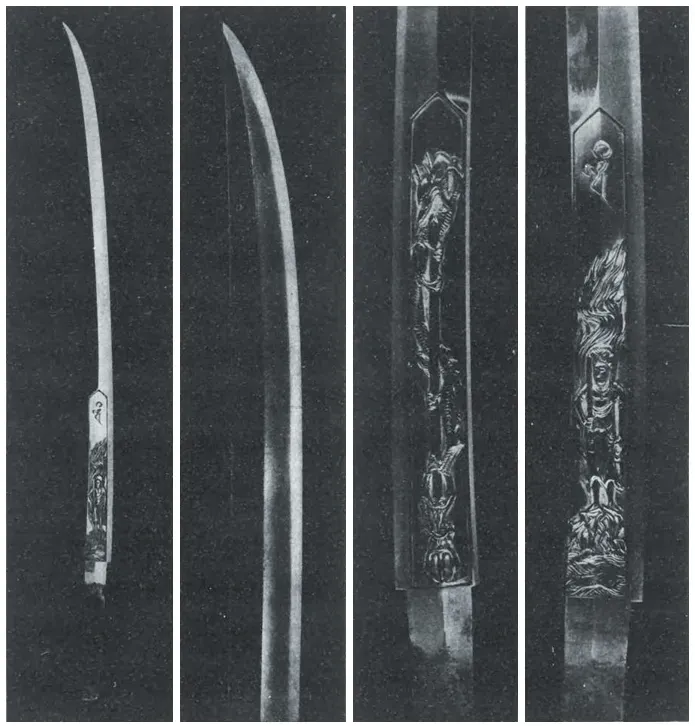
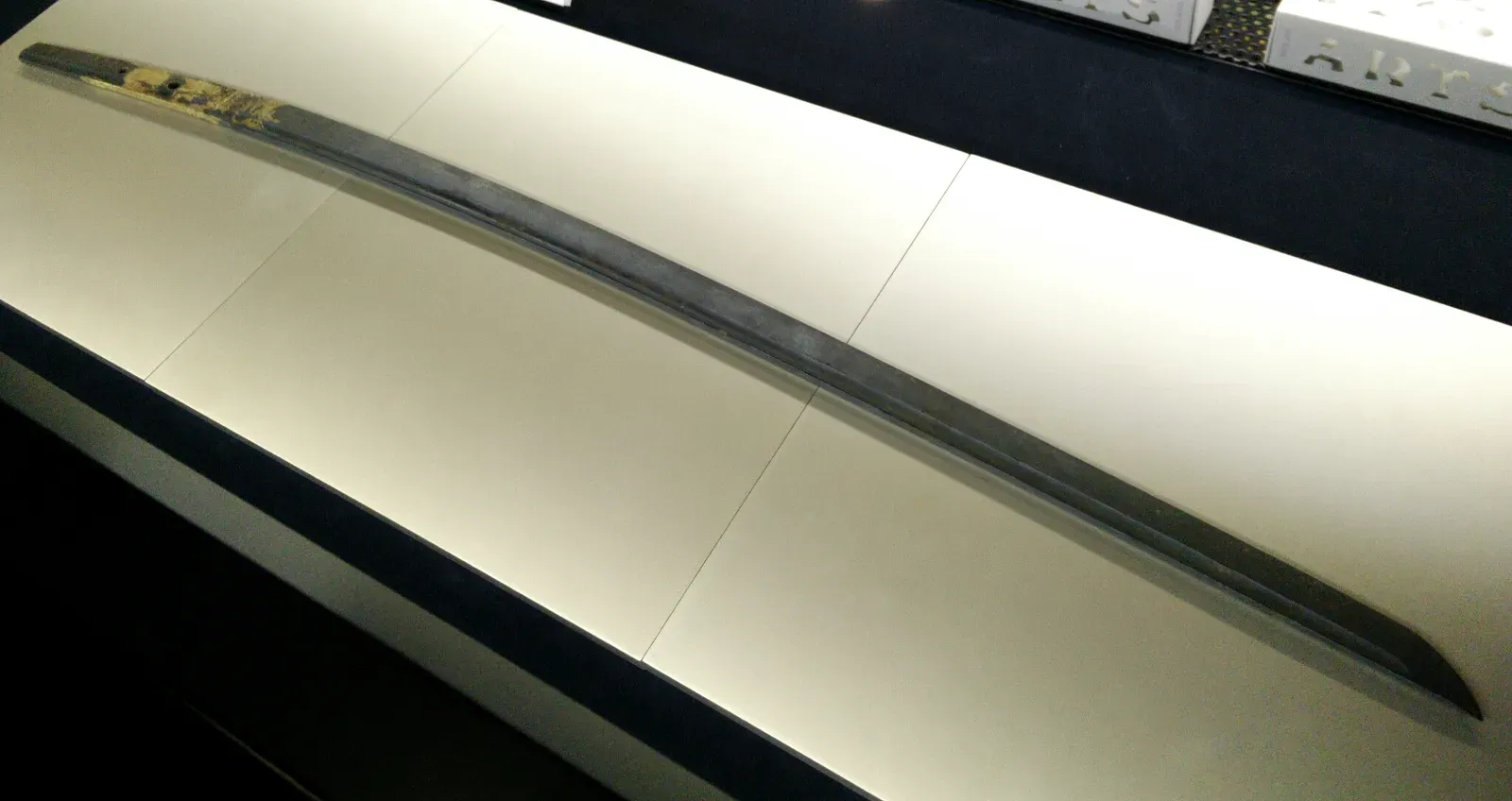
Two famous blades show the two fates. Honebami Tōshirō (骨喰藤四郎), by Awataguchi Yoshimitsu and an Important Cultural Property, burnt in the great Meireki fire (1657) and was retempered by the third Echizen Yasutsugu; it belongs to the Toyokuni shrine and is on deposit at the Kyoto National Museum. Shokudaikiri Mitsutada (燭台切光忠) burnt in the Kantō earthquake of 1923 and is kept as it is, without temper, at the Tokugawa Museum in Mito.
The Ichigo Hitofuri (一期一振), the only tachi attributed to Yoshimitsu, a maker of tantō, went the same way as the Honebami. It burned in the fall of Osaka Castle in 1615, was re-hardened by the first Echizen Yasutsugu, and is kept today among the treasures of the imperial household.

Wounds of use
A hakobore (刃こぼれ) is a chip in the edge. Small, the polisher takes it out; a deep one forces a lot of steel away, with all the wear that means for the blade (see wear, above). Even so, some polishers prefer to leave a small nick rather than distort the blade to remove it: keeping the shape matters more.
Other marks tell a story. kirikomi (切り込み) is the notch left by the blow of another blade, nearly always on the back, and ya-kizu (矢疵) the mark of an arrow. They are called homare-kizu (誉れ疵), «wounds of honour»: they prove the sword was really used and, far from taking away, they can add value. The Ishida Masamune, at the Tokyo National Museum, keeps so many cut marks that it is also called Ishida Kirikomi Masamune.

Additions and deceptions
Some interventions cover a flaw, and it pays to recognise them:
- umegane (埋金): a plug of steel set in to close a fukure, an opening or a rust pit (kuchikomi, 朽ち込み). Done well, it goes unnoticed; if the steel of the plug is not the same colour, it shows. And the plug cures nothing: the rust carries on underneath and over the years may push it out. The best modern plugs even follow the pattern of the grain so as to go unnoticed.
- ato-bi (後樋) and ato-bori (後彫): a groove or a carving added after forging. They are not bad in themselves, but they are sometimes made to hide a flaw; it is worth asking what lies underneath. A worn original carving, on the other hand, should not be "restored": recutting it turns it into an addition.
- kaki-bōshi (描き帽子): a «drawn» bōshi. On a point that has lost its temper, the polisher imitates one with tiny needle marks that mimic the shine of nioi. Looked at very closely under good light, the pricks show, and there is no temper beneath.
Something similar happens with the hamon. The white seen on a blade in today's polish is not the temper but the hadori (刃取り), a whitening the polisher traces along the hamon, which is why it never copies it exactly (see Polishing and care). Over a burnt or unhardened stretch, a hadori can draw a hamon that does not exist. There are also chemical finishes that bring out hamon and grain with more contrast than the stones give. Such finishes can leave rust beneath the surface and hide the real quality of the steel.
How much the polisher's hand weighs is shown by a story told in the workshops: a blade polished by Hirai Chiba (平井千葉), one of the great polishers of modern Japan, lost most of its value when someone else repolished it. The steel was the same; what changed was how it looked.
The check is simple and serves in all these cases: a point light —a bare bulb, a torch— and the blade tilted slowly until the reflection runs along the edge. The real temper then shows as a line of bright grains (nie and nioi) with a shape of its own, inside or at the border of the white; where the white hides no temper, nothing shines. A white band with no activity inside, that does not change as the blade tilts, calls for a slower look and a second opinion.
One last warning: if a known crack in the hardened edge no longer shows after a new polish, and the hamon is dull right in that stretch, the area may have been heated to hide it.

Severity, in a table
A rough guide: real severity always depends on size, place and the blade itself.
| Flaw | Severity | Why |
|---|---|---|
| hagire | Serious | Can snap the blade when cutting. In workshop practice, it does not pass to Tokubetsu Hozon. |
| karasuguchi | Serious | The point can break off. |
| forging shinae | Serious | Betrays steel that may bend or break. |
| Point without temper | Serious | The point will not stand up to use. |
| yakemi and saiha | Serious for the work | The blade has lost its original temper and nearly all its artistic value. |
| False hamon, kaki-bōshi | Serious | They hide a stretch without temper. |
| fukure, kitae-ware | Depends | Small and away from the edge, they barely count; large, they spoil the look. |
| hagarami, tsuki-no-wa | Depends | Worse in the upper half of the blade and in the point. |
| nioi-gire, hajimi, yaki-kuzure | Depends | Visual; the longer, the more they count. |
| tsukare, exposed shingane | Depends | On how much steel is left and on the school. |
| hakobore | Depends | Small, it polishes out; deep, it costs a lot of blade. |
| umegane, ato-bi, ato-bori | Depends | On what they cover and how well they are done. |
| mizukage | A sign to check | It may be original or from a retempering. |
| masa-ware in masame grain | Not a flaw | It belongs to that grain. |
| mukade-shinae | Not a flaw | Shallow wrinkles from straightening; they wear away with polishing. |
| small uchikomi, ishike, sumigomori | Not a flaw | Of no practical importance. |
| kirikomi, ya-kizu | Adds | They are homare-kizu: proof of real use. |
Further reading
- Japanese Sword Index · blade flaws The kizu one by one: which a polisher can correct and which make the blade unusable. In English.
- Wikipedia · Honebami Tōshirō A famous blade burnt in the great Meireki fire (1657) and retempered afterwards. In Japanese.
- NBTHK Sword Journal 822 · mizukage The NBTHK commentary on a Kunihiro: why mizukage appears and why one must decide whether it is original or from a retempering.
- Markus Sesko · the retempered point Yakitsugi-bōshi and kaki-bōshi, and how to recognise them.
- Kizu, in a diagram A Japanese study page with a map of flaws and the tang method for measuring wear. In Japanese.
- NCJSC · visual glossary of kizu A Californian study club defines the most common flaws, with photographs.