The Awataguchi school
The Nihon Kokugo Daijiten dictionary calls the Awataguchi school the smiths who worked at Awataguchi, in Kyoto, from the late Heian period to the middle of the Kamakura, headed by Kuniyori. Tradition attributes the school to Kuniyori, who was not a smith, and to his son Kuniie, its de facto founder; but no work by Kuniie survives, nor is there any document of the time that proves the kinship of the six brothers, according to Sesko.
Japanese Wikipedia gives as Hisakuni’s brothers Kunitomo, Kunikiyo, Kuniyoshi, Arikuni and Kunitsuna; Sesko adds Kuniyasu, younger brother of Kunitomo. The exact list of the six brothers changes from one source to another.
Forging instructor to Go-Toba
The retired emperor Go-Toba summoned him as a rotating smith (御番鍛冶, goban-kaji) and entrusted him with the post of forging instructor; he received the title of 大隅権守 (Ōsumi Gon no Kami) and was the first smith with a provincial title, according to Japanese Wikipedia.
Sesko adds that, to include him, an intercalary month was added to the monthly list of rotating smiths, and that Go-Toba also gave him the office of head of all the smiths of Yamashiro (Yamashiro kokuchū kaji chōja), while Ichimonji Nobufusa, of Bizen, received that of head of the smiths of Japan. He is said to have worked eight years with the retired emperor: this is tradition.
The dates
Japanese Wikipedia gives his years of birth and death as unknown. The Kotō Meizukushi Taizen, published in 1792, has him die in Kenpō 4 (1216) at the age of 67; Sesko warns that the dates of birth and death in that late work must be taken with caution, and in the same book his brother Kunitomo dies in 1213, also at 67.
The Hisakuni shrine
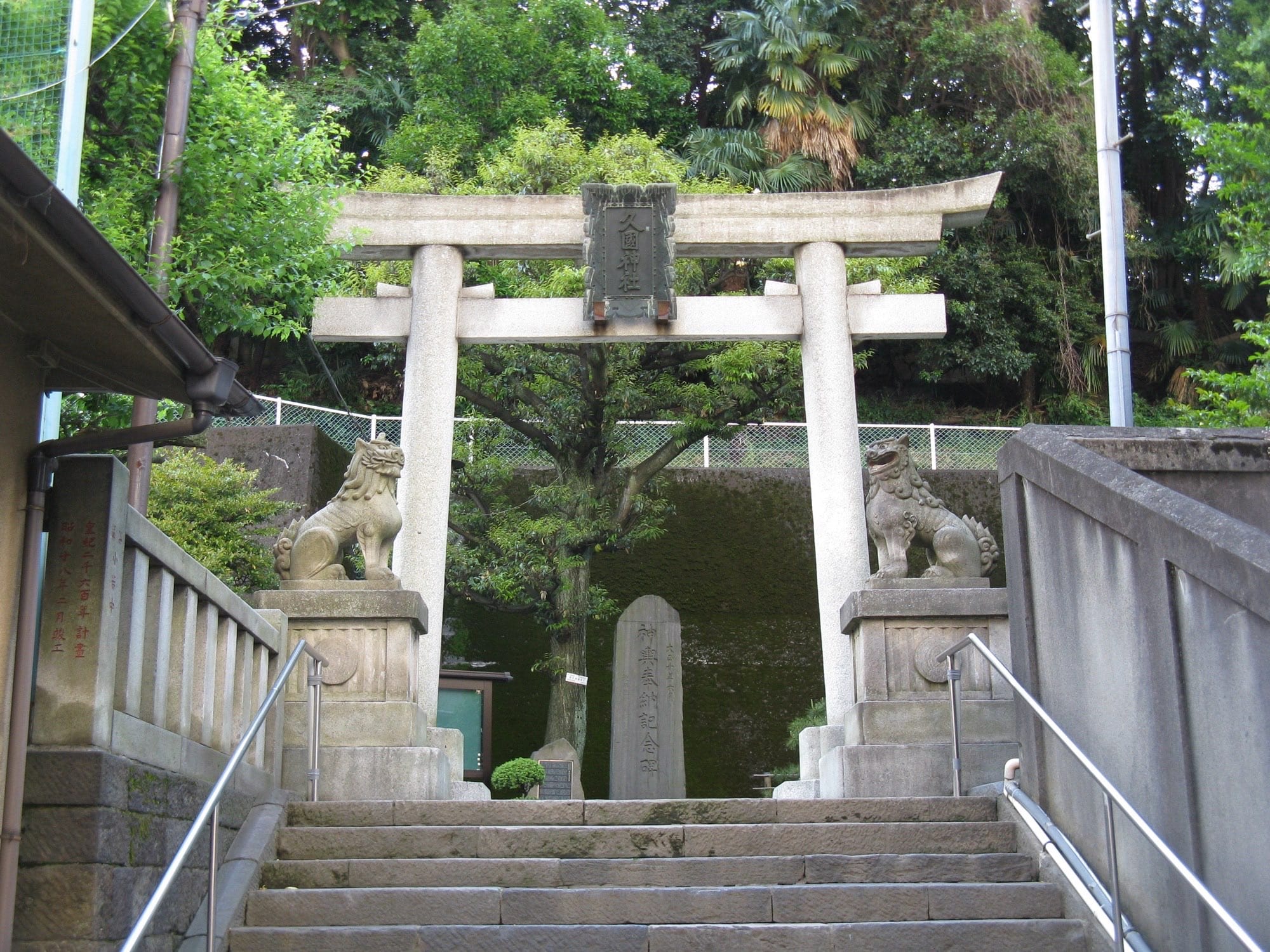
The 久國神社 (Hisakuni Jinja) shrine, in Roppongi (Tokyo), owes its name to a tachi by Hisakuni donated to it by Ōta Dōkan (1432-1486), according to Japanese Wikipedia.